Editor Louis Allday spoke with the Sameer Project about their Palestinian-led mutual aid work in Gaza, detailing how their ground-up infrastructure, from water desalination to community schools, rejects traditional top-down charity to centre collective survival, steadfastness, and sustained international solidarity.
LA: Thanks so much for agreeing to do this; I know how busy you are. I was wondering if you could begin by explaining briefly how the Sameer Project first came to be and when? How has its organisation and scope adapted to meet changing conditions and needs over the last 3 years?
SP: The Sameer Project was formally established in April 2024 by three Palestinians living in the diaspora, although each of us had already been independently involved since the bombardments started in October 2023.
What brought us together was not simply the overwhelming need for humanitarian assistance, but a shared frustration with the way aid was being delivered. We saw a system that too often stripped Palestinians of their dignity and agency, where assistance was conditional, bureaucratic, and dictated by Western institutions.
We wanted to challenge the idea that Palestinians should be passive recipients of assistance, and instead dictate their own needs, assess the situation themselves, and provide aid to one another based on the situation on the ground.
Initially, our work focused on providing tents and essential supplies to displaced families. But as conditions deteriorated and the needs changed, we expanded dramatically. Today, we operate across Gaza, providing food, clean water, medical care, rehabilitation, shelter, education, free transportation, and distributions based on the current need in the camps we serve.
One of our greatest strengths is that we have never allowed ourselves to become rigid. We are constantly adapting because the reality in Gaza changes daily. And this is the most effective and efficient way for aid to be delivered – agility to respond to emergency needs.
But we see a shift in support after three years. We have operated without taking any large grants with conditions, zero government funds, and the majority of our donations come from crowdfunding. Our community is giving, but it is not enough to deal with the inflated expenses of genocide that continue after three years. The world has become desensitised. People are distracted by catastrophes and bad conditions at home.
Even when donations dip, and the world’s attention focuses on something else, we hold onto our core principles and values: that Palestinians must remain at the centre of every decision about their own survival and future.
LA: How do you embed a commitment to full liberation into your approach and daily operations, ensuring that the project functions as solidarity and collective survival rather than top-down charity from outside?
SP: We have never taken the typical NGO stance that we are only a “humanitarian organisation.” We believe the traditional humanitarian model too often addresses the consequences of oppression while refusing to confront the structures responsible for creating the suffering in the first place.
Aid is political – by nature. The need for aid stems from systematic oppression of a people. To give assistance to Palestinians in Gaza is to acknowledge that they need it, due to blockade, siege, a destroyed commercial sector, socioeconomic struggles, deprivation, and military bombardment. Genocide. We have this presence; there is this need in Gaza, because of the military occupation.
So to us, there is a fundamental difference between delivering aid that maintains the status quo and delivering aid that supports liberation.
We do not want to create another generation of Palestinians dependent on international institutions for permission to eat, drink, travel, receive medical treatment, or rebuild their lives. Being offered, and accepting, the bare minimum. We want Palestinians to have the resources and agency to determine our own futures.
Our operations are Palestinian-led, and with this comes a degree of responsibility we carry from all our relatives, our ancestors. Although the three founders live in the diaspora, the communities we support and our teams inside Gaza identify their needs and determine the priorities, and 98% of our team is based inside Gaza. Our responsibility is to mobilise resources and facilitate. Those on the ground experiencing the oppression, the genocide, decide where the aid goes.
The aid we give today is so that families can survive. We give water and food to communities close to the yellow line so they can remain steadfast on their land, not giving up one more inch to the occupation’s army. We support so families can endure today, tomorrow, next month, one more year – so that Palestinians are not pushed out of their land, so they remain, so they fight ethnic cleansing, resisting the military occupation’s attempted extermination. As long as we can support Palestinians so they can remain in Palestine, we are one day closer to the liberation, freedom, and sovereignty of our people.
Examples of this commitment are our bus initiative, sustainability projects, and school. Transportation allows people to reach hospitals, children to attend school, workers to pursue livelihoods, and families separated by displacement to reconnect – it restores a measure of freedom of movement. Rather than providing a family with temporary assistance, our sustainable projects establish a source of income, whether that means opening a small market stall, replacing professional tools, or supporting someone in returning to their trade – so that families can provide services while supporting themselves. And our Hasan School now gives the opportunity to learn to nearly 1,000 students so they can shape a future that are not defined by oppression.
Of course, meals, water and other humanitarian assistance cannot lead directly to liberation. But it can help protect Palestinians on their land so that they can push for freedom and sovereignty.
LA: What are the biggest practical, logistical, or structural hurdles you’ve faced in maintaining such large-scale distribution and support, and how have you navigated them?
SP: Our greatest challenge is that we are attempting to provide life essentials in an environment where all infrastructure has been destroyed, social systems systematically destroyed, and where the actual goal of the military occupation is to stop the very survival we are trying to provide.
There are bombings close to our distribution sites, restrictions on the entry of food, medicine, fuel, construction materials, and medical equipment. There are no physical cash bills circulating in the market. Many bank accounts have been shut down to create obstacles to money transfers. Even when supplies are available commercially inside Gaza, their prices are high due to supply and demand, and the military occupation charges more than $16,000 “tax” on each truck that enters the Gaza Strip.
We face shortages of everything from insulin and basic medications to fuel for ambulances, buses, water trucks, and generators. Roads have been destroyed, communications are unreliable, and our teams regularly work under the threat of bombardment and displacement.
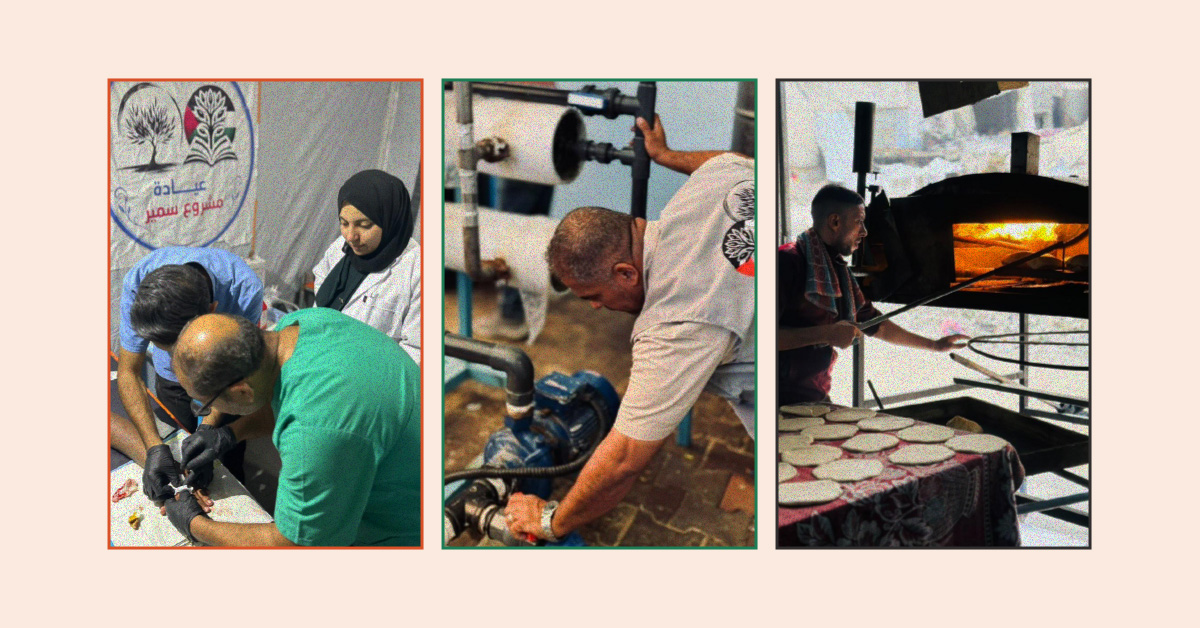
We tried to respond to some of these obstacles by being self-sufficient and opening up projects that allow us to problem-solve and not rely on others. This is why we opened up our own kitchen, our own bakery, our own water desalination plant, and operate our own medical clinics, camps and a school.
One of the most difficult aspects is the unpredictability of funding. We can develop a plan to support a community; we can try to anticipate the needs, but the lack of consistent donations is prohibitive. The scale of need is relentless, but donations fluctuate. When funding declines, we face decisions about which services can continue. We even had to suspend most services for 2 weeks in August 2026 because we didn’t have enough daily contributions to sustain our work.
And as soon as we feel like we are back on track, starting to make a difference, things are calmer, and we can start thinking about long-term support, there is another bombing, another shelling, a death of someone we know or someone we respect. And then there is another funeral, another grieving person, and more talk about how to overcome today’s set of challenges.
LA: Exactly, organising such an immense and multifaceted project in response to an ongoing genocide carries huge personal and emotional weight. How are you and your team processing that toll while keeping your efforts sustainable?
SP: There is no clean separation between this work and our personal lives! Our team in Gaza is caring for others while facing displacement, hunger, danger and the loss of their own loved ones. One member of our team lost 117 family members. For those of us outside, there is grief, anger, and the helplessness of knowing that people we love are in danger while we have the privilege of safety. We don’t want to romanticise that exhaustion or suggest that commitment makes anyone immune to it.
We lean on one another, but solidarity also has to be practical: sharing responsibilities and building systems so the work doesn’t depend on one person being available every hour. Though we just started to implement this! We really do need to make a better effort to create space for grief and rest. We are still learning how to do that under relentless pressure. Sustainability also requires consistent funding, because constantly deciding which essential service we can afford to keep running adds another layer of distress. Our team’s dedication is extraordinary, but it cannot substitute indefinitely for the resources and support they deserve.
And of course we have our faith and belief in God’s will, and that He will show us the way. Even during times of struggle and when donations slow, and bombardments increase in Gaza, we say “alhamdulillah”…praise be to God.
LA: On that note, one of the most remarkable things the Sameer Project has achieved recently is the opening of a desalination plant. I was so moved and impressed listening to you and one of your engineers talk about this in a recent discussion we held on Twitter/X space. It is hard to fathom the faith and perseverance needed to pull off a feat like that in the direst of circumstances. Could you maybe tell our readers a little bit about this project specifically and how they can support it?
SP: We started The Sameer Project’s water station in Gaza City because the destruction of water infrastructure and the shortage of affordable, safe drinking water were forcing displaced families to rely on unsafe sources. With new equipment blocked from entering through the border, our local engineering and technical team sourced parts from the local market and gathered individual components to build the system, preparing the site, drilling a well, and assembling the desalination equipment, storage tanks, and distribution infrastructure.
The station currently produces 12 cubic metres per hour, with capacity expected to increase to 15 cubic metres per hour. Based on 10 operating hours daily, this means 120,000 to 150,000 litres of clean water a day, enough to provide 8,000 to 10,000 people with 15 litres each for drinking, cooking, and basic hygiene. Water is distributed free through collection points and water trucks to displaced families and communities most in need.
Sustaining a desalination plant in genocide is costly at around $1,500 per day. So that means every month, we need at least $45,000 to operate the plant for all days of the month. One-off donations are important, but what is more important is to create predictability and sustainability for our work by becoming a monthly donor. Think of it as a Netflix or Spotify subscription in which you transform solidarity into action. We would love those reading to consider becoming a monthly donor to our Food & Water Campaign, and to encourage your community to do the same.
LA: How do you involve the local community in Gaza in decision-making to ensure the project’s activities remain horizontal, accountable, and actually reflective of what people need?
SP: Our team in Gaza is part of the community. They live the same reality as the people we support, and their knowledge guides our decisions. Families, camp representatives, medical staff and field coordinators tell us what is needed, what is working and what needs to change. We also developed a camp and shelter assessment application that rates a camp’s needs based on standard criteria: access to community kitchens, access to water stations, sanitation, and the number of members of vulnerable populations like widows, orphans, the sick and the injured. This way, we ensure we are supporting camps that are underserved and the most in need since resources are limited. Our role outside Gaza is to help secure the resources to act on those priorities. We are the facilitators, and we work with the ground team to make decisions.
That means listening beyond the initial request, following through, and staying accountable afterwards. Can people actually reach our water trucks? Does the bus route get them to treatment? Is the support appropriate for someone with a disability? We adapt through those conversations. We don’t pretend that being a mutual aid project automatically makes every decision horizontal. It takes ongoing work to share power, welcome criticism, adapt, and ensure that people receiving support have a say in how it is provided.
LA: For comrades, organisers, and supporters internationally who want to stand in meaningful solidarity, what are the most effective ways that they can support your work and amplify all that you’re doing?
SP: We’ve been saying that consistency is solidarity. The most meaningful support is sustained support. We need people to stay involved beyond the moments when Gaza dominates the headlines. Regular donations make a real difference because they allow us to plan and keep services running. Organising a fundraiser through your community, workplace or union can also turn individual concern into collective action.
Amplifying our work means sharing the voices of our team and the people we support in Gaza, and helping others understand how their contributions become medical care, transport, clean water and food. But we see this as part of a broader solidarity movement. We need people to keep challenging their governments’ complicity and organising for Palestinian liberation. Immediate aid is essential, and we aim to help people survive and remain on their land while we collectively fight for the conditions in which that aid is no longer necessary.
Thank you so much for your time answering these questions and for everything that the Sameer Project has done and continues to do.