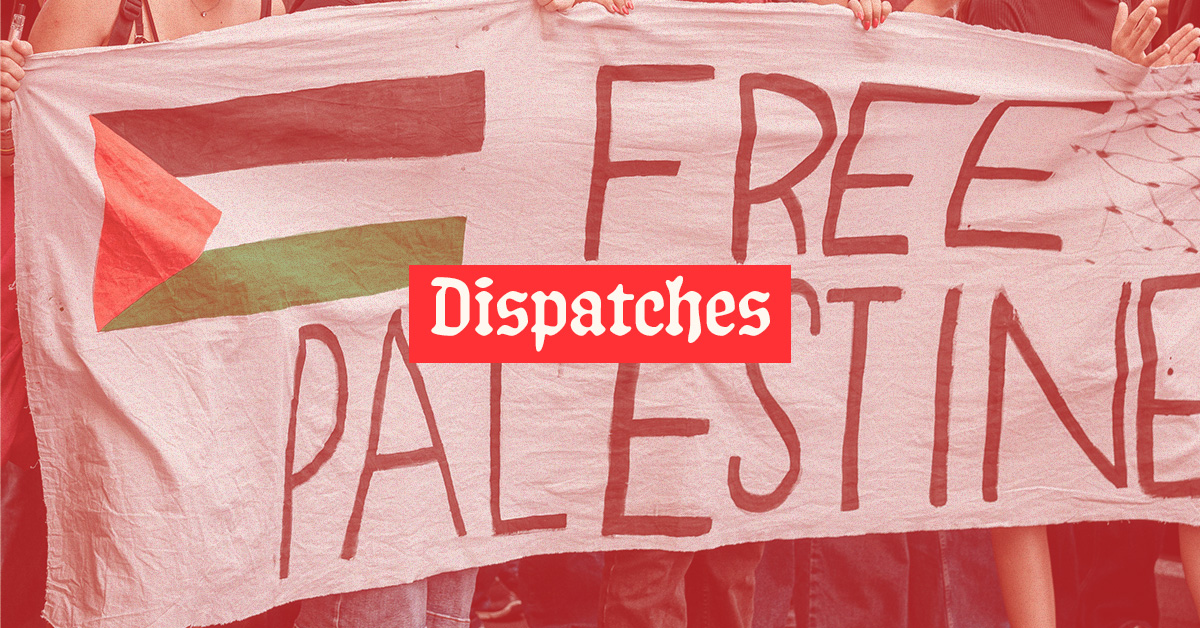
As Israel perpetrated its genocide in Gaza, the ruling classes, governments, and institutions of the world looked on indifferently at the string of atrocities. Those who did not supply weapons for the extermination of Gaza’s population were content to spectate; and with very few exceptions, nobody took up the Palestinian cause. It was in these grim circumstances that the students and youth of the world stood forth in emphatic protest: they erected encampments; they demanded an end to the genocide; and they told their universities to cut off their material support for Israel by divesting from firms complicit in the crimes. It was the students who, when all seemed hopeless, vindicated the conscience of humanity, and infused the Palestine solidarity movement with new energy. Their labours for justice were repaid with harassment and repression; but they have not yet been defeated.
1. The Conference
What is the state of the British student movement for Palestine today? Some useful answers may be drawn from the 2026 National Student Conference for Palestine, hosted by the Palestinian Youth Movement in London on the 24th and 25th of October. The conference attracted over 200 students from about 37 universities across the country, in London, the Midlands, the North of England, Scotland, and elsewhere.
This was the third such conference organised by PYM since 2024, and there is a recognisable thread in their purposes. An attendee of last year’s conference, Qamar,1 said that some of the main advantages of attendance were the “upskilling” of herself and her comrades, learning from the “accumulated knowledge” of the movement, and collective reflection alongside delegations from other universities. Rami, one of the organisers, explained the rationale for the conferences by referring to the historic role of students in “progressive causes” and the influence they can wield. These events are designed to “properly activate and equip” the student movement to “meet its potential”, and to give more precise direction and structure to the zeal and energy of young people, for the purpose of securing real victories and sustaining the struggle in the long term.
Besides, as Khadija, another organiser, observed, universities remain “an important site of struggle for Palestine” because they supply “material and ideological support” to Israel. The student movement is now in a period of rebuilding its campaigns, and is correspondingly developing its organisations, strategy, and tactics to a higher level.
The conference sessions were of a broadly practical stamp. During the first session of the first day, attendees were addressed by two speakers – one from Gaza and one from the West Bank – on the dire state of Palestinian education owing to Israel’s violence and repression. The history of British support for the Zionist movement and Israel was introduced by other speakers, as well as the complicity of universities in the oppression of Palestinians.
Universities, it was observed, invest in firms complicit in grave Israeli crimes; they have research ties to arms companies; they sometimes invite those companies to campus; they may have academic links to Israeli institutions; and, in summer 2026, the Defence Universities Alliance was launched: a government-backed initiative to secure closer collaboration between universities and the military sector. All this, of course, is additional to British state complicity in the genocide.
There followed a session on tarakum (accumulation) and building sustainable organisations. Conference speakers rightly emphasised the importance of organisation, structure, and the cultivation of both theory and practice as indispensable tools in political struggle. Reference was made to Jo Freeman’s famous essay “The Tyranny of Structureless” – one of the pre-conference readings – to stress that loose and informal organisations are often less effective, less oriented toward clear objectives, and their members less accountable. Among many good suggestions for organisational sustainability—for students and their groups are frequently transient—speakers advocated clear handover procedures; the documentation of activism; and a culture of internal study, both theoretical and practical.
The day’s final session was on facilitation and struggling through differences: struggle was defined as “The process of engaging in disagreement … with the intention to seek points of unity over factionalism and personal interest, confronting disagreements in a productive manner.” It was refreshing to see the speakers treat disagreement, not as a curse, but as a means of attaining a “higher unity” characterised by a clearer and more refined political standpoint. Advice was also presented on the etiquette of giving and receiving criticism within an organisation.2
The programme of the second day largely expanded upon the practical concerns of the first. In a session on building mass power, speakers analysed the student body, its different layers of consciousness, and the diverse tactics that might be used to win more students to the causes of pro-Palestine student groups.
A further session was devoted to the correct methods for undertaking university mobilisations and direct action protests: attendees were addressed on the importance of planning, assessing their particular circumstances, setting realistic objectives, and taking a pragmatic (rather than paranoid) view of the risks of activism.
Two final sessions were concerned with the development of a national student strategy in opposition to imperialism and British support for Israel. Targeted embargo campaigns were discussed as a potent tactic which the student movement ought to learn from: For example, PYM was able to make significant progress with its transnational campaign against the shipping company Maersk. The methods of planning effective campaigns were reviewed, and students were reminded of the strengths and weaknesses of student groups and higher education institutions, so that they might think more clearly about how to secure victories.
As to our general observations after two days of attendance, it was clear that the organisers took pains to promote the participation of the attendees. Speakers frequently invited contributions from the floor, and many sessions included breakout activities whereby attendees could immediately apply what they learned and consider the matters introduced by the speakers. In our opinion, the discussions indicated strong political commitment, advanced political consciousness, and an admirable moral seriousness about opposing imperialism and upholding solidarity with Palestinians. As is to be expected, student attendees made new connections and learned a great deal from listening to each other.
We were also informed that students from different university delegations had a considerable part in planning (and sometimes presenting) the conference sessions: it seems dozens of students from various universities contributed to the agenda and content of the conference at the pre-conference stage. This, too, involved a salutary course of study, and close preparatory reading, among the student planners.
At the conference’s end, attendees told us that they benefitted from the presentation of the broad political context, and the thorough treatment of subjects like planning and momentum. They found discussions with other delegations on their organisations and tactics exceedingly useful: students felt more conscious of the strengths and weaknesses of their own groups, and those delegations that were stronger in one department were able to share information with delegations that were weaker in that department, and so forth.
The general sentiment was that the students’ political level was raised by their attendance, and organisers say they have observed noticeable improvements in the quality of political discussion and organisation over the years they have held the conference.
2. Reflections
Our first duty is to congratulate the organisers on a successful, artfully managed conference. As we said previously, the conference was designed to give students the practical skills they need to build strong organisations, and lay the groundwork for political victories: it achieved this objective. The attendees, for their part, displayed the energy and enthusiasm that we tend to expect of young people, and were of diverse backgrounds.
We observed that all the sessions were closely tailored to the immediate demands of the student movement. These are well summarised by the slogan “Disclose / Divest / We will not stop, we will not rest.” The general strategy of student groups has been to campaign for institutional divestment from Israel, and for the end of other forms of collaboration with it, to further isolate Israel internationally as a genocidal apartheid state, and thus impose material punishments for its atrocities against Palestinians. It is certainly right that a student conference should be chiefly devoted to student matters, but we were struck by some of the omissions in the main sessions.
For instance, apart from some general references to political principles and the thawabet, the political programme for Palestinian liberation, and the precise character of that programme, remained unclear. Perhaps it was assumed (how reasonably, we cannot say) that attendees were already familiar with a specific programme of Palestinian liberation, but given that many issues are still warmly debated within the solidarity movement, a clearer delineation of where the organisers stood on some of those issues would have been helpful. Should the programme of Palestinian liberation be grounded in international law, for example, as the Palestine Solidarity Campaign, the largest solidarity group in Britain, avers? Or should Palestinian liberation be grounded on a more ambitious socialist, anti-imperialist programme for the region? Even if these subjects could not be discussed in depth, it would have been good to receive some clearer indications of what Palestinian liberation means, or ought to mean; for that is undoubtedly the grand objective.
It was, moreover, striking to us that some political developments of national significance went unmentioned during the main sessions. Since the last student conference was held, Britain has been bestowed with a new prime minister, and a new foreign secretary – Ed Miliband – who has promised certain changes in policy toward Israel. These developments were omitted; and, in consequence, there was no debate as to how the student movement should respond to these changes, or how it might usefully employ such changes to promote its own objectives.
Similarly, despite the controversy produced by the decision of the 2026 Green Party conference to pass a motion declaring that Zionism is racism – a party that polls at about ten per cent – this remarkable political event was omitted. It seems to us that, to promote a really informed student movement, a better balance could be struck between narrower higher education matters and broader questions of national politics, principle, and programme.
We also observed that the conference was somewhat democratically constrained by what we presume to be security measures. The conference agenda was only shared a day before the conference began, and it is therefore highly unlikely that any student who was not directly involved in the planning could have had time to consider the topics deeply, or adequately prepare to discuss them beforehand. To be clear, this was not a conference in the sense of a decision-making body, which debates various motions, and then votes on them, whereupon the conference resolution is binding on the participants. No votes were taken: the student movement has not yet developed to such a level of democracy and coordination, though we hope it will in the future. The conference was more of the nature of a series of training sessions, all useful and good, but not with the same opportunities for political debate that a more traditional conference would afford.
We do not say any of these things to derogate from the achievements of the conference organisers; and it may well be true that, under present adverse political conditions, it is not possible or desirable to run conferences very differently from how the conference was in fact run. Besides, the professionalisation of the student movement, and its political maturation, were evidently served by the conference agenda, and these elements of political work are not to be deprecated. We only hope that the student movement develops to a point where greater democracy and openness become practicable.3
To return to the question: what is the state of the student movement for Palestine in Britain? We were told that the experience of student groups remains uneven, and different parts of the country present remarkably different opportunities to organisers. In London, where repression has been especially fierce, student groups have faced much greater challenges than elsewhere. Repression, however, is far from a perfect weapon: students are learning to adapt, to build more resilient organisations, to be conscious of security matters, and to promote a culture of risk analysis and mutual care and regard.
It suffices to say that we departed the conference impressed by the dedication and seriousness of all who were present. We have some reason to be hopeful about the future of the student movement, and the future of those who will pass through the student movement to become lifelong activists in the cause of anti-imperialism and Palestinian liberation.
- All names in this piece have been anonymised. ↩︎
- Although of less direct political relevance, it should be recorded here for completeness that the first day concluded with a splendid cultural night. ↩︎
- It is perhaps worthy of mention that, to our knowledge, Prometheus Magazine was the only publication to attend the conference and report on it. ↩︎