The old world is not dying. Each time we foresee the final collapse, it hideously mutates, contorting into novel and hitherto unforeseen forms. In evolutionary theory, a mutation is a mistake made by the machinery responsible for the replication of DNA. The vast majority of these mistakes are inevitably harmful to the survival of the organism. On extremely rare occasions, however, a mutation will arise that will fractionally increase the chances of survival and reproduction of the individual in which it occurred. Whether such a mutation is beneficial is a question of context. To attempt to understand the effects of this mutation, then, one must seek to grasp some fundamental laws of the various processes that shape individuals, populations, or species.
Biological systems of evolution are immensely complex, yet social systems are infinitely more so, due to the presence of social actors with agency that both shape and are shaped by the system itself. Like evolution, capitalism is a contextual process, though fundamentally a social one too. Like evolution, it has never been just one static thing. If it were, pinning it down would be straightforward enough. As Marx put it, “all science would be superfluous if the outward appearance and the essence of things directly coincided.”1 Marx’s project of demystifying the outward appearance of capitalist production remains incomplete to this day, not just because his own writing project remained unfinished at his death, but because capitalist society is a changing phenomenon that requires ongoing demystification. The Marxist research programme therefore remains necessarily incomplete whilst the capitalist production process continues unabated. Yet despite this protean quality, capitalism – as with evolution – is underpinned by invariant dynamics that must exist for us to even mark it as a coherent process. Phil Neel is at pains to emphasise this in Hellworld, arguing that, “every new iteration of capitalist society is simply a reiteration of the same fundamental laws within the ever-shifting environment produced by the playing out of these laws in time and space. So long as capitalism exists, these laws do not change.”2
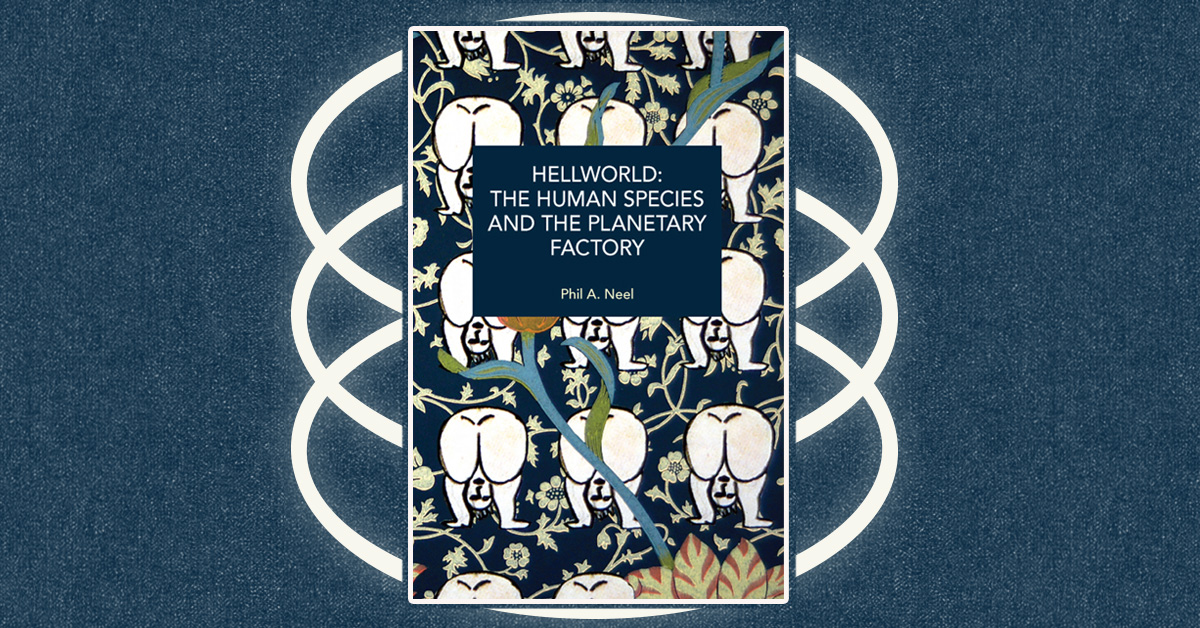
Neither a report on the global juncture divorced from theoretical underpinnings, nor a Marxological deep dive aimed at a niche interest group, Hellworld is a remarkably ambitious attempt to root the current moment in the historical and ongoing social processes that have made it possible. It is an exploration of the dialectic of change and invariance, drawing from on-the-ground studies of the proletarian condition in parts of the world whose recent history highlights the processes shaping our fractious world today.
The first and most obvious point to make is that this book is dense. Hellworld clocks in at over 800 pages. The geographic and theoretical scope is breathtaking, with fieldwork taking place across the globe, including mainland China, Hong Kong, Thailand, and Tanzania. Covering it all is beyond the scope of any single review. Instead – at the risk of disservice – I have attempted to draw out some aspect of Hellworld that I found most useful to take forward into struggle. In what follows, I attempt to unpack some of the core ideas that shape Neel’s overarching thesis.
Immiseration and abundance
The tale begins properly in 2012 in the Chinese interior. China is a source of endless debate for Marxists. Is China capitalist? Is China socialism with Chinese characteristics? Is China developing the productive forces to a point where they can emancipate the globe? These can be important and generative questions, but too often they lead to partisan debates predicated on contested terms. Marx famously never defined what capitalism is. Instead, he drew out the system’s internal logics (i.e., the process of production for exchange). Neel takes a similar tack. Rather than lingering on definitional questions, Neel traces the evolution of Chinese productive capacity, demography and geography, highlighting specifically how China is immersed in the world market. This evolutionary process includes the emergence of Chinese capitalists from within the ranks of the Chinese Communist Party itself.
Meanwhile, the expansion of a proletarianised class was necessarily a case of forcible construction. This is a familiar story, with land financing resulting in a rapid series of enclosures, dwarfing the rapidity of those that were enacted in Britain over the course of 400 years. Throughout Hellworld, the causes of historic and ongoing proletarianisation are central. The implications of these processes both for people’s everyday lives as well as for the communist horizon are complex and multifaceted. When our friends and family, and more often those who identify with our class enemies, argue that capitalism has lifted millions out of poverty, they are correct in the most reductive sense. Capitalism has produced material abundance. Yet the other side of this dialectic is the sloughing off of labour as the organic composition of capital3 increases, driving the ongoing search for new avenues of accumulation. In the wake of this boundless hunt we find the detritus of this social process, in the form of broken bodies, abandoned communities and the empty husks of once thriving industrial production. Both living and dead labour are hollowed out:
“Capitalism is not horrific because it casts us all into absolute immiseration but because it produces, in Marx’s words, ‘surplus capital alongside surplus population.’ In other words, the worst torture is precisely that the system works: that capitalism is, in fact, a developmental force that has produced and continues to produce an immense material abundance, the scale of which is entirely unprecedented in the history of humankind. And that, despite this, the worst medieval horrors persist not as accidents but as necessary outcomes of this social system.” 4
We experience these seemingly contradictory forces in our everyday lives. We own phones that harness greater computing power than the most powerful supercomputers could leverage just a couple of decades ago, yet the cost of living has outstripped wage growth in real terms multiple times over;56 we barely look up when a car with no driver speeds past, yet secure and stable employment is a rare thing, and basic subsistence needs such as food, housing and healthcare are accessible to a diminishing number of people. As Wendy Brown noted in her foreword to the new edition of Capital, capitalism “arrays eight billion homo sapiens across a wildly uneven spectrum of opulence, comfort, poverty, and desperation”.7 Yet the moment we inhabit is one where immiseration and downward mobility dominate. The dynamics of super-exploitation (where workers are remunerated below subsistence levels – i.e. they are quite literally unable to reproduce themselves) – once largely outsourced to the imperial peripheries – are now prevalent everywhere.
What Neel convincingly shows in Hellworld is how combined and uneven development has swathes of the planet speedrunning capitalist development. The three-sector model of orthodox developmental economics assumes that initially agricultural subsistence societies give way to mass industrial employment. Then, as profitable investments dry up, the service sector grows more rapidly than industry. Reality has debunked this neat tripartite schema. In the face of automation and squeezed profit rates, developing economies that are shifting away from agriculture have been dominated by a flourishing service sector whilst industrial production lags. Neel highlights this tendency in several locations: the growth of the service sector in China, Thailand, Vietnam, and Ethiopia has outstripped industrial growth, a trend generated by a slowing pace of investment. The newly proletarianised have been swept up and disposed of at ever-increasing rates, in a process that has created what Neel termed hinterlands in his previous book, with urban cores or “clear islands of affluence, encircled by a near hinterland composed of identifiable industrial-logistics expanses that gradually fade into a farther hinterland of agriculture, black markets, and (half-) abandoned fields, factories, and forests.”8
The return of the proletariat
This – from a coarse-grained perspective – is the global landscape in which we find ourselves. There are important implications for class dynamics that stem from this analysis. Firstly, the notion of an exclusively – or even primarily – industrial proletariat no longer holds. The proletariat – those stripped of the ability to produce the means of their own subsistence, who must sell their labour power daily to reproduce themselves – is larger and more heterogeneous than ever. The only large-scale politically-cohering agents appear to be the left populists – relics of an iteration of capitalism from which social democratic concessions were possible – and the “lumpenbourgeois” right-populisms of the likes of Donald Trump and Nigel Farage. Crucially, it is only through the figureheads themselves that such fractious coalitions are capable of cohering. We are witnessing a rise of politicisation that is matched by an absence of coherent organisational forms capable of absorbing and harnessing this energy.
In the midst of all this, it is folly to a priori determine a revolutionary subject in line with the more reductive strains of Marxism. Indeed, any revolutionary strategy that is predicated on a powerful global movement of the industrial working class must reckon with the absence of the productive base from which such a movement might rise again. Neel’s critique of programmatism – the political strategy centred on and – crucially – contingent on the 20th Century’s global workers’ movement as the lever for assuming proletarian power – follows in the footsteps of the likes of Joshua Clover’s Riot. Strike. Riot and the Endnotes Collective’s ‘A History of Separation’.9 In the former, Clover combines the periodisation of Giovanni Arrighi in The Long 20th Century with Robert Brenner’s long downturn hypothesis to explain why the resurgence of a revolutionary strategy predicated on a global workers’ movement that socialists must look to synthesise with is no longer possible.
Very briefly, Arrighi traces the development of capitalism through periods of accumulation (where investing in production is profitable), followed by periods of financial speculation (when productive avenues for accumulation have dried up). During periods of accumulation, the strike (a point of production struggle over the wage) has proven the most powerful weapon available to workers. These periods of profitable endeavours are such that making concessions to workers is less harmful to profits than having workplaces shut down by the withdrawal of labour. However, material expansion leads to an overaccumulation of capital. With profits squeezed and avenues for productive investment scarce, the tip of the spear of class struggle is sharpened and such concessions are no longer a possibility. Capitalists instead turn to the financial markets as workers see their standard of living plummet. In such phases, the main weapon of the working class becomes the riot form, with struggles no longer over the wage itself, but over the means of subsistence – access to food, housing, healthcare, education, i.e., the means to reproduce ourselves. This period of financial dominance marks the “signal crisis”, indicating the terminal phase of the current global hegemon, from which a new global order emerges, along with new avenues for accumulation.
Crucially, these cycles of accumulation and financialization are contingent and changeable. From the 15th Century onwards, each full cycle has become notably shorter. Clover’s innovation is that he synthesises Arrighi’s periodisation with Brenner’s thesis that since the 1970s we have entered a “long downturn,” in which the cycle is stalled due to levels of overproduction and a lack of profitability from which there is no way out, short of massive destruction of capital (i.e., something akin to the world wars). For Clover, this means the strike has given way to the riot (i.e., struggles over social reproduction have displaced struggles over the wage), as reflected in the collapse and unlikely resurgence of a powerful global workers’ movement. Programmatism then,
“accurately refracts the real conditions of the world in which it arises…it arises with the rising power of industrial labor, which is why workers in this sector are able to stand as the revolutionary class fraction. Their growth is capital’s expansion. This does not, however, imply an immutable standpoint or form of struggle…It is from the far side of accumulation’s rainbow that programmatism’s historical limits become evident. When the class fraction that centered the program era no longer exerts a peculiar power over capital, such a course of struggle is foreclosed.”10
In ‘A History of Separation’, the Endnotes collective took this critique further, delving into the historical formation of the workers’ movement. What they found was not a workers’ movement as an emergent phenomenon of the capitalist mode of production, but a working class identity that – much like all identities – was consciously constructed from often opposed fractions. These fractions were not simply those that to lesser or greater extent existed in pre-capitalist societies (e.g., race, gender, religion, etc.), but the “unity-in-separation” that market society generates, with workers reduced to “petty commodity sellers, providing them with some autonomy, but always within limits.”11 Endnotes’ analysis implies that the construction of a working-class movement is not a quasi-natural byproduct of the development of capitalism, which further implies that there are no fixed strategic coordinates for communists to run with.
Though a critique of programmatism is by no means the central focus of Hellworld, Neel reserves some of his sharpest barbs for static, dualistic conceptions of politics:
“Within this prevailing paradigm, politics begins as an idea and then proceeds into reality through the practical commitment of self-aware activists who, if successful, spread this idea to others and thereby create new converts to the activist project. This is the fundamental presumption of liberal political philosophy and serves as the basis for both the civil society paradigm and the various formal and informal sects of the self-described ‘left’ in its multifarious forms. But, just as the fossil alone fails to capture the truly living aspects of the beast – from its basic phenotype to its ecological niche – this fossilised approach to politics fails to approximate the living thing. The attempts to emulate the political programs of these dead generations are much like those of the early palaeontologists building behemoths from bone fragments or Renaissance sculptors mimicking the blanched ruins of Rome. They can ultimately produce nothing but monstrous, melancholic facsimiles. This is because they take the endpoint of long sequences of political organisation as the starting point of struggle, rather than seeing in living proletarian antagonism the potential for the practical elaboration of a future politics. 12
Living struggles proceed in the exact opposite direction, beginning not from thought but from action. Consciousness enters the body through the skin.”
The critique may be withering, but more important is how Neel attempts to develop a positive vision. In Riot. Strike. Riot., Joshua Clover invoked the riot-form and the building of the commune-form as the revolutionary path forward. However, this path is dependent on conjunctural revolutionary breaks. A riot that brings forth the commune-form has failed to materialise, and questions remain: How does the riot cohere into something coherent and enduring? How best to approach the interim is left largely undertheorized. Fleshing out these thorny questions is a central aspect of Neel’s research program.
Subsistence struggles, decommodification and the party form
What distinguished Endnotes from other left currents was a brutally sober analysis of the historical trajectory of capital accumulation and its downstream implications for revolutionary movements, which came without a sales pitch. They had no ready-made revolutionary strategy, and they offered no silver bullets. For many of us (including the author of this review), the critique of the Orthodox Marxist worldview was path-breaking. However, negative critique can only get us so far. It may break the shackles of historical chains that have weighed us down, but the need to act remains. How then, in our fragmented political landscape laden with rage yet lacking coherence, can we articulate a positive vision that doesn’t simply look beyond the wasteland of today and focus on a communism of some hoped-for tomorrow? Throughout Hellworld and elsewhere, Neel constantly returns to the importance of subsistence struggles.13 As discussed previously, the dynamics of super-exploitation are more prevalent than ever. In any context, organising around subsistence is both morally and tactically important. Neel argues that:
“the invariant communist program is relentlessly reborn in struggles for subsistence and against domination – not because these struggles lead to limited victories (they usually fail) or broader social reforms that gradually ratchet up toward socialism (often, the result is instead national chauvinism) but instead because they tend to overspill their own bounds by initiating mass political actions that take on an irreducibly conflictual character.”14
According to Neel, the communist program is invariant because – following Bordiga – the general laws of the capitalist mode of production are invariant (i.e., they are unchanged from their initial elucidation in Marx’s scientific analysis in Capital). Capitalism shifts through phases that are geographically and demographically heterogeneous, yet its beating, noxious core remains the same. Subsistence struggles are also invariant, since they are necessary components of our ability to reproduce ourselves both individually day to day, as communities, and indeed as a species. Furthermore, given that we now find the proletariat largely located in the service sector rather than industry, struggles at the point of reproduction necessarily become the loci of contemporary class conflict. Sectional struggles must therefore be incorporated into building communist power to prevent simply reinforcing current social relations. The umbrella term here is decommodification, specifically the decommodification of the means of reproduction.
In Hinterland, Neel spoke at length about the far right’s ability to root themselves in abandoned communities throughout the US by focusing on immediate needs including housing, food, and medical aid. Rather than simply mimicking the tactics of the right, Neel ushers us towards an “oath to action”. This is quite simply a commitment to act, with decommodification of the means of reproduction as the necessary pole of attraction. With this orientation to hand, there is a fundamental need to experiment; to try and fail and fail better. We are in a moment of strategic breakdown and an absence of coherence; there is no ready-made revolutionary subject. Neel returns multiple times to the term “antepolitical” – reminiscent of the “pre-political” that organisations like the Independent Labor Club have diagnosed the current moment15 – to signpost the need to build the spaces in which a revolutionary politics may gestate. What these spaces look like is not predetermined, and varies considerably from place to place. How these spaces fit into the conception of the party-form is one of the most interesting threads that Neel pulls on, both in Hellworld and in his essay, ‘Theory of the Party’.16
First articulated by Marx and Engels, then drawn out by Amadeo Bordiga, the concept of historical, formal and communist parties helps us place the throughline – or red thread – that connects both seemingly autonomous actions throughout history with the communist party-form itself. Neel has recently utilised this framework to bridge the gap between how locally contingent and broad-scale organisations are theorised. The historical party is the connective tissue that links disparate struggles together. Whilst formal parties (the collective self-conscious groupings that often emerge as a response to – or to bring about – struggle) flicker in and out of existence, the historical party is the ever-present current of unrest and resistance to existence under capitalist society. Though it is constant, it is not static. It peaks in the upswell of struggle, and dies down when uprisings are dispersed. Yet it is always there, operating at the level of the “subconsciousness of the class” in Neel’s words. Formal parties, by contrast, are not simply the formal organisations that come and go, but also every informal grouping, every collective that attempts to cohere around some point of unity, be it a temporally limited local campaign, a theoretical unity around a specific ideological tendency, or indeed any of a multitude of other binding agents. When conjunctural factors result in political rupture, the moment may unite the formal parties with the upswell of the historical party (an upswell that results from said rupture), with the communist parties emerging out of this coalescing moment. Communist parties thus break forth through qualitative shifts – punctuated equilibria in the ebb and flow of history – as opposed to a gradual emergence of revolutionary subjectivity. Furthermore, the communist party is not merely a single formal organisation, but the whole unified current, composed of potentially many organisations which express the new horizon of revolutionary subjectivity (i.e., the movement in toto).
The party then is seen as a process, rather than some static organisational form which is the key to unlocking working class power. Formal and communist parties are emergent phenomena, whilst the historical party veers through the tides of history, bursting forth wherever political ruptures appear. Where communist parties diverge from formal parties is that the latter are often willed into existence, even in the most historically unsuitable times. The communist parties, by contrast, are the unity of conjuncture and agency. The implication is that the throughline that connects struggles traces its way from below and bursts forth upward, rather than an imposition from above, predicated on the correct theoretical line. As Marx argued in The Holy Family, “ideas can never lead beyond an old world order but only beyond the ideas of the old world order. Ideas cannot carry out anything at all”.17 Subsistence struggles then act as the lifeblood of the historical party. If we are to work toward that unity of conjuncture and agency, we must swim in that lifeblood. The question of the historical party is non-negotiable, for it is ever-persistent. That does not mean we should reject formal organisation. The question of formal organisation doesn’t have a single answer, but is dependent on the specific conditions we operate in. Yet whether it is via formal organisation or transient grouplets (for example, time-limited organising related to a specific campaign), these all fall under the category of the formal party.
The great unwilding
Neel’s analysis of the party form operates on a necessarily structural level. How this analysis relates to individual agency is the subject of the quite remarkable introduction to Hellworld. We find ourselves on the coastal plain of the Southeast USA, plunged into the reality of the factory farm. Amidst discussion of the consolidation of family farms into dependent cogs within a complex supply chain, and how the distribution of factory farms has shaped racial and class-based histories, Neel lingers on that most-human of animal analogues, the pig. Sociable, intelligent and sentient, seemingly accepting of their momentarily approaching death. My own partner recalls visiting an abattoir in Surrey, England, and seeing the maze-like approach that cows make in single file toward their death. Unable to see around the next corner, they have no clue where or how this journey will end. The focus here is not specifically on the ethics of animal abuse, however, but on how domestication fundamentally breaks sentient creatures to the point of accepting and willingly reproducing the very conditions of their domestication:
“The horror of domestication is, fundamentally, a political horror. Domestication not only destroys any independent basis for revolt but also enforces a resigned complicity on the part of the domesticated subject. This then leads to the question repeatedly posed by (Jacques) Camatte, and clearly visible in the eyes of the swine: ‘How can destroyed human beings rebel?… In much the same way that an animal can be broken through continual conditioning, the retention of this conditioning also requires the construction of an environment that constantly reinforces domesticated behaviours. If that environment is porous or breaks down, two things happen: first, the shaping force of domestication weakens and previously suppressed behaviours begin to reappear; and, second, a new environment will introduce new stimuli that pose new behavioural puzzles for the mind and body of the animal, inducing a new sequence of transformation.”18
The mute compulsion of life under capitalism has made humanity servile. Dislocated from any sense of agency with which to change the world we live in, adaptation feels like an instinctual response. This is also the case for many of us with revolutionary aspirations, often unconsciously moulding our immediate political horizon to fit within the constraints dealt to us. Domestication is such a compelling framing because we have borne witness to how sentient creatures have been conditioned to reject their own agency. More importantly, however, domestication is an ongoing process, not an established fact. I am reminded of John Holloway’s argument19 that commodity fetishism – whereby the social relations between individuals appear as relations between things – is not complete, and never can be. As such, fetishisation is the more appropriate term for the ongoing reproduction of fetishism. What may appear to be an innocuous distinction is immensely powerful. Without constant reinforcement, such programming cannot maintain its hold, and suddenly other worlds become possible.
Whilst reorienting capital toward new phases of accumulation, crises create such openings. Crises are the breaking of the bounds of domestication; event horizons pregnant with possibility and all the more dangerous for it. Once again we find ourselves thinking about gradual and qualitative shifts. In the interim periods, the tasks are less clear, with communist consciousness meandering along. It is when the seemingly stable equilibrium is rent apart by crisis that political radicalisation proceeds in bursts. In these moments, the building of revolutionary power may become substantive, coalescing as communist parties. Neel follows this line of thought in a remarkable attack on cowardice:
“It is easy enough to call oneself a communist, a socialist, an anarchist and to act out the role on the internet or within microscopic social circles or activist projects, and then to exhibit the most despicable cowardice when faced with the emergence of actual social unrest. Conflictual and violent uprisings therefore also serve to draw those who are willing to learn from struggle on the ground and who hope to exert a real, if minimal, political force through action. This distinguishes those for whom communism is a ‘theory’ or a ‘philosophy’ from those attempting to build some modicum of communist power in the world of substance (however hopeless this prospect might seem). Perhaps one of the most important functions of riots and insurrections, then, is their ruthless threshing and winnowing of ‘the left,’ sorting communists from cowards.”20
When I read this passage, I was struck by how rarely we talk about the necessity of this aspect of struggle. We rightly laud those who put their lives on the line in the struggle, but rarely do we name cowardice as the enemy of social change in such a direct manner. Although Neel is focused specifically on the moment of violent uprising, I think we can follow this line of inquiry and apply it in the context of organisation as well. What is bureaucratic centralism, and what is centring the reproduction of an organisation over the unpredictability of and embeddedness in struggle, and what is rejecting this critique of our near and distant historical record? These are all forms of active cowardice; shelter from exposure to the cold can become the generative light of the collective, and it is in this light that I believe we can draw out some immediate tasks.
The republican commitment
Recent years have seen the gradual resurgence of the Orthodox Marxist left in the Western world, driven by the publication of Mike MacNair’s Revolutionary Strategy in 2008,21 and the growth of the Marxist Unity Group within the Democratic Socialists of America — a caucus which seeks to apply the strategy elaborated in Revolutionary Strategy within the US context. I will not rehash the details of this strategy as it has been well documented elsewhere, including in this magazine. In the British context, the first step in this orientation is typically seen as the regroupment of the Marxist left into a “mass communist party”, with a collectively agreed programme as the point of unity holding such a party together. Although this tendency is by no means the majority within the British Marxist left, it has certainly grown in the post-Corbynism years, driven by a desire for greater democratic oversight and programmatic coherence. As someone whose orientation is closer to the likes of Neel than those espousing regroupment and programmatic unity, I have been thinking about the points of overlap between these seemingly disparate approaches to social change. The most obvious point of contention is a rejection of programmatism and the strategic approaches dependent on the 20th-century zenith of the global workers’ movement, as discussed above. However, I do think a point of convergence exists around a commitment to republicanism. This strain of Marx’s thought has been drawn out by William Clare Roberts’ Marx’s Inferno22 and more recently in Bruno Leipold’s Citizen Marx.23 Put simply, the republican commitment in the communist context is a commitment to democratize everything; to facilitate the agency of every individual in every aspect of social life, including, of course, production, reproduction, and politics. What this often means in the immediate context is clearing away the vestigial blockages that stymie our ability to act and experiment. Thus, spaces in which to link into networks of struggle and actions occurring both locally and nationally should be desirable for all who identify with the struggle for a social republicanism. Within nominally left-wing organisations, what is required at the current moment is less a programme, but more a set of minimal thresholds of solidarity about both class and other identitarian struggles. Such organisations are then capable of acting as loci for establishing – as Jasper Bernes puts it – “correspondences, networks in which communist resonances can proliferate.”24 Capital has shaped the planet in spatio-temporally heterogeneous ways. How one might affect the world necessitates an engagement and understanding of the local conditions that generate tactical openings. Thus, the pre- or antepolitical is not a ceding of the political terrain, but a recognition that the construction of – and engagement with – spaces in which communist resonances can proliferate is one of the tasks at hand today.
Hell is alive
The task of a reviewer is not simply to summarise a work, but to engage with it critically and build on – or against – the contentions of the author. Although I have attempted to fulfil this task here, I have focused on but a fraction of a work of considerable depth and breadth. Hellworld is an immensely generative work on multiple levels. In his essay on Gramsci for Viewpoint Magazine, the late Asad Haider argued that the optimism of the intellect and the pessimism of the will is an inversion that more accurately recapitulates the sentiment of Gramsci’s original assertion (i.e., the optimism of the will and the pessimism of the intellect), given the current moment.25 The optimism of the intellect is the starting point of any political orientation fit for today. Everyone is capable of thought, innovation and experiment. Not for nothing was the role of the intellectual – both traditional and organic – of such importance to Gramsci. However, the will – the vehicle for revolutionary politics – is the long shadow that hovers over any emancipatory horizon. Simply put, the material basis for the mass revolutionary organisations of the 20th century no longer exists. We lack the concrete basis for the mass organisations on the model of the twentieth-century communist movement. Thus, with this simple inversion, we have a pithy summary of the tension between agency and conjuncture that faces us today: the old models cannot readily overlay new terrain, yet we have the collective capacity to start the process of generating them anew. Neel’s research programme puts meat on the bones of this assertion, exploring why the conjuncture is as it is, and urging us to break out of the strategic bottlenecks that we have inherited. The most useful works to have come out of the Marxist tradition and beyond emphasise that ours is a living, changing world, modulated by processes that are themselves changeable. Making sense of this assemblage is no small feat, not least because of how generalised commodity production has generated interconnections across the globe unlike ever before. Hellworld is amongst the most comprehensive guides to aid in the navigation of this terrain. I would urge everyone to read it.
- Karl Marx, “Chapter 48: The Trinity Formula.” Capital: A Critique of Political Economy, Vol. 3, edited by Friedrich Engels, Marxists Internet Archive, www.marxists.org/archive/marx/works/1894-c3/ch48.htm. Accessed 16 Sep. 2026. ↩︎
- Phil A. Neel, Hellworld: The Human Species and the Planetary Factory (Brill, 2025), p. 671 ↩︎
- That is, the ratio of constant capital – factories, machinery, raw materials, etc. – to variable capital – i.e. living labour. ↩︎
- Neel, Hellworld, p.30 ↩︎
- House of Commons Library. “Rising Cost of Living in the UK.” UK Parliament, 7 Aug. 2026, commonslibrary.parliament.uk/research-briefings/cbp-9428/. ↩︎
- Stephen Machin, “Real Wage and Productivity Stagnation.” Oxford Review of Economic Policy, vol. 41, no. 1, Spring 2025, pp. 105–19, https://doi.org/10.1093/oxrep/graf013. ↩︎
- Wendy Brown, Foreword. Capital: Critique of Political Economy, Volume 1, by Karl Marx, translated by Paul Reitter, edited by Paul Reitter and Paul North, Princeton University Press, 2024, pp. vii–xx. ↩︎
- Phil A. Neel, Hinterland: America’s New Landscape of Class and Conflict (Reaktion Books, 2018), p. 120. ↩︎
- See through Endnote 1 for some of the foundational debates around programmatism. ↩︎
- Joshua Clover, Riot. Strike. Riot: The New Era of Uprisings (Verso, 2016), p. 148. ↩︎
- Endnotes, “A History of Separation.” in Endnotes 4: Unity in Separation (Endnotes, 2015), p. 85. ↩︎
- Neel, Hellworld. p.371 ↩︎
- Whilst workplace struggles are at the point of production, subsistence struggles centre on the point of reproduction. Where the former are related to wages and/or workplace conditions, the latter are rooted in the very necessities of survival such as access to food and shelter. ↩︎
- Neel, Hellworld. p.134 ↩︎
- https://ilclabor.com ↩︎
- Phil A. Neel, “Theory of the Party” (Ill Will, 2025), https://illwill.com/theory-of-the-party ↩︎
- Karl Marx and Friedrich Engels, “Critical Battle Against the French Revolution.” in The Holy Family, or Critique of Critical Criticism (Progress Publishers, 1975) Marxists Internet Archive, www.marxists.org/archive/marx/works/1845/holy-family/ch06_3_c.htm. ↩︎
- Neel, Hellworld. p.21 ↩︎
- John Holloway, Change the World Without Taking Power: The Meaning of Revolution Today. New ed., (Pluto Press, 2005), p. 80. ↩︎
- Neel, Hellworld. p.409 ↩︎
- Mike Macnair, Revolutionary Strategy: Marxism and the Challenge of Left Unity (November Publications, 2008) ↩︎
- William Clare Roberts, Marx’s Inferno: The Political Theory of Capital (Princeton University Press, 2016) ↩︎
- Bruno Leipold, Citizen Marx: Republicanism and the Formation of Karl Marx’s Social and Political Thought (Princeton University Press, 2024) ↩︎
- Jasper Bernes, The Future of Revolution: Communist Prospects from the Paris Commune to the George Floyd Uprising (Verso Books, 2025), p. 163. ↩︎
- Asad Haider, “Pessimism of the Will.” Viewpoint Magazine, 28 May 2020, viewpointmag.com/2020/05/28/pessimism-of-the-will/. I was recently reminded of Asad’s essay in an engaging excavation of his intellectual trajectory by Duncan Stuart for Fracture Magazine, available here: https://fracturemagazine.com/issues/for-asad ↩︎