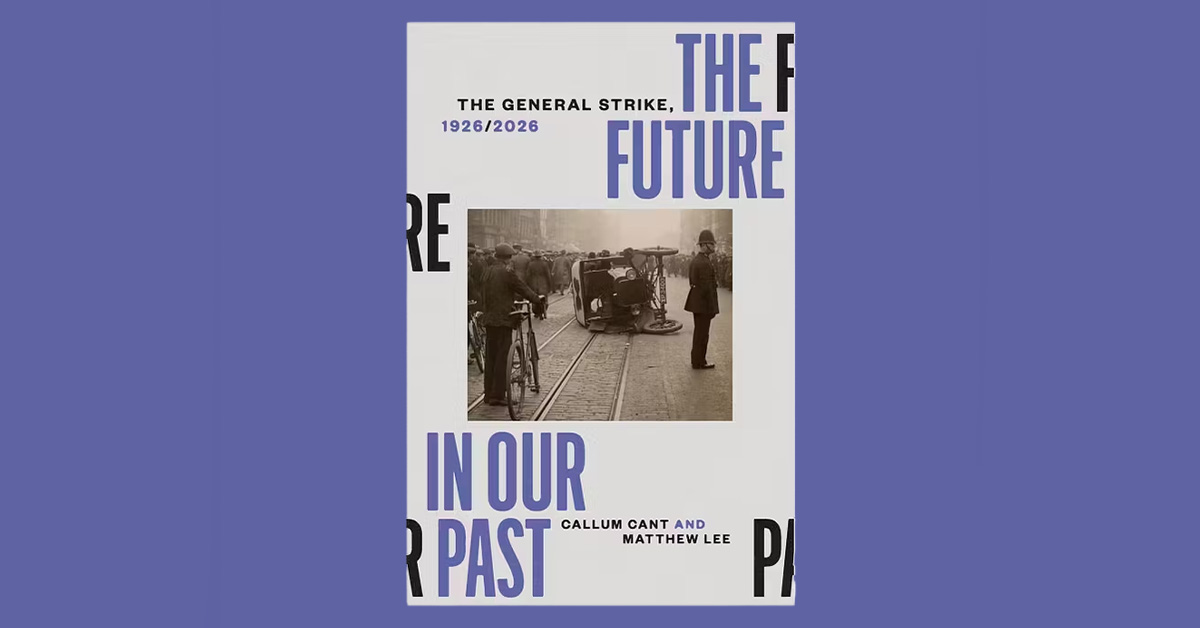
This Spring marks 100 years since the General Strike in Britain. Then, workers across various sectors of British capitalism acted in solidarity with striking miners, far beyond the vacillating wishes of the Trade Union Congress. To mark this century, the editors of Prometheus sat down with Callum Cant and Matthew Lee, the authors of The Future in Our Past, a book discussing the importance of the strike today.
In your opening overview of the pre-history of the 1926 General Strike, you explore British worker history with particular reference to the ideas of a ‘vanguard’ section and a ‘labour aristocracy’? How do you understand these terms? Why do you think they are important to comrades interested today?
When a collective subject takes part in a class struggle, it generates tactics and theories that are more accurate than anything dreamt up by external observers.1 In the opening chapter of the book, we lay out how the idea of the General Strike was produced by exactly this kind of development. The tactic emerged from the conjunction of the failed insurrections of the early 1800s and the economic conflicts of newly-subsumed labour-power, before being explicitly codified by William Benbow in his idea of the “Grand National Holiday”. The concept of the labour aristocracy has a very similar origin: it too was produced through struggle by the foremost layers of the Chartist movement. At the 1839 convention, where the General Strike was first discussed by a mass movement as a tactical option, a delegate brought forward the idea of the labour aristocracy to analyse the political forces that had backed the Charter:
It was a fact that unanimity towards Chartism could only be found in the worst-paid ranks. The men who earned 30 shillings a week cared nothing for those who earned but 15 shillings, and the latter cared as little for men who worked for 5-6 shillings per week. There was an aristocracy of the working classes as well as of the gentry and nobility.2
What these early industrial militants understood is that the working class is not a monolith. Whilst existing in a common antagonism with capital, we are crossed by a million possible fracture lines: skill, income, gender, nationality, racialisation, religion, migration status, industry, the list is as endlessly various as we are. The political unity of the working class is something to achieve through a conscious struggle for recomposition, rather than a structural given.
As members of the editorial collective of Notes From Below, we have been involved in attempts to spread a theoretical approach based on class composition which centres of a few key ideas: that the social relations of the capitalist mode of production take on different forms over time; that we can group these social relations into three camps (technical, social, and political); that the technical and social composition of the working class – the ways we work and live – determine the pattern of self-organisation and conflict that shapes the form taken by class struggle; but also that the transition from technical/social to political is non-linear, and is best understood as a ‘leap’. Fundamentally, class composition is a way of forming a concrete analysis of a concrete situation, of developing a conjunctural analysis that is specific to a particular social formation. In this book, we have extended the class composition framework by asking how certain elements within the working class can become politically consolidated and form poles of attraction that battle for leadership. This extension was necessary because the General Strike was the final act in a decade-long struggle for leadership.
We theorise the existence of two main poles of attraction: the “vanguard” and the “labour aristocracy”. In short, the vanguard describes the militant minority that pushes for a revolutionary class perspective, whereas the labour aristocracy is the elevated section of the class that seeks to integrate into the machinery of bourgeois society as the junior partner of capital. Neither of these are fixed sociological layers, with membership exactly described by characteristics like income level or industry. Their membership is based on material factors, but in the last instance, it is determined politically. Their relative size can fluctuate over time, and the organisations they build can grow or decay. Membership of one of the poles of attraction often only imperfectly overlaps with formal organisational membership (take, for instance, the micro-sect that declares itself a ‘vanguard party’). These poles of attraction can only be understood in movement.
In the period we discuss, each pole of attraction wanted to recompose the working class in specific ways: as a rank-and-file industrial movement allied across sectors and orientated towards a revolutionary horizon, or as a formally-recognised junior partner integrated into the machinery of collective bargaining and parliamentary democracy, dominated by the ideas of the ruling class. The story of the General Strike is the story of the climax of this struggle between these two opposing visions of class politics.
Today, in a conjuncture characterised by proletarian disorganisation, this pair of concepts can help us recognise the openness of the political field. Both the mechanisms that would integrate workers as a junior partner and those that would unite us as a revolutionary force are unusually weak. The potential for rapid political transformation in any direction, good or bad, therefore appears significantly greater than at any point in the preceding forty-odd years. Hopefully, this book can help us ask and answer the questions this situation implies.
You open your chapter in South Wales on the blowing up of a scab-van outside Neath by workers, one of many acts of direct action during the strike. Why this event?
We got this story from an oral history interview archived at the South Wales Miners’ Library. It was a remarkable interview to listen to. Between the straightforward way that the use of explosives was described and the absolute confidence of the speaker in their justification, you got a sense of what the lockout must have felt like after the miners were abandoned by the TUC. We wanted to pass some of that feeling on to the reader.
The struggle in the South Wales coalfield reached a level of intensity rarely seen in Britain in the 20th century. There was a council of action in the Afan valley that renamed itself a council of war; the Communist miners’ leader Arthur Horner explicitly called for illegal tactics; miners formed guerrilla-style squads to conduct nighttime raids. These weren’t the acts of an adventurous minority, but the collective defence of a whole section of the class. Often, people feel the need to tiptoe around what this entailed with allusions to ‘escalation’ – that isn’t our approach.
You situate the strike activity on the East London docklands in the longer roots of imperial labour and racist border control. Why did you think it was important to highlight this?
You really cannot grasp the dynamics of the General Strike in the London docklands without situating it in relation to these factors. The massive accumulation of fixed capital in the physical infrastructure of the docks, the imports of food and raw materials, the racial division of labour, the reaction of the East End to de facto military occupation, the attempt to shore up British finance capital through the reimposition of the gold standard that pushed wage cuts onto the miners – good luck understanding any of that without an analysis of imperialism, migrant labour and the British state’s use of race as a technology of division. But you are right to suggest that we also think that the contradictions of migration, racialisation and imperialism are also particularly important in our moment.
Capital in Britain rests on a growing layer of disenfranchised migrant workers. The labour-intensive and geographically-fixed industries (care, healthcare, platformised service work, hospitality, and agriculture being the most significant) are structurally reliant on importing cheap labour because low productivity work relies on an expanding supply of labour power to expand output, and a rising rate of exploitation to ensure profitability. The mechanisms of importation in these sectors tend to be via undocumented migration or visa schemes that are either short term and/or restrict basic employment rights and social freedoms. If the British labour market remains relatively tight (largely due to ageing and disablement) and workers with citizen status continue to avoid the sectors with the worst conditions of employment, then there’s no way around this demand from sections of the capitalist class to import labour.
Given that the post-2008 economic situation in Britain entails stagnating or actually declining living standards for the vast majority of workers, capitalist legitimacy cannot be pursued by offering a bargain hinged on rising real wages and expanding political participation to an aristocratic layer, as it was historically. This has led to elements of the ruling class exploring a new integration strategy in coalition with the far right. It’s a strategy that rests on performative anti-migrant cruelty and a kind of nostalgic social conservatism. Being a labour aristocrat in this context means enjoying the spectacle of deportations, and perhaps even being directly employed in the massively expanded repressive apparatuses of the state that carry them out. It seems likely that a Reform-led coalition of some kind will form the next UK government and try to put this vision into practice.
But there is an obvious contradiction here: it is very unlikely that these far-right forces can actually achieve what they want. Reform intends to target something like 600,000 to 2,000,000 migrants for deportation or other regressive changes to immigration status, but also accepts the need for an “Acute Skills Shortage Visa” that runs directly counter to that spectacle of border enforcement. The further you go rightwards, the sharper the contradiction becomes: Lowe’s Restore Britain party wants to deport 2 million people in less than 3 years, which would shrink the labour force by something like 6%.
If the far right forms a government and attempts to implement a policy of mass deportations, the examples of Los Angeles and Minnesota have shown us that this attempt at repression will target the working class in general and must be opposed by the working class in general. Given the ideological consensus on the far right that “London Has Fallen”, it seems likely that the city would be ground zero for such a confrontation. That possibility guided what we wrote about East London, and shapes our thinking about organising in contexts ranging from platform work to the education system.
You discuss the emergence of the Supply and Transport Organisation and Organisation for the Maintenance of Supply. These bodies saw collaboration between civil servants, military, fascistic and aristocratic elements, and others to break the power of organised labour. We’re similarly entering a period of sustained breakdown of access to imports and cheap goods, what do you see the British state and far-right response being to this crisis?
On the side of the state, the period from 1910-1926 could be characterised by the rapid development of a more advanced form of repressive apparatus. There were three key elements to this development: first, new ‘triangular’ forms of collaboration between state, capital, and trade unions, particularly those pioneered by the treasury agreements during WW1; second, the growth of secret police forces like MI5 with an explicitly political mission; and third, the creation of a shadow state strikebreaking apparatus in the form of the Supply and Transport Organisation. One of the reasons that the PM Stanley Baldwin finally feels capable of pushing the TUC to the brink of a General Strike in 1926 is because of the confidence he has in the strikebreaking capabilities of the shadow state machinery that had been constructed. The rifles had been distributed, the fascist squads were ready – if the worst came to the worst, there were paramilitary forces and a system of dictatorial ‘civil commissioners’ spread around the country ready to step in. There’s still much history to be written about these developments, but there is one key element of our analysis that we want to highlight here: different parts of the labour movement saw this development from totally different perspectives
During WW1, the integration of the Labour Party into the War Cabinet and the expanded participation of trade union officials in the state machinery via nationalisation and treasury agreements was seen as presaging the development of socialism. As for the more overtly authoritarian developments of secret political policing and strikebreaking organisations, the first Labour government in 1924 is instructive. PM Ramsay MacDonald went to great lengths to avoid meeting with the security services directly while allowing their funding and operations to continue uninterrupted. There was serious debate within the deeper recesses of the state regarding whether Labour should be told about the existence of the secret Supply and Transport Organisation, but the government was eventually told – and indeed, Labour was the first party to deploy this secret state machinery, as part of breaking a dock strike in February 1924.
But amongst the vanguard, the approach was the exact opposite. The rank-and-file militants of the shop stewards movement experienced the wartime transformation of labour relations as the emergence of a ‘servile state’, with their supposed representatives in their own organisations actively facilitating the repression of collective action and collaborating with their bosses to destroy cultures of workshop-level organisation and control that had been built over decades of struggle. They were subsequently able to build on this analysis of the state-capital-bureaucracy alliance to press for a revolutionary analysis. One of the key markers of the vanguard’s historical position has been an antagonistic relation to the state and its repressive apparatuses. Everywhere where a critique of bourgeois state power has flourished, people have come to revolutionary conclusions.
Drawing parallels with our present moment isn’t simple. Without doubt, the wobbling legitimacy of capital has led the state to invest more heavily in repression. Where this goes next is a more open question. What’s notable about Restore Britain’s proposals for achieving 2 million mass deportations is that the plan doesn’t rely on classical fascist street militias, but on a privatised surveillance architecture and the expansion of immigration-specific policing and detention: it assumes a lower level of popular participation in the process of repression. Whereas in 1926 the state was ready for a theoretical situation in which they handed out hundreds of thousands of rifles to fascist squads, the plans of the state and the far right today seem more centralised.
An argument you stress is the latent possibility of revolutionary action after the TUC called for an end to the strike, recognising that rank and file activity by workers exceeded the attempts to contain it. Can you briefly explain what happened that week and your understanding of why the defeat occurred?
On May 12th, the TUC General Council surrendered to the government. They were increasingly scared that the strike was escalating beyond their control, in doing so creating new forms of leadership and authority. The day before, the National Sailors’ and Firemen’s Union (NSFU), one of the only unions whose leadership openly opposed the General Strike, had taken a rogue branch that had joined the strike to the High Court to seek an injunction against them. The judge declared not only that branch’s strike unlawful, but the whole General Strike. Its continuation now also threatened the resources and structures that the bureaucracy relied on. They had negotiated a non-binding ‘Samuel Memorandum’ on the coal industry that they thought could act as cover for a sell-out, and so they decided that it was time to call it quits, before things got out of hand.
Some of the most naive histories treat this surrender as the final act of the strike. But the blunt reality is that on May 13th, 100,000 more workers were on strike than on any day previously. The Home Secretary was having to broadcast special messages on the BBC, threatening pickets with arrest, while in parliament, the leader of the opposition, Ramsay MacDonald, was warning about guerrilla warfare and the PM, Baldwin, was issuing desperate appeals for calm.
The title The Future In Our Past refers to exactly this moment, because it was in these days that an alternative future hovered in the wings. Every council of action contained a faction that agitated to continue the struggle. This continued strike action from the rank-and-file was partially motivated in part by widespread attempts from employers to take advantage of the TUC’s retreat to wage their own offensive, cutting wages and victimising strikers in various industries..
But it also should not be underestimated how many strikers were willing to continue striking in solidarity with the miners, and not content to go back until their demands had been met. As the Poplar Trades Council reported to the TUC General Council on 13th May:
“Workers of POPLAR remain SOLID. Meetings evince greatest enthusiasm. No breakaways. Stoppage DEVELOPING. Go on and WIN”
Whilst able to maintain and coordinate these struggles on a local level, these organisations were incapable of creating a new alternative leadership that could coordinate them across the country and continue the political element of their initial fight. They had, for the most part, been built out to meet the immediate local tasks that faced strikers, rather than for this larger task, practically coordinating and politically articulating the continuation of the strike following the TUC’s surrender.
In this period, then, after TUC support for the General Strike has been pulled, but the strike is very much continuing across the country, is where we see “the future in our past”. That is, where an alternative path could have been formed that may have had deep repercussions for the labour and socialist movements in the 20th Century. It is during this period that an alternative leadership could have come to the fore, and a new organisational form could have been built that created pre-revolutionary conditions in Britain. Just as 1871 created the commune, and 1905 created the Soviets, 1926 could have created a new development in class struggle.
With no alternative independent rank-and-file structures to help coordinate their continuing struggles, local strikers eventually drifted back to work, some with deals negotiated with their bosses, some without. The miners were left to fight on their own for months, locked out, until they were eventually starved back to work in November and December that year. There is far more painstaking work to be done to lay out the exact dimensions of the ‘second wave’ of the General Strike between May 13th to 19th. This is the most urgent gap in the history of the General Strike, and we hope to contribute something towards closing it in the future.
I want to turn to the final arguments you make regarding the Communist Party in this period. You argue, against many interpretations, that the CP failed to act effectively to build for the strike, predominantly not due to size or mere repression, but because its “lack of emphasis on the independent development of rank-and-file structures meant that it was organisationally hamstrung at the vital moment.” You argue this relates to the call for a ‘United Front’ by the Comintern and this led it to subordinate itself to the TUC General Council until it was too late. However, our understanding of the United Front is that political independence (and necessarily continuing such rank and file initiatives) are a prerequisite to such work. Why did such rank and file initiatives not occur? How do you see this analysis fitting with calls for the party as a necessity to retain the political independence of self-activity amongst the class?
The vanguard knew that the TUC were going to sell out the miners. Time and time again in the previous decade, the trade union leaderships had chickened out: in 1921, Black Friday saw the miners abandoned by the railwaymen and dockers unions. At this moment, prominent Communist J.T. Murphy noted that the CPGB should have prepared for the foreseeable betrayal by directing members to support the building of independent, rank-and-file initiatives that could have pushed beyond the TUC. Unfortunately, that lesson was not learned.
Instead, a distinct lack of preparation was baked into the CPGB’s interpretation of the “United Front” policy pushed by the Comintern. In the lead-up and during the General Strike, the CPGB told members and supporters to place their faith in the TUC General Council. Their slogan was “More Power to the General Council”, or even “All Power to the General Council”. They knew the TUC would fail, but they believed that all they needed to do at the point of failure was pivot to a new slogan, and the masses would either spontaneously create the structures needed to continue the strike, or else the strike would fail, but a lesson would have been learned. They saw a future in which the Communists recruited en masse from disenfranchised strikers and became a mass party. In reality, the climate of defeat was poisonous to radical politics, and the labour movement reverted to partnership and conciliation. The state triumphed, the aristocracy secured its leadership of the labour movement, and the vanguard was crushed.
However, it’s worth noting that the role of the Communists in the strike varied widely based on location. Local party militants determined their course of action based on local circumstances, and this process was accelerated by the collapse of official party communications under brutal state repression. But even in areas like Northumberland and Durham, where a joint strike committee was set up to co-ordinate councils of action across the region (in no small part thanks to the influence of leading Communist Robert Page Arnot), there was still a loyalty to TUC authority baked into these structures.
The end of the strike did radicalise a new layer of militants in this manner, and membership of the CPGB doubled that year, from 5,000 to over 10,000. However, by the same time the next year, the size of the organisation had reduced by 30%, and this increase in membership didn’t correlate with any increase in rank-and-file labour movement, which had been demoralised and disorganised by the scale of their defeat. The politics of direct action, which had a significant influence on the socialist and labour movement since the 1910s, were marginalised, with the politics of Labourism solidifying its hold over the movement. Our critique is therefore not aimed at the United Front per se, but rather at its tactical operationalisation in the British context, which manifested in seeing the strike as a predetermined failure, a lack of preparation, and a refusal to build genuinely independent rank-and-file structures on both a local and national level.
Even the more “open-facing” Communist-aligned organisations that did exist before the General Strike were not suited to this task of building truly independent, rank-and-file initiative. Take, for instance, the National Minority Movement, whose conference in March 1926 called for preparations, including the formation of a worker self-defence corps, which did not actually result in preparation. Similar to how many broad-left, oppositional formations in trade unions today function, the National Minority Movement’s mode of operation tended towards getting representatives from supportive branches to pass motions that did not necessarily lead to concrete outcomes in the workplace or across the sectors they were organising in. The National Minority Movement’s tight political control by the CPGB also prevented it from reaching the mass scale of previous organised rank-and-file organisations, such as the combines that made up the Shop Stewards Movement. In this sense, the National Minority Movement was not only unwilling, but ill-suited for the practical work of building a mass rank-and-file organisation.
Official CPGB analyses of the strike blame the size of the party, defending the strategy the party took, claiming they could not viably continue the strike with just 5,000 activists. What this fails to understand is that the party cannot substitute the class in any scenario. The existence of a Marxist party shouldn’t be a barrier to the continued independent self-activity of the class; it should be an accelerant. This is what an analysis that blames the CPGB’s small size as the reason for the General Strike’s collapse fails to grasp. No one party can act as a substitute for the self-organisation of the working-class, and therefore any successful Marxist party must be based on its ability to support this mission. Salar Mohandesi’s influential essay on the Party as Articulator captures some of what this relationship between the party and the working-class could look like at a higher level of political consolidation.3 He argues that rarely is the task of the party to build the social forces engaged in struggle – “at any given moment, there are hundreds, if not thousands, of social forces engaged in struggle” – but rather to facilitate their coming together and political articulation of those with a wide diversity of experiences and forms of struggle, yet a shared antagonism to capitalism.
Finally, I want to turn to your wider work as members of Notes from Below and the resurgence of interest in workers’ inquiry today. How do you see such work, reflected in the conversations in this book, developing further? What do you think its role is in the political struggle against the British state?
Our conclusion to the book hinges on this idea we mentioned above, of proletarian disorganisation. We live relatively more atomised lives than our predecessors, with fewer connections to one another, and a labour movement that seems rudderless and often incapable of defending itself against employers and the state. This disorganisation is a condition of weakness, but also of possibility. There is space for something to emerge.
The role of workers’ inquiry is to facilitate that emergence. Where pockets of vanguard activity exist, inquiries are always taking place, whether they are theorised as such or not. Militants research their enemies, map their workplaces, think about their experiences and what they will do differently next time: that is just the nature of fighting your boss. What we try to do is provide a way of thinking about those insights, and an infrastructure to share them with other pockets of vanguard activity elsewhere. We shuttle ideas, data, concepts, experiences, and tactics back and forth between these nodes, preserving these learnings beyond the immediate cycle of struggle and making them visible to people without immediate IRL connections to one another. People who read the publication or listen to the podcast can start to see a map of class composition taking shape in the messages going back and forth. They might learn about life in a town like Great Yarmouth, or work in a coal mine in Turkey, or organise in a bar in South London, and hopefully that learning can contribute to the forms of militancy they are engaged in. The intended sum of all this activity is a process of recomposition and development whereby people can start to work out how we might take a political leap together, and start to create a vanguard pole of attraction that can move more and more of the class into struggle, first against their bosses and then against the entire system.
Because we start from such a low ebb, the work of this recomposition often looks and feels insufficient given the scale of the challenge ahead. Meeting with ten other reps from the same industry to plan a rank-and-file approach to a sectoral crisis; chatting to a courier that you meet on the street; catching the train to another city to support a strike; forwarding an article to a contact you have developed in the workplace. We hope that by reading The Future In Our Past, the people doing this work can recognise that their predecessors felt that way too. The Unofficial Reform Committee in the South Wales coalfield started with a handful of miners discussing Marxist ideas and ended with a council of war. Our moment demands that we do the same.
- This is why we see workers’ inquiry as such a fundamental process: it’s an approach to knowledge generation that’s based entirely on articulating and circulating the insights being generated across the class through the constant cycle of struggles and experiences. ↩︎
- Northern Star, 20 July 1839 see John Baxter’s ‘Chartist notions of ‘labour aristocracy’ in 1839’, Labour History Review, 40, (1980), pp13-16. ↩︎
- Salar Mohandesi, ‘Party as Articulator’, Viewpoint Magazine, 4 September 2020, https://viewpointmag.com/2020/09/04/party-as-articulator/. ↩︎