On 28th February 2026, the US and Israel launched ‘surprise’ strikes against Iran, during Omani-mediated negotiations with the Iranian government. The initial attacks followed the playbook witnessed during the genocide in Palestine, with assaults on the institutions of Iranian civil life, from schools to hospitals, alongside attacks on its symbols of political life – beginning with the assassination of Supreme Leader Ali Khamenei.
In response to imperialist aggression against it, Iran has delivered on the late Khamenei’s promise to usher in a regional war with what they have termed the Ramadan War, or the Third Imposed War.
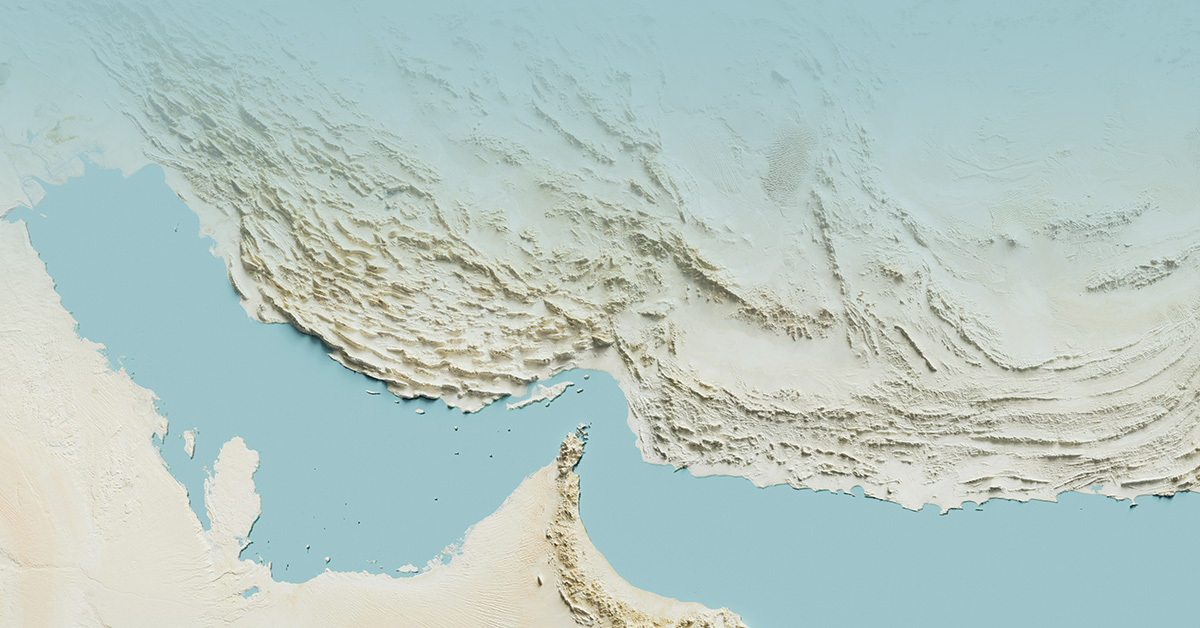
With their strikes on the sprawling architecture of US military bases and assets implanted across the fiefdoms of the Gulf Cooperation Council, Iran has brought the war home to the Gulf monarchies – most of whom spent the past two and a half years of the Gaza genocide further ingratiating themselves with US imperialism, and orienting themselves towards business with Israel. With their move to control transit through the Strait of Hormuz, sending oil prices skyrocketing – and latterly, imposing a toll for transit through it – Iran has brought the war home to the rest of the world, too.
Meanwhile, in Lebanon, Hezbollah has re-emerged as an insurgent resistance force. But while fending off attempts at invasion and re-occupation by Zionists from the South, it faces down its own multi-front war: a Vichy regime at home committed to disarming it, a fractured domestic consensus, and the looming threat of a sectarian Syrian militia-state invading from the east. The Popular Mobilisation Forces in Iraq have proved a surprisingly militant factor, assailing US military assets occupying the country. And Ansar Allah in Yemen has made its re-entrance to the field felt, while its ability to restrict the Bab al-Mandab strait remains a potent weapon in its arsenal.
As the war currently hangs in a very fragile stasis, we must caution against proclamations made in undue haste, especially with so much remaining obscured by the fog of war – and the firewall of censorship in the case of the US, Israel and Gulf states. But we can say with certainty that, with this war, we are facing an epochal shift, if not a world-historical event.
Here in Britain, the anti-imperialist left must face up to our own responsibilities in this time of history-making. While the mainstream anti-war movement has long maintained an opposition to the prospect of war with Iran, it found itself disoriented and on the defensive in the lead-up to the present assault: unable to challenge the distortions of imperialist propaganda and the confected ‘popular’ support for Pahlavist reaction in Britain.
Amidst this strategic impasse, the anti-imperialist left finds itself also battling on two ideological fronts. Gaza exposed the limits of operating on the familiar registers of international law, humanitarianism and righteous victimhood. Meanwhile, since 2011, a barrage of cliches — a rigid binary of “campism” and “anti-campism” and accusations of “anti-imperialism of fools” and many others — have become calcified in the consciousness of a generation of the existing left, intellectually disarming and politically demobilising the more militant streams of anti-imperialist organising needed now.
How then do we make sense of this conjuncture, what value can be found in our historical analogies, and how do we develop an analysis as urgent as the times demand?
To provide some clarity about the stakes of the moment, the situation across the various fronts of the war, and the possible shape of the emerging world to come in its wake, Prometheus Magazine has curated this discussion piece with several leading intellectual forces theorising imperialism — and anti-imperialism — today.
Characterisations of this war have varied sharply across the left. Some have identified this as a simple bourgeois war in which neither side deserves support, for others an ‘inter-imperialist war’, and others still a war of liberation against imperialism. How would you characterise the nature of this war, and what should our orientation towards the forces involved in it be?
Helyeh Doutaghi: This war cannot be coherently understood through the framework of an “inter-imperialist war” or a “bourgeois war” in which symmetrical forces compete over markets or territory. Such characterisations obscure the structure of the contemporary world-system.
The United States does not merely represent one capitalist power among others; it functions as the organising centre of capitalist imperialism, exercising systemic control over the flow of capital, energy, and finance, as well as military domination in West Asia through its colonial proxy, the Zionist entity. The present war of aggression against Iran must therefore be situated within a struggle over that very structure of control and domination.
In this context, the war is best understood as an anti-imperialist war of liberation at a regional scale. What distinguishes this conjuncture from earlier moments of decolonisation is that the challenge is not confined to territorial sovereignty, but extends to the mechanisms through which dependency is reproduced – sanctions regimes, control over shipping lanes, and the dollarised oil economy. Iran’s actions, particularly in contesting control over strategic arteries such as the Strait of Hormuz, are not reducible to conventional state rivalry; they directly confront the economic and military “two legs” through which imperialism enforces global hierarchy.
The argument that this is an inter-imperialist war assumes that Iran operates as an imperial centre seeking to subordinate others, conducting wars of aggression, and operating through theft and plunder of resources of other nations. There is no empirical basis for this argument. Iran does not control global financial circuits, does not impose structural adjustment, and does not extract surplus from a periphery. Rather, it has historically been subject to sanctions, covert and overt sabotage, regime change operations, wars, and coup attempts through US imperial violence.
Our orientation, then, cannot take the form of a gesture of moral authority rooted in neutrality or “both-sidesism.” The anti-imperialist principle has long rejected such positions as politically disarming, particularly when one side seeks to preserve a global system of extraction and domination while the other contests it. This does not require an uncritical endorsement of the internal contradictions of the Iranian state. Rather, it requires recognising that, at the level of the world-system, Iran’s resistance constitutes a material rupture in the reproduction of imperial power.
To remain neutral in such a moment is, in effect, to default to the continuity of imperial violence and domination.
Matteo Capasso: The debate about how to characterise this war reflects a deeper methodological problem on the left, which is the persistent tendency to analyse historical conjunctures through isolated fragments rather than as expressions of a structured totality. Before we can answer the question of what kind of war this is, we need to recover the analytical standpoint from which the question becomes answerable, namely, the dialectical method.
The “bourgeois war / neither side” and “inter-imperialist rivalry” characterisations share a common error. Both treat the belligerents as equivalent or symmetrical units, and both arrive at this position by abstracting the conflict from the US-led global system of imperialism that produced it. The inter-imperialist framework, developed to analyse rivalry between roughly equivalent capitalist powers in the early 20th century, cannot be transposed onto a confrontation between the dominant imperial power and a peripheral state that has resisted subordination for four decades – one under comprehensive economic siege, the other commanding the global reserve currency, the world’s largest military apparatus, and a network of regional comprador formations built to enforce its interests.
A related objection holds that to raise the question of Iranian sovereignty is to ignore the Islamic Republic’s internal contradictions, its class character, and its distance from any socialist project. This objection must be taken seriously and then refused. What is at stake in this war are the primary questions of sovereignty and security: the right of a people not to be bombed, not to have their state decapitated, not to have their economic life strangled by decades of sanctions.
These are not secondary questions to be deferred until the ‘preferred’ social formation arrives. A left that conditions its opposition to imperialist aggression on the ideological purity of the state being attacked has, in practice, conditioned itself into paralysis, thus into a position that objectively serves the aggressor.
A more sophisticated objection argues that structural analysis subordinates human agency to geopolitical determinism. But this objection rests on a false separation: it divorces human agency from the structural conditions that produce, constrain, and shape it. The dialectical method does not deny contradictions within resistant formations – it insists on holding them alongside the structural determination of the whole. We can and must account for Iranian society’s internal contradictions without allowing those contradictions to collapse our analysis of what this war is and who is waging it against whom.
The world must be analysed as a unit, not as a set of parts assembled according to political convenience, but as an integrated totality in which the particular only becomes intelligible in relation to the whole. From that standpoint, the characterisation follows: this is a war of aggression by the dominant imperialist power against a sovereign formation whose refusal of subordination has become structurally intolerable. Our orientation is opposition to that aggression and support for the right to resist, held in permanent tension with the contradictions that serious dialectical analysis is obliged to name.
Max Ajl: It began as a war of self-defence, a war “in defence of the fatherland,” for safeguarding political sovereignty and of the productive forces guarded by the armed forces which defend political sovereignty. It has acquired larger systemic characteristics because of the nature of the Iranian targets, Iranian political demands, and, in particular, Iran’s deployment of the Hormuz weapon.
To begin with, the question of which side deserves support – that is, which side we should wish to win – we should ask a simple question: do the popular classes in Iran benefit from Iranian political sovereignty, the existence of the Iranian state, and the Iranian productive forces? It goes without saying that they could have drawn more benefit from these than they have in recent years. But it is clearer than day that Iranians benefit from their university systems, hospitals, and public transportation systems. They also benefit from homes that are whole rather than homes which are collapsed. They benefit from living free of bombardment versus living under bombardment. That is, there is a basic working-class interest in social reproduction, and there is a basic working-class interest in defeating the imperialist forces which profit from the collapse of social reproduction in targeted states. There is a basic working-class interest in not being subject to encroachment wars. Because the Iranian popular classes benefit from avoiding war, which can mean defeating war-making against them and reimposing a new deterrence equation, the war of national defence is progressive, even if we hold in analytical parentheses the war’s other aspects.
In fact, the US bases in the Gulf, which are also a target of the Iranian war effort, are the physical expression of imperialism. They, likewise, are not of benefit to the region’s popular classes. And the potential re-direction of a portion of surpluses, through a Hormuz toll, to popular development, could be a long-run redistribution of resources in favour of the Iranian popular classes, and a boost to rebuilding. If the US is forced to retreat from the region, its capacity to project power – to destroy Yemen, Syria, and Libya – will probably diminish, which opens up more space for a broader political and economic self-determination.
One should add that contemporary discussion of “inter-bourgeois war” not only misleadingly transposes and distorts an older criticism of how we should orient to inter-imperialist wars, but it is an idealist understanding of social relations in Iran and the United States, as though all bourgeoisie are the same. Older debates around these questions often turned on whether the US wishes capitalist development in the periphery, or how it will react to such development. Arguments against Dependency Theory claimed that the US was willing to accept capitalist development, and therefore that the national bourgeoisie was antithetical to peripheral working classes. Those debates were the children of their moment and could not see that the US was warring against autonomous development, irrespective of the political character of governments in the periphery.
We need to start from the concrete: at this moment, the US bourgeoisie profits from de-development, from war, from the melting and warping of life in the Gaza Strip, Lebanon, Yemen, Syria, and Iran. The US is literally sanctioning the IRGC. It does not want an autonomous or Asian-linked Iranian industrial development, be it capitalist, socialist, or what-have-you. That is why it has bombed the steel plants. Moreover, are the Iranian popular classes mobilising to defend bridges and power plants from US-Israeli destruction saddled with “false consciousness”? Would they be correct to shrug at the destruction of their infrastructure, the concrete output of their social labour, because Iran is not communist nor in a state of transition? These rhetorical questions answer themselves.
In that sense, we should hope that the forces fighting for the decisive defeat and withdrawal of the US and Israel from regional hegemony – especially but not only the IRGC – achieve their objectives.
Patrick Higgins: We should find ways to support Iran’s ongoing war of national liberation, which is being led by the Islamic Republic of Iran (IRI) and the Islamic Revolutionary Guard Corps (IRGC).
The IRI is fighting for Iran’s right and ability to determine where the value from its own resources, land, water, and people’s labour goes. The battle for the Strait of Hormuz recalls the 20th-century Arab nationalist struggles to nationalise oil fields, gas pipelines, and choke points (such as the Suez Canal).
There is a view on the left, advanced by the “anti-campists,” which treats revolutionary governments in the Global South as if their character and trajectory are ossified, a totally settled matter – as if the struggle for national liberation is finished once the revolutionary government is declared. For the “anti-campists”, national liberation movements are to be venerated out of state power, never when in state power.
But these are simply two stages in the process of national liberation. If it were indeed true that revolutions always wind up in “corrupt dictatorships” once they capture the state, what would even be the point of revolution? Would history have not then proved Edmund Burke correct in his classical conservative argument against the revolutionary position, that in defending against “conspirators,” the zealots of revolution turn necessity into virtue and lose “all natural sense of right and wrong,” thereby birthing a new tyranny?
In the abstract, the “anti-campists” view themselves as the true heralders of the revolutionary position. In practice, they refuse to follow the path of revolution through the contradictions of the state, opting instead to destroy what they regard as the new tyranny. This combination is dangerous today, when successful rebellion against the highest tyranny of all – imperialism – requires the advancement of class struggle on the international terrain, i.e., through states as operating bases. So long as the IRI exemplifies a commitment to national liberation, it ought to be defended as a matter of principle. Critiques of its government ought to teach us something about building revolution: they should not cast moralistic judgements, but rather helpfully diagnose the structural problems arising from uneven global development. By contrast, the moralistic mode of the “anti-campists” tends towards wholesale condemnation, an attitude which rhetorically supports imperialism’s aim of wholesale destruction.
For some, the issue at stake is the role of Islam in the IRI’s cultural resistance. For reasons of cultural affinity, the Western left is typically more at ease with the Catholicism of liberation theology in Central and South America, but there too the relationship between faith and the practical demands of revolution was often complex, at times productive and tense. Both Catholic and Islamic liberation theology see the masses gripping theory through their particular lens, under their particular circumstances. The practical question at hand is how specific interpretations and deployments of Islam may either limit or advance the prospects of national cohesion in the struggle against imperialism, in Iran itself and in the broader West Asia region in which Iran plays an increasingly significant role.
But Islam itself is an indispensable part of the historical development and cultural inheritance of West Asia; even the secular Arab nationalist projects of the 20th century absorbed and utilised Islamic culture and language. This is why the Palestinian organic intellectual Nizar Banat beckoned Arabs to view Iran as part of their own Islamic strategic depth, just as the Islamic Revolution had looked west towards Syria, Lebanon, and Palestine for their Arab strategic depth.
What have the last two months and Iran’s response illustrated about the nature of US-led imperialism and its vulnerabilities in the region, and beyond?
Helyeh: At a systemic level, what is being revealed is an imperial formation increasingly unable to reproduce its own conditions of dominance. US imperialism is best understood as a system that depends on its military force, economic domination, and ideological legitimacy. What is becoming visible is the simultaneous erosion of all three.
The ideological registers of imperialism, such as ‘liberal democracy’, ‘human rights’, ‘rules-based order’, and ‘international law’, are increasingly discredited, unmasked, and delegitimised. The gap between proclaimed values and material practice – from genocide, to child exploitation, to war, sanctions, coups, and support for mass violence – has become structurally exposed. This weakens the capacity of the US to maintain imperial hegemony.
The crisis further reflects a deeper constraint in the material architecture of imperialism: declining industrial capacity relative to competing centres such as China, overstretched military logistics, and limits in sustaining prolonged multi-theatre confrontation. The inability to decisively impose outcomes despite overwhelming military expenditure points to a crisis of armed enforcement within the imperial system.
At the same time, this should not be misread as a simple ‘collapse’. Declining imperial powers often become more volatile, relying on coercion and escalation to compensate for weakening structural control. Historically, such transitions are marked by intensified violence rather than orderly decline.
Iran’s response, alongside the Resistance forces, reveals these contradictions: imperial power remains capable of destruction, but increasingly incapable of stable governance over global flows of capital and security. What is unfolding is therefore not immediate collapse, but a prolonged reconfiguration of the world-system in which US imperialism is no longer structurally guaranteed.
Matteo: What ‘Operation Epic Fury’ has exposed is the structural exhaustion of the strategic model through which US imperialism has attempted to manage the contradictions of its own decline. That model, what I have termed violent unilateralism, the systematic resort to terrorism and genocide as a substitute for the political and diplomatic resolution of contradictions (however selectively applied these were in the past), is producing precisely the outcomes it was deployed to prevent.
The logic of violent unilateralism is sequential: isolate resistant formations, destroy their institutional capacity, and force reintegration into the imperialist order before resistance can consolidate elsewhere. Applied to Iran, this logic demanded that a sufficient display of force would compress Iranian decision-making, fracture its political cohesion, and produce either capitulation or collapse. Neither has occurred. Instead, Iran has demonstrated the depth of sovereign industrial and developmental capacity that decades of sanctions were specifically designed to prevent from maturing: the missile arsenals, the drone production infrastructure, the capacity to sustain a multi-front military campaign while absorbing strikes of historic scale. These are the products of developmental sovereignty that the sanctions regime was meant to strangle.
This is the profound paradox at the centre of the current crisis of US imperialism: the very tools it has deployed to arrest the development of resistant formations have, over time, deepened their self-reliance and accelerated the shift in the global balance of forces. Iran is not an isolated case. What remains, when the consensual architecture of hegemony has eroded and the coercive instrument has reached its limits, is a power that can still cause enormous destruction but can no longer translate destruction into political outcomes. This is the conjuncture we are in. The US can bomb Iran; it cannot restore the regional order that Arab and Iranian resistance have done so much to undo. The gap between military capacity and political efficacy is the most precise measure available of imperialist decline.
Of course, this makes an anti-war movement in the West an utmost priority.
Farwa Sial: We can draw two broad conclusions from the currently evolving war. Firstly, the US empire has been taken hostage by its own elites. Individuals within the government and adjacent financial circles have been betting on and profiting from war speculation, insider trading and market manipulation, in an almost obscene caricature of what US capitalism has purported itself to be. In this regard, this war is unique in highlighting the decay in US imperialism. However, it should not be considered an aberration of capitalism but a natural outcome of a system ultimately designed to consume itself. This war is not being waged in the interests of any large segment of the US population, but of a narrow group, whose short-term gains override any coherent strategy for renewing the American domestic economy or even sustaining the imperial order.
Secondly, multipolar hedging is accelerating and becoming tangible in real-time, and the domestic political economy of the US has become a structural constraint. The Gulf states are no longer subject to diplomatic obedience and are openly diversifying to Chinese, Russian, and European security partnerships. The beginning of a post-American regional order in the Gulf will, in turn, result in high energy prices, fuel inflation and economic and electoral volatility inside the United States. US imperialism is, therefore, additionally becoming increasingly vulnerable to its own internal class contradictions.
Max: War is inevitably an arms race, which pits societies – social formations – against one another. Within states or people who are well-prepared for war, war is also attritive. “Decapitation” strikes, beloved of Trump, are rare. There are deep reserves within the Axis of Resistance’s military leadership (even if the loss of leadership, as with Yahya Sinwar, Mohammed Deif, or Hassan Nasrallah, did indeed hurt). The war in the Gaza Strip – which was a genocide, but also a people’s war – required huge amounts of force to grind down, even partially, Hamas, the PFLP-DFLP, Islamic Jihad, and others. And they retain massive numbers of men under arms. The ability to fight a war depends on the mobilisation of a society’s capacities, and therefore, there is not a linear relationship between productive capacity and war-making capacity. Rather, the intervening or intermediary factor is the social organisation of the capacity to wage war.
The US and, to a lesser extent, Israel have moved to relatively casualty-averse and capital-intensive war methods: the “Revolution in Military Affairs.” This shift has been based on networked technology and the massive application of capital-intensive violence. In military terms, the reduction of the risk to warfare’s human element means finding ways to hit an enemy and prevent them from hitting back: hence the much-discussed issues of interceptors, on the one hand, and drones, on the other. In fact, US partial de-industrialisation has meant that the US has under-invested in these types of technologies relative to its needs. But US imperialist military technology has been designed in part based on the experience of destroying weak or far weaker enemies. This gap was under-explored so long as the wars did not become hot and as long as the technological disparity between the US and its adversaries, like Hamas, remained large. When the technological gap narrows sufficiently – as with Iran – it has become harder for the US to fight a winning war, in particular when Iran can exploit its own advantages, namely pressure on bond markets through the Strait of Hormuz, and the fact that the human element in Iranian military posture is high.
This combination of technological advancement in Iran and regionally combined with the weapon of organisation means that the Axis of Resistance can inflict damage on a wide range of expensive US-Israeli installations. It can fight more cheaply than its enemies, with respect to military costs, and endure greater civilian suffering, while inflicting worldwide economic damage with social effects that it is not clear the EU and US governments are willing to accept.
Patrick: Marco Rubio articulated the reasons behind the war clearly on Fox News when he said in 2023, “Today, Brazil, in our hemisphere, the largest country in the Western hemisphere Southeast of us, cut a trade deal with China. From now on they’re going to trade in their own currency and get right around the dollar. They’re creating a secondary economy in the world totally independent of the United States. We won’t have to talk about sanctions in five years because there will be so many countries transacting in currencies other than the dollar that we won’t have the ability to sanction.”
Although Rubio was referring to the case of Brazil, he was diagnosing a worldwide problem facing the United States empire – as more nations and movements transact outside of the dollar, inflation bears down on the United States.
Inflation is, in the words of US economist Kenneth S. Rogoff, “a form of partial default,” mainly on the US’s endless military expenditures, “since investors get repaid in dollars whose purchasing power has been debased.” As US planners see it, time is running out. They are trying to resolve the issue by using military force to break up the alter-trade zones, such as kidnapping Nicolás Maduro to smash the 2022 cooperation agreement between Venezuela and Iran, or resorting to classical colonialism to directly administer the processes of resource extraction and transport, without having to defer to nominally sovereign nations as go-betweens.
This means that the United States has to rely less and less on the methods that have proved most successful since the ignominy of its defeat in Vietnam: psychological warfare, economic warfare in the form of sanctions, and the kinds of covert operations spanning from El Salvador in the 1980s to Syria in the 2010s. As we saw in Syria, the advantage of such methods was that the US could hide its hand and even sell its machinations as “revolutions” to Western publics. But Syria took over a decade to produce the desired counterinsurgent results. A similar campaign was tried in Iran in January of 2026, and it rapidly failed. Now the US has to emerge from the shadows and scream across the sky in the form of F-35s, inflaming hatred with every bomb dropped.
Its strategy is to induce state collapse. Instructive in this regard is the targeting of the Islamic Revolutionary Courts, intended to deprive the state of its means to deal with sedition during wartime after having faced a major uprising in which planted agents carried out armed attacks. Yet, in actually having to use its military equipment, the US has revealed the limits of its power and the datedness of its architecture. The June 2024 War irreversibly altered the nature of asymmetrical warfare, and the Ramadan War exposed the US’s bases and aircraft carriers as massive sitting ducks, either sluggish or immobile.
Iran’s hypersonic missile cracked the offensive code: it is the Global South’s great equaliser and redeemer. It’s “missile city” cracked the defensive code: no empire can defeat the land of Asia, the “great continent,” in the words of Mao.
With Iran’s military strategy bringing into focus the role of the Gulf monarchies in imperialism in the region, and bringing some costs to bear for their complicity, what are the stakes and prospects for the Gulf monarchies as the Gaza genocide has now evolved into a regional war?
Matteo: To grasp what is at stake for the Gulf monarchies in this war, it is necessary first to understand the structural arrangement on which their existence depends. The petrodollar system, consolidated through agreements between Washington and Riyadh in the aftermath of the 1973 oil shock, established the financial architecture that has organised both the Gulf political economy and US global hegemony for half a century. Gulf states invoice and sell their oil in US dollars, generating permanent global demand for the currency and sustaining dollar seigniorage regardless of US domestic economic performance.
The surplus revenues that accumulate in Gulf sovereign wealth funds are recycled back into US Treasury bonds and American arms purchases, simultaneously financing US debt and sustaining the defence industry. This circular arrangement is a structured dependency that subordinates Gulf development to the reproduction of US financial power, and it requires constant political and military enforcement to function.
That enforcement has operated through two complementary mechanisms. The first is the direct US military presence in the region – the bases, the naval deployments, the security guarantees – which protects the comprador arrangement from external challenge. The second is Israel’s function as a regional disciplinary force, the power that punishes any state that attempts to exit the arrangement or build the sovereign capacity to resist it. Gaza, Lebanon, Syria, and now Iran represent successive applications of this disciplinary logic. The Gulf monarchies have benefited from both mechanisms while maintaining the fiction of distance from their most visible consequences.
What this war has done is make that fiction untenable. Iran’s simultaneous targeting of the Gulf Cooperation Council states was a precise political communication: complicity in the imperialist architecture carries costs that the US security umbrella cannot fully absorb. This matters structurally because the entire political survival of Gulf ruling classes has rested on the reliability of that umbrella.
The Gulf monarchies’ domestic legitimacy is not grounded in popular consent – it rests on the distribution of oil rent, systematic political repression, and the ideological function of what Adel Samara has called Politicized Religion, a form of political religion that sanctifies private property, defers the claims of the poor to the afterlife, and actively suppresses the secular nationalist and socialist currents that once represented the genuine aspirations of Arab popular classes. Remove the security guarantee, and the foundations of the comprador arrangement begin to shift in ways the ruling families cannot control.
The structural question that this war is forcing into the open is whether the petrodollar architecture can survive a prolonged demonstration of US operational limits. The answer to that question will determine not only the future of the Gulf monarchies but the financial infrastructure of US hegemony itself, and the ecological mode of reproduction on a world-scale.
Max: This remains unclear.
At an earlier stage of the sanctions regime against Iran, indeed through to 2026, the Gulf states – especially the UAE, which now seems the most Zionist-friendly of the sandcastle monarchies – helped Iran circumvent sanctions, probably with the Gulf governments looking the other way.
Furthermore, the Gulf states, particularly Saudi Arabia, have, over the past period, signed several development and partnership agreements with China (giving rise to a somewhat misleading academic literature over-focused on Gulf Cooperation Council independence from the US). One hypothesis is that the US is waging this war in part to grab hold of the Gulf states and bring them back into their proper place and alignment with the US, and Saudi Arabia would clearly prefer a subdued Iran with a non-anti-Zionist foreign policy.
During this war, Iran has mostly targeted US military infrastructure, and only under duress or in the interest of deterrence has it hit economic infrastructure. Clearly, Iran is seeking to expel the US presence, but it remains to be seen whether this anti-imperialist goal will be consummated by the negotiations.
Patrick: The late Ali Larijani’s six-point letter to Muslims signalled the IRI’s definition of strategic victory: joint Arab-Iranian Islamic control over the Persian Gulf and Strait of Hormuz. Larijani asked a question: “On one side of today’s battle are America and Israel; on the other side are Muslim Iran and the resistance forces. Which side are you on?” That was not a question for the Gulf monarchs, who have already chosen their side; they float or sink with the USS Gerald Ford. It was a question posed to the people of the Arabian Peninsula.
The war has revealed stark differences between the organisational models of the IRI and the Gulf Arab monarchies, which are so often talked about in US parlance as if they were simply the Shi’i and Sunni versions of each other. The IRI certainly has its discontents inside Iran and among the Iranian diaspora, but it survives so far because of the organic links between its institutions and its social bases. Iran’s sovereignty is protected by the masses flooding into the streets of Iranian cities daily to rally for the defence of the revolution. It is on such people’s watch that the Islamic Consultative Assembly passed the “Act to Obliging the Government to Provide Comprehensive Support to the Oppressed Palestinian People” in 2008.
A similar popular mobilisation will be required to translate the pro-Palestinian sentiment in Gulf Arabs’ hearts into an exportable policy. It would also require a confrontation with the US presence from within the Gulf, considering that one of the US and Israel’s war aims is to extinguish Iranian support for regional anti-Zionist militias.
This is ultimately why the United States is at war: to destroy people’s movements and their organised expressions, which is to say their institutions. It is trying to expand its graveyard of revolutionary republics.
Farwa: The Gulf monarchies have long stood as the most extreme expression of American capitalism’s contradictions, where absolute, theocratic regimes are not merely tolerated, but actively sustained as the only politically acceptable order within the US sphere of influence in the Middle East.
As an integral yet invisible component of the “liberal” order, they have been incentivised to pursue development through a model of oil rents and poorly compensated wage labour, sustained by immigration. This arrangement has allowed their monarchical governance structures to mimic nation-states, whilst remaining exempt from the necessity of productive investment.
Their existence proved a false promise even for the United States, as it failed to revive the golden age of capitalism and has instead advanced little beyond financialised and technology-driven models of rent extraction.
The prospects of the Gulf states, previously tethered to the US empire, now depend on their ability to manoeuvre alliances with Iran and China, as well as to seek a reorientation of relations with South Asian powers such as India and Pakistan. In more ways than one, the destruction of US bases by a third actor beyond these client states presents them with a fresh opportunity to restructure their domestic economic models and redefine the terms of trade with existing partners.
The advent of peak oil has compelled them to acknowledge their vulnerabilities: lack of military protection, food dependency, and financialised growth built on real estate and tax havens. The fact that their elites were the first to flee upon Iran’s attacks, while simultaneously facing domestic unrest, leaves them with few viable options. Although the Gulf monarchies are not homogeneous in their dependencies, ultimately, their economic and political model needs a reset, which must be regionally aligned.
Bikrum: The immediate stakes for the Gulf monarchies are that they have lost the US security guarantor that was the key pillar of their ability to sustain their economies and the broader petrodollar order. This reality has, in fact, been evident for some time. Most notably, Saudi Arabia was incapable of meeting its strategic objectives even after eight years (2015 – 2023) of attacking and bombing Yemen – US weapons, military bases, and intelligence support proved to be of little value.
A China brokered detente with Iran, which brought the Yemen war to an effective end, opened space for Saudi Arabia to potentially reorient itself towards achieving security via the reintegration of Iran into the region. However, Saudi Arabia and the Gulf Monarchies, more generally, have proven rather incapable and unwilling to leave the US-led order, even in the face of its evident limitations in providing security. This may reflect the depth of US client regime construction in the region and the integration of their ruling elites into US capital circuits.
The Gulf monarchies have, thus, continued to allow their territories to be used by the US for military, intelligence, and surveillance activities against Iran. It is now clear that the costs for doing so are so high, on both security and economic grounds, that the Gulf monarchies may be forced to reconsider their future in a US-led order. The balance of power in the region will be shaped decisively by Iran’s demonstration of its sovereign power over the Strait of Hormuz.
How do we advance an integrated understanding of imperialism and the region, especially concerning the Gulf states, and counter the attempt to fragment and compartmentalise the various ways and fronts through which imperialism operates there?
Matteo: The fragmentation of the analysis of imperialism is a political achievement of the imperialist order itself. When we are asked to study Palestine separately from Yemen, the Gulf states separately from Iran, the financial architecture separately from the military one, we are being asked to accept the imperialist division of labour and knowledge that makes each element manageable and none of them legible as a system. The first task of an integrated understanding is to refuse that taxonomy and insist on capital as a totality.
However, integration cannot be purely structural. It must also be historical and dialectical, which means accounting for how the present conjuncture was produced by the contradictions of the imperialist model itself. The rise of the Global South – including China’s sovereign modernisation, the deepening of regional integration in West Asia, the growing assertion of developmental sovereignty across Africa and Latin America – did not occur despite US imperialism but through the contradictions it generated. The very mechanisms deployed to enforce dependency produced, over time, the conditions for its transcendence. China’s industrial rise was enabled by the same neoliberal integration that was meant to subordinate it. Iran’s military-industrial capacity was hardened by the sanctions designed to prevent it. The contradictions of the system are internal to it, and their resolution is being worked out in real time on the terrain of this war and the wider global realignment it is accelerating.
An integrated understanding of imperialism in the region also demands that we recover what imperial violence has systematically destroyed: the sovereign intellectual traditions of the Arab world itself. Libya, Syria, Iraq – these wars targeted societies that had produced independent traditions of political thought, developmental planning, and anti-hegemonic organisation. The thinkers, the institutions, the archives, the universities, all were among the casualties. Reconstructing an autonomous knowledge production about this region, from within the region and the Global South more broadly, is therefore a political and intellectual necessity, following the development of industrial and scientific productive capacities.
This is the project that publications like Ebb Books, Middle East Critique and many others have tried to advance, by creating a space in which the region is analysed from standpoints internal to the struggle for sovereignty, grounded in these traditions that imperialism works hardest to marginalise, and oriented toward the kind of integrated, dialectical analysis that the current conjuncture demands. The war has made this work both more urgent and more possible because the political clarity that reality imposes is precisely the clarity that overcomes fragmentation.
Farwa: The resort to unbridled violence, devoid of any coherent strategy to revive the American domestic economy or sustain the US-led imperialist order, has become the decisive hallmark of the current imperialist epoch. As Europe and other Western nations diverge from the United States in search of more advantageous alternatives, the clientelism of the Gulf states will inevitably wither as well.
It is always instructive to compare this clientelism with that of America’s East Asian allies, Japan and South Korea. Whereas the power and dependency of the Gulf monarchies on the US-led order rested entirely on oil, military trade and unproductive financialised rents, the United States calibrated its relations with Japan and South Korea along markedly different lines.
Japan’s US-influenced demilitarisation ensured that its 1947 constitution prohibited the maintenance of armed forces for resolving international disputes, a measure imposed just two years after the United States detonated atomic bombs over Japanese cities. Since 2015, Japan has introduced several changes to the role of its military and defence strategy, but these have been grounded in considerations of collective self-defence centred on Japan and its allies, with a particular focus on the perceived threat from China. Japan’s political capitulation to the United States, reinforced by its economic subordination through the US-engineered Plaza Accords of 1985, has enabled Japan to remain a firm member of the G7.
South Korean development, which was entirely contingent on US and Japanese capital during the Vietnam War, was granted the rare possibility for a Southern state to be rooted in productive investment. In mainstream literature, the bifurcation of Korea is never a starting point for analysing the rise of South Korea’s capitalist prosperity. Dubbed the only developing nation to enter the club of developed nations in a short span of 40 years, South Korean capitalist development was ultimately a defensive tactic to counter North Korea’s communist model, whilst imposing forced isolation on the latter.
As is evident, clientelism in the Gulf States is very different. In essence, while South Korea and Japan were empowered with different possibilities to pursue semi-autonomous models of development, the Gulf monarchies have been cultivated as helpless dependents. An integrated understanding of imperialism, therefore, hinges on comparing the prospects of different US client states and imagining their future trajectories once the United States no longer stands as the central power.
Max: Historically, the US has integrated the Gulf states into the historical imperialist system as military outposts for US naval and aerial fleets, US air defence installations, US subcontracted military force multipliers (Yemen, Syria, Libya), and US arms purchasers.
On the economic front, they have been integrated as markets for US goods and contractors, for US development of oil and AI (Blackrock), purchasers of US treasuries through Sovereign Wealth Funds and UK-based “dark” purchases, non-controlling investors in US treasuries, and through pricing their oil in dollars.
And politically-ideologically, their integration has come through funding either quietest or right-wing Islam, e.g. Qatar Charity and Qatar Foundation, the Saudi-supported Dar al-Hadith Institute in Dammaj, Yemen; or Kuwaiti funding of Salafis, reportedly as far abroad as Mozambique; through media-based sectarianism or an anti-Zionism separated from broader anti-imperialism, as with Al-Jazeera Arabic and English, respectively; and finally through the growth of a form of academically-oriented Arab nationalism or anti-Zionism generally sheared off from the Axis of Resistance.
This is a holistic project, based on the internal accumulation needs of the Gulf states and their relationship with the US, and it is based on the ideological fragmentation of thought and opposition. It is meant to ensure that value is created through murder and de-development, alongside productive relationships, and value flows towards the US primarily, alongside its organic linkages with the Gulf and Israel.
But value does not just flow. Politics is the control, hence the centrality of basing, political structuring, and ideology. And war. During the heyday of the Arab Cold War – indeed, sometimes a hot war – the holistic and forward role of the Gulf states meant confrontation with Arab nationalist forces, as when Egypt sent forces to Yemen. More recently, it has meant US-GCC proxies or air forces have directly fought Arab states’ armies, as in Yemen and Syria.
But there is a more-or-less overlap of interest between these states – the Gulf monarchies, the US and Israel – and classes, as they understand them. One way of bringing this into focus is by understanding their relationships as holistic and reciprocal: the well-being as they see it of the Gulf upper classes is the well-being of the US, and the well-being of Israel. This linkage is perhaps best exemplified in Jared Kushner’s Affinity Partners private equity firm, funded by Saudi Arabia, Qatar and the UAE while investing in Israeli companies.
And what do they fear? As Amer Mohsen has written, “what truly terrifies these regimes is the idea of liberating Palestine,” which could be extended to the idea of an Iran freed of sanctions and still enlivened by the ideas of arming regional forces and refusing normalisation with Israel. If the Gulf states survived the withdrawal of their US patron, it would be through creating an entirely different world trading system.
Bikrum: Fragmentation and balkanisation of subjugated regions and territories is a fundamental condition of the imperialist structure of the capitalist world-system. The Axis of Resistance has challenged this premise of imperialism by increasingly putting in motion a “unity of fronts” across the region capable of upending the imperialist’s preferred formula for how resources are mobilised for war and how the costs of war are distributed. An explicit aim of the current aggression is to fracture this “unity of the fronts,” and force Iran in particular to abandon its support for those conducting armed resistance to the US-Zionist genocidal project in Palestine, Lebanon, Yemen, and Iraq. Again, there is a belief amongst the imperialist-Zionist bloc that the resistance in Lebanon and Palestine, in particular, cannot be disarmed without a defeat of the Islamic Republic of Iran.
If it is the aim of imperialism to fragment and fracture the fronts, then it is irrational for those who claim to support anti-imperialism in the region to reproduce this logic of fragmentation by, for example, emphasising Iran’s supposed lack of reliability or capability in standing with Lebanon or Palestine. The Islamic Republic of Iran would not be under this aggression if it were not materially supporting Palestinian and Lebanese resistance. The unity of the fronts is an indispensable foundation for escalating resistance from an anti-colonial to an anti-imperialist scale that can alone defeat the US-Zionist imperial project and end the genocide in Palestine.
What we have witnessed confirms that imperialism has, thus far, not only failed in its strategic aim of fracturing the fronts, but it has suffered again here a strategic reversal. Hezbollah, motivated primarily to end the murderous impunity that Zionism has exercised in Lebanon since 2024, has at the same time demonstrated a kinetic harmony with Iran that represents a qualitative advance in the capabilities of the Axis of Resistance. Iran, for its part, has refused to decouple the fronts in the diplomatic negotiations centred on ending the war, and thus brings the Hormuz lever to bear upon all the wars being waged by the US-Zionist bloc across the region.
As the US now seeks to impose a naval blockade on Iran to force concessions, the power of the “unity of the fronts” once again expresses itself as the imperialist world looks nervously at the Bab al-Mandab Strait.
Patrick: The organised anti-imperialist left has a two-fold responsibility.
One responsibility is to explicate the deep structural contradictions currently animating imperial praxis – that is, to point out the weaknesses of imperialism’s objective conditions. From this analysis arises a rational optimism for the successful defence of sovereignty in the Global South, which is the substance of national liberation and a necessary condition for socialist construction.
Another responsibility is to provide a sober assessment of imperialism’s capabilities and intentions. The Gaza Holocaust significantly exceeded previous campaigns in both duration and scale, alerting us that we are dealing with a different United States and Israel than we saw in 2006, 2009, 2012, or 2014 – not in terms of their essence, but in their historical conjuncture and strategic responses to threats. The Trump Administration is calling for a $1.5 trillion war budget for a reason. As the US’s withdrawal from the Islamabad talks demonstrated, the necessary shock about the limits of US military power has not yet spread widely enough among the MAGA faithful – either in the imperium proper or among the wider US population – to compel an immediate withdrawal from the West Asia region.
As for the Gulf monarchies, they are not just indispensable to imperialism; they are imperialism itself. The Bank of Credit and Commerce International (BCCI), a notorious money launderer for deep state operations in the 1980s, began as a joint venture between Bank of America and Abu Dhabi. This bank provided a major conduit for Saudi Arabia to fund the antecedents to the kind of sectarian takfiris who conquered Syria in 2024. The obscurantist ideology of the Gulf monarchies has overtaken Pan Arab nationalism in the latter’s historic Levantine heartland. Whereas the latter project historically preserved Syria’s religious diversity within a framework of ecumenical respect, the former project exploits sectarian difference to foment exterminationist violence that mirrors and benefits Zionism.
This represents a crisis in the zones of frontline confrontation with the Zionist entity, apparent in the attempted cornering of Hezbollah and the free use of Syrian airspace to attack the Axis of Resistance. Arab monarchist media – e.g., Al Jazeera, Middle East Eye – now predominate as the countless revolutionary Arab nationalist publications that once provided anti-sectarian clarity and republican alternatives to monarchism have been lost to counterrevolutionary wars. We must amplify those resistance media which remain while creating our own from our existing and growing research networks.
Contributors
Helyeh Doutaghi is a Postdoc Fellow at the University of Tehran
Max Ajl is a fellow at MECAM-University of Tunis and the author of A People’s Green New Deal.
Farwa Sial is a political economist interested in the relationship between imperialism, finance, technology and development.
Matteo Capasso is Professor at Northwest University, China, and Editor of Middle East Critique.
Patrick Higgins is a historian focused on Arab revolutions and imperialism in West Asia. He is a co-editor of the publishing project Liberated Texts and an Associate Editor of the peer-reviewed academic journal Middle East Critique.
Bikrum Gill is a scholar of International Political Economy and the author of the book The Political Ecology of Colonial Capitalism: Race, Nature, and Accumulation, published by Manchester University Press.