Introduction
In 2016, former Israeli Major General Gadi Shamni bragged that Israelis had become “world champions in occupation”, effectively turning the subjugation of Palestinians into “an art form.”1 Two years later, Israeli army Chief of Staff Gadi Eisenkot proclaimed the Zionist State to be “invincible.”2 Such exceptionalist claims have been frequently reproduced in mainstream media but are also at times echoed by critical commentators. In 2017, Eyal Weizman argued that Gadi’s “bragging is not necessarily an exaggeration”, stressing that Israel’s system of control” has hardened into an exceptionally efficient and brutal form of territorial apartheid.”3 In 2023, Antony Loewenstein similarly noted that “Palestine is Israel’s workshop”, serving as a “laboratory for the most precise and successful methods of domination.”4
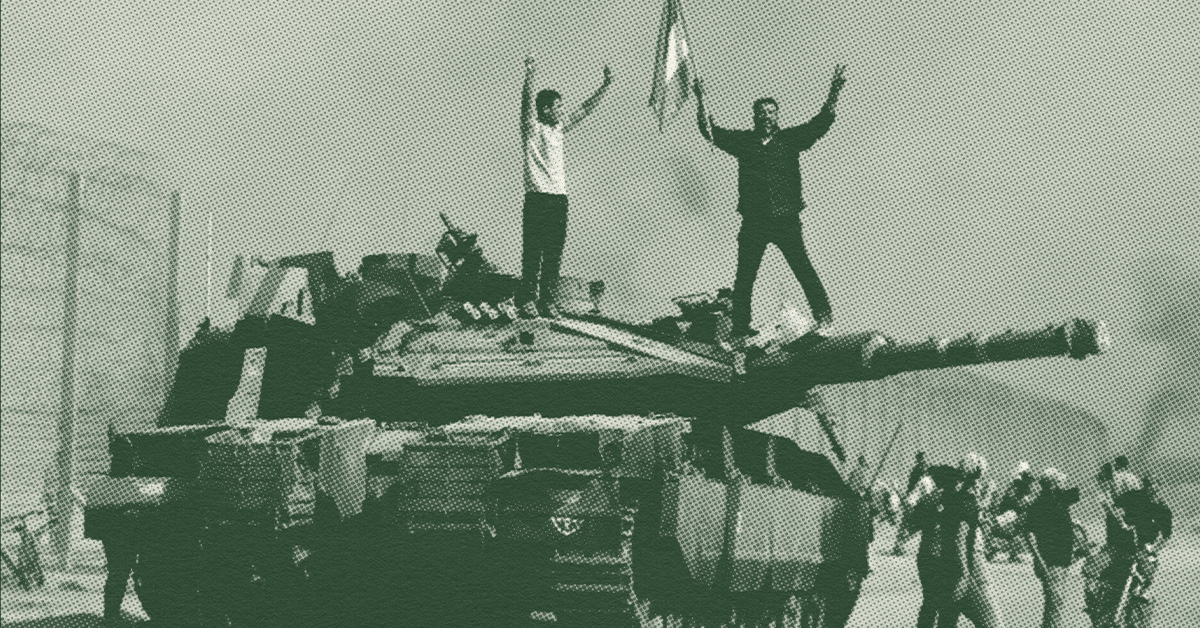
This exceptional aura of technological progress and invincibility was spectacularly and humiliatingly shattered by Operation Al Aqsa Flood on October 7, 20235. On October 8 the New York Times noted how “a Hamas force that had been widely seen as a ragtag collection of militants, has delivered a psychological shock to Israel so great that its very foundations are being questioned: its army, its intelligence services, its government and its capacity to control the millions of Palestinians in its midst”, emphasising that Israel’s “wealth, vibrant start-up culture and increasing acceptance in the Middle East could not forever mask a fundamental Israeli instability.”6 The Jerusalem Post similarly conceded that “Israel’s advanced technology, ironclad defense systems, and some of the best intelligence units in the world, faltered.”7
Al Aqsa Flood not only upended the prevailing image of the Zionist entity’s sleek martial prowess but also the underpinning ideological mythology of the so-called “start-up nation”, namely that the Zionist State had successfully resolved its political problems through high-tech solutions and that such success was a global standard replicable abroad8. Thus, in early October 2023, it seemed that the longstanding fabrication of Zionism’s exceptionalist security credentials had been badly damaged, if not entirely obliterated.
Yet, in the weeks and months thereafter, Zionist leaders and representatives of Israel’s weapons and security industry went into overdrive to try to resuscitate this fractured edifice now hanging by a thread. Initially, their strategy was to simply disavow such revelations. In early 2024, Neve Gordon observed that Israeli military technology manufacturers were never going to admit this and indeed had “a vested interest in showing that the failure was not due to their technologies.”9 As an outgrowth of a well-worn Zionist strategy, Israeli officials have further sought to portray their assaults on Palestinians and other peoples of West Asia as moral and “defensive”10 over the past two and a half years.
Leaning into genocide
Subsequently, however, these officials have returned to their standard exceptionalist scripts to parlay their campaign of endless destruction in Gaza and West Asia to update and reaffirm their longstanding claims to so-called “combat-proven” experience. Moreover, as evidence of the Zionist entity’s genocidal calculus became ever-more impossible to deny, Israeli officials have increasingly leaned into this to resuscitate their martial credentials, which Al Aqsa Flood had destabilised. A Drop Site News article reported that at a military technology conference held in Tel Aviv in December 2025, “Israeli weapons companies made some of their most explicit remarks yet connecting the value of their products to the real-world testing of that firepower on Palestinians in Gaza.”11 The article quoted Gili Drob-Heistein, executive director of the Blavatnik Interdisciplinary Cyber Research Center, who argued that “Israel’s technological leadership combined with smartness, boldness, and out of the box thinking continues to yield astonishing results.”12 Drob-Heistein further emphasised how parlaying this experience has enabled the Zionist State to mutate from a “startup nation” into a global player in “defense tech”, offering “the next big economic engine for Israel and beyond.”13
Despite their neoliberal language, such exceptionalist claims to out-of-the box security “solutions” are nothing new. In remarks to the Knesset in 1949, David Ben-Gurion asserted that “We [Israelis] will not solve [our security problems] by means of simple answers, drawn from our past or adopted from other people. Whatever [solution] was adequate in the past, and for others-will not be adequate for us, since our security problem is one of a kind.”14 As he elaborated, “We will not withstand […] unless we perceive our situation and needs in their geographic and historical singularity, and construct a security method adequate for that uniqueness.”15
Such strategies have also long been central to redressing doubts about the Zionist entity’s material viability in Palestine. In the face of charges of “deficiencies” in the Israeli army, in 1956 Ben-Gurion drew parallels and contrasts to America, stressing that early American colonists also faced similar challenges in their early years. “I am entitled to say to the IDF [Israeli army], even when there are the most extreme deficiencies, that it has nothing to be ashamed of in front of [George] Washington’s army… [But] our situation is different from the situation of any other nation.”16 Ben-Gurion thus insisted that the exceptional nature of the “situation” in Palestine meant that Zionists certainly should not feel subservient to the Americans, even as he and his fellow Zionist leaders pressed American leaders to more unequivocally support the settler-colonial project in Palestine during the 1950s.
In light of this history, the current Zionist strategy of gleefully boasting about its genocidal exploits to reestablish its supposedly unparalleled martial credentials is neither unprecedented nor surprising. What has surprised me, however, is the extent to which this strategy seems to be having its desired effect. For instance, in July 2025, a New Yorker feature noted that “The most prominent real-time laboratory for using A.I. in warfare is in Israel.”17 Whilst acknowledging “widespread accusations that Israel has committed war crimes”, it quotes an Israeli official who argues that killing roughly twenty-five thousand Hamas personnel and twenty-five thousand civilians represents “a better proportion than was ever achieved by a modern military.”18 The above Drop Site article also suggests the Zionist strategy is working, emphasising that “the boasting at the [Tel Aviv] conference reflects genuine upward trends for Israel’s weapons industry.”19 Indeed, in recent months, there have been major new Israeli arms deals announced with Europe20 and the prospects of others with India21. The Zionist entity has proven all too capable in the arena of endless aerial bombardment and has landed significant blows against key enemies, not least of all on the leadership of Hamas, Hezbollah, and the Islamic Republic of Iran. It has also largely disarmed Syria and seized additional territory there as well as in Gaza, behind the so-called Yellow Line. And Hamas has been significantly weakened, even if not entirely defeated.
These feats have been celebrated in Western capitals, as exemplified by the glowing reception to the assassination of Hezbollah leader Hasan Nasrallah in a massive airstrike in the southern suburbs of Beirut on September 27, 2024. As news of this assassination broke, it was roundly welcomed by Western leaders22, heralded as evidence of unparalleled Israeli intelligence prowess23, and broadly understood as a major hinge point in Israel’s efforts to turn the tide against the Iran-led Axis of Resistance seeking to bring about a ceasefire in Gaza. The Washington Post quipped that Nasrallah’s killing “eviscerated decades of myths and assumptions about Hezbollah’s military might, along with the stature of the organization as a regional powerhouse.”24 The New York Times further proclaimed that Prime Minister Benjamin Netanyahu’s recent bold decisions have “defied — and, at least for now, undermined — warnings by allies and foes alike that an escalation risked setting off a broader regional war.”25
Of course, the recent joint US-Israeli assault on Iran engulfed West Asia in precisely such a war, where Zionist strategy has appeared to be one of trying to foment a total collapse of the Iranian state with the unbridled backing of the US empire. They saw an opportunity to crush the Iranian state, weakened by years of brutal sanctions and prior assaults and took it. The Zionist entity has also taken the opportunity to once again redouble its siege of Gaza by continuing to attack it whilst further constricting vital flows of sustenance, destroying and depopulating vast swathes of Lebanon, and in so doing generating the deepest regional and global crisis in recent memory.
This most recent war on Iran began with the assassination of Iran’s Supreme Leader Ayatollah Ali Khamenei on February 28, 2026, through an Israeli airstrike that killed him and several close family members. These were followed up with the aerial assassinations of Iran’s Secretary of the Supreme National Security Council, Ali Larijani, and Basij paramilitary force commander Gholamreza Soleimani on March 17, as well as Iran’s intelligence minister, Esmail Khatib, the day after, as well as a range of other high-ranking Iranian officials in the days and weeks since. These feats have enabled Israeli officials like war minister Israel Katz to boast of having “eliminated members of the axis of evil” and sending them into “the depths of hell.”26 Zionist outlets like the Jerusalem Post have further credited these operations’ success with the Zionist State’s “special capabilities” and swift decision-making27. Subsequently, other Zionist mouthpieces have further claimed that Iranian retaliatory attacks on Gulf states sparked by the war on Iran are “going to be a bonanza for the Israeli defense industries.”28 Indeed, as a range of critical commentators have repeatedly emphasised since October 7, the genocide and wider assaults across West Asia have undoubtedly offered the Zionist entity a testing ground for new weapons systems and tactics to be marketed as “battle proven,”29 with the 2026 war on Iran potentially accelerating this trend30.
Contesting ‘success’
Yet, beneath the surface of supposedly unparalleled martial credentials, the picture is rather less straightforward. The past two and a half years of unvarnished Zionist aggression do not exactly add up to some story of unparalleled military success. The Zionist entity has repeatedly proven itself incapable of strategic achievements in ground combat. In September 2025, Séamus Malekafzali remarked that in Gaza, Zionist forces showed no evidence of commitment to any “solemn undertaking, a noble mission to save hostages.” Instead, they carried out “a campaign of revenge, mockery, theft, and wanton killing, maiming and detonation” with a total absence of any military discipline. He called this the “Sisyphus doctrine,” characterised by its propensity to push the proverbial boulder uphill again and again under the auspices of defeating Hamas once and for all. Yet, as this proved elusive with the boulder always falling back down, Zionist forces routinely showed themselves “unwilling to attempt anything other than mass murder.”31
Alongside these atrocities, Zionist forces have committed major operational blunders, including having explosives used in controlled demolitions turned against their own personnel in Hamas ambushes32, killing many of their own soldiers in “friendly fire” incidents33 and “mistakenly” killing numerous Israeli hostages in Gaza34. This is not even to mention the Israelis intentionally slaughtered by their own government in the immediate aftermath of Al Aqsa Flood through the infamous Hannibal Directive35. In Lebanon, the Zionist entity was forced to constrain its 2024 ground invasion after encountering fierce Hezbollah resistance36. Even their missile-defence systems like the Iron Dome, often uncritically lauded as unparalleled37, have proven patchy at best, requiring the US and other allies to step in to defend the Zionist entity from incoming Iranian drones and missiles in 202438. This dependency became visible again when Iran retaliated against the Zionist entity in the summer of 2025 during the Twelve-Day War with rocket and drone attacks, which forced Zionist leaders to again request support in missile defence, in vain, from Saudi Arabia and then abruptly end their campaign39. As Malekafzali noted at the time, there was a growing sense that “Israel’s war machine is destroying its reputation.”40
Since the onset of the 2026 US-Israeli war on Iran and the acceleration of Israeli assaults on Lebanon, the Zionist entity’s exceptionalist martial credentials have slid considerably further still. While it has wreaked untold devastation across Iran and killed an estimated 2,076 people in Iran as of time of writing, it is becoming increasingly clear that aerial targeted assassinations (based on highly sophisticated intelligence-gathering, to be sure) as well as versions of the Dahiya doctrine are the only real tactics the Zionists have left in their arsenal, with the Israeli army having become “entirely useless” as Saree Makdisi recently pointed out41. They continue to deploy these in a similarly Sisyphean manner to that of their genocide in Gaza, despite these tactics’ incapacity to achieve their ostensible goals of bringing the Islamic Republic and Hezbollah to their knees. The killing of Larijani, according to Ori Goldberg, evidences how the Zionist entity has become “addicted to pointless, flashy assassinations.”42
And much like during the Twelve-Day War, Israeli air-defence systems have once again proven incapable of shielding the Zionist entity and its residents from incoming drones and missiles launched by the Islamic Revolutionary Guard Corps and Hezbollah. While the Zionists’ military censor has ensured that many of the strikes within 1948 Palestine remain unreported, some voices have broken through this censorship. On March 10, Goldberg reported that despite official denials from Zionist officials, “Israel is deeply rattled and effectively paralysed”, stressing that “Israel is significantly less mighty than it would like the world to believe.”43 Since then, as the censorship has begun to ease, it is becoming abundantly clear that some Iranian and Hezbollah missiles and drones have gotten through and wrought significant damage: a Hezbollah missile struck as far as Ashkelon, and Iranian missiles have made direct hits on oil refineries in Haifa as well as on Dimona, which hosts the Zionist entity’s nuclear arsenal.
As exemplified in the case of the 2025 war with Iran, what has rescued the Zionist entity was not its own self-standing martial capabilities but rather its support from Western allies44, not least of all the US, which intervened by bombing Iran on the Zionists’ behalf. Indeed, during that war and throughout the past two and a half years, the US and other Western and regional allies have been essential to protecting Israel from drone and missile attacks launched by Iran and Ansar Allah at an estimated cost of $3.6 billion45. The 2026 war on Iran – the first time that the US decided to not merely back the Zionist entity but wage war in tandem – is estimated to have cost the US $11 billion in its first six days alone46. Before announcing his plan to suspend the bombing of Iran for two weeks on April 7, 2026, Donald Trump had suggested he was gearing up to request a whopping $200 billion from the US Congress to continue funding it47. This tells a broader story that is all too often neglected: the actual material power of the Zionist entity’s ‘exceptional’ martial credentials often rests, in whole or in part, on the largesse and weapons supplied by the US empire and Western power more generally.
A perverted superiority
Thus, whilst taking very seriously what Israel has in fact achieved militarily and politically since October 7, the apparent resuscitation of its claim to unparalleled martial supremacy amid Zionism’s ever-growing global political isolation requires more thorough examination. I argue that it is both inaccurate and misleading to ascribe the partial success of this resuscitation to an unequivocal pattern of Zionist military victories. Nor is it evidence of some unparalleled tactical genius or so-called “Israeli innovation.”48 As Spencer Ackerman incisively observed already in July 2024, the Zionist entity’s capacity to carry out the genocide and generate profit from it was happening despite rather than because of any clear victory over Hamas. Yet, as he stressed, “just because a war cannot be won does not mean that it lacks for winners”49, a claim directly borne out of UN Special Rapporteur Francesca Albanese’s subsequent reports on this profiteering50.
Making sense of this dynamic, I suggest, requires grappling with the relationships between Zionist claims to martial supremacy and the broader fabrication of Jewish supremacy at the core of the Zionist project. What deserves particular scrutiny is the slippage of a racist claim of superiority into an (implied) tactical or material superiority.
To do so, I turn to the work of Ghassan Kanafani. In his recently translated 1967 On Zionist Literature, Kanafani ruminates extensively on the myth of Zionist exceptionalism and its connections to broader imperial narratives. He notes that “the Zionist cause could not justify its conquest of Palestine without leaning on the same justifications of all other conquests throughout history – i.e., by citing physical, civilizational, mental and moral superiority.”51 To do so, however, he crucially points out that the mission of fabricating Jewish supremacy required more than merely replicating these prior myths of exceptionalism. It also required retooling such myths by inverting “the same racist ideology that persecuted the Jews” as the foundational ideological basis on which to carry out the Zionist colonisation of Palestine52.
Kanafani also powerfully unsettles the mythology of Jewish superiority as consecrated by Zionist exceptionalism. He calls this form of supremacy “perverted” in the sense that rather than being based on a “common, natural and legitimate sense of pride”, Jewish supremacy “is premised upon contempt for other peoples by placing them in a second tier in a ‘human hierarchy.’”53 In other words, it represents a fundamentally racist sense of superiority that establishes a claim to Jewish supremacy through denigrating the Arab Other as less-than-human.
While always foregrounding their deep synergies with other forms of European racism, Kanafani also crucially identifies the particular features of a perverted sense of superiority and what gives it its narrative force within Zionist literature. According to him, Zionist literature gives rise to central characters that are defined by “a recalcitrant psychological complex that disguises itself in a deep-seated and absolutely racist sense of superiority.”54 As he further points out, these figures are in significant respects unlike parallel figures in the literature of other settler societies, for instance, those in the genre of the cheap novels of the American West.
What I find particularly striking and instructive about Kanafani’s attention to the “perverted” sense of Zionist superiority in the present conjuncture is how it unmasks the underlying racist precepts of this (supposedly) “natural”, i.e. God-given superiority. In so doing, it also importantly gestures to the flimsiness of Zionist superiority in the sense that it lacks any “legitimate”, i.e. material basis. This is not merely of scholarly concern but also has practical significance. Indeed, thinking with Kanafani here can enable us to grasp how Zionists’ indulgence in their own mythologies of technological mastery has produced actually-existing material vulnerabilities.
Exceptionalism’s fragilities
This is evident in the run-up to October 7, where Zionist leaders’ focus on bragging about their own (supposed) ingeniousness and omnipotence itself seems to have made them more vulnerable to the Al Aqsa Flood operation. As Shir Hever notes, leaked internal investigations from March 2025 show that Israeli officers “dismissed the possibility of a Palestinian attack, believing their deterrence regime to be unbreakable.”55 Others have argued that the Israeli army’s “quest for high-tech superiority over low-tech adversaries” ultimately “clouded its vision” and claimed that this “tech fetish” was itself partially responsible for its failure to anticipate Operation Al Aqsa Flood56. We can see a similar dynamic playing out in recent weeks, whereby Israeli officials have expressed their shock and surprise about Hezbollah’s quiet resurgence that has emerged in conjunction with the 2026 war on Iran57.
This is in no way to diminish the profound sophistication of the Operation and Palestinian resistance to the genocide that followed, despite the extremely limited resources at the Palestinians’ disposal. As Nasser Abourahme stresses, “the battles waged against this genocide” are on par with or even exceed “the great feats of anticolonial history.”58 Alon Mizrahi has made parallel claims in relation to Hezbollah’s assaults on Israeli army positions in Lebanon in recent weeks59. The key point here is to identify how Zionists’ indulgence of their own perverted mythology of Jewish superiority has itself given rise to vulnerabilities to be targeted through armed struggle. Put differently, Zionists’ propensity to indulge their own mythology of Jewish supremacy has itself produced cracks in the material infrastructure of Zionist power. Palestinian resistance figures involved in the Operation reference these, recalling how Israeli military units often lauded as some of the world’s most sophisticated “simply evaporated” under attack60.
This dynamic of Zionists imbibing their own supremacist mythmaking has precedents within the annals of Zionist settler-colonialism. In the aftermath of the 1967 Arab-Israeli war, a profile in the Atlantic magazine glowingly recounted that the Zionist State’s “capacity” for its unparalleled victory was “primarily” based on “that the brainpower with which this people [the Jews] is endowed was channeled for the first time since the Exile into the military art in defense of their own homeland.”61 It quoted Ezer Weizman, Chief of Operations of the Israeli army, who stated that Israelis’ reliance on their “own ideas” and refusal to become “prisoners of computers” is what gave them the necessary confidence to “clobber the [Arab] enemy.”62 As Weizmann explained, “the military world has become a victim of its own sophistication in weaponry‚ bewildered by the technology of the atom age. It has forgotten that brains, nerves, heart‚ and imagination are all beyond the capacity of the computer.”63
Weizmann’s claims exemplify the mobilisation of racist Jewish supremacy as the basis of Zionist martial exceptionalism. Moreover, its reproduction for consumption by American audiences in the Atlantic captures how such claims are consecrated as the necessary common sense to justify the Western support that actually props up the Zionist State’s ostensible stand-alone military credentials. Indeed, contrary to Weizmann’s assertions, it was not exceptional (Jewish) minds or ideas that enabled the Zionists to “clobber the enemy” in 1967, but rather the Western-supplied aircraft and funding. Moreover, with striking parallels to the post-October 7 period, American officials were themselves deeply complicit with the Zionist mythmaking around the 1967 moment by collaborating to obfuscate much of what actually took place during this war64.
While Weizmann proclaimed in 1967 that Israelis would have to be careful to “guard against the extremes of being either too arrogant or too humble”, Zionist officials clearly never actually took such dangers to heart. Instead, their immediate focus was on mobilising this newfound glory as martial pioneers post-1967 to, at last, successfully compel the US empire to anoint them as its “strategic asset” in West Asia. Yet, as Hever points out, while the Zionist entity’s military success against Egypt, Syria, and Jordan in the 1967 war “generated overconfidence among Israeli military elites, the 1973 Yom Kippur war shattered this conception of self-sufficiency, including in arms manufacturing.”65 Moreover, much like the basis of the 1967 victory, what rescued the Zionist project in 1973 was notably not the supposedly exceptional “brainpower” nor “military art in defense” as the Atlantic would have it, but rather redoubled US economic and military support.
While Zionism’s Western guarantors have long grasped that they are the ones who sustain its stranglehold over West Asia, they have also proven all too happy to play along with the mythology of unparalleled Zionist martial supremacy and its inherent value to them. Joe Biden proclaimed in 1986 that “Were there not an Israel, the United States of America would have to invent an Israel.”66 Some of these officials, both in public and in secret documents, profess to be acting in a narrow realist strategic calculus, while others, like Biden, have also played along in no small part because of their own deep ideological commitment to the Zionist cause; an enduring investment that continues to shape the positions of leftist figures like Bernie Sanders, too. The actions of other figures like Bill Clinton have also notably unfolded under the duress of blackmail campaigns directed by the Zionist entity67, which are of growing significance with the ongoing Jeffrey Epstein disclosures68.
But these specific individuals’ proclivities to Zionism aside, the willingness of Western allies to collaborate in the reproduction of Zionist martial exceptionalism is ultimately self-serving. This is because this exceptionalist mythology contains within it an in-built flexibility that enables not merely the Zionist entity but also its Western backers to have things both ways. It offers allies the possibility to cite the Zionist project as doing, in the words of German Chancellor Friedrich Merz, the West’s “dirty work”69, like attacking Iran. Simultaneously, this mythology also affords them the capacity to discretionarily disavow their complicity in Zionist aggression, when the resulting depravity becomes too blatant, controversial or politically costly to these western backers, as was the case in relation to the Zionist incursions into Lebanon during the 1980s.
As Kanafani further alerts us to, however, the admiration, even fetishisation of the Jewish superiority consecrated by Zionist exceptionalism has also satisfied an underlying libidinal desire among the Western political class to sustain a racist posture toward the Arabs. As he points out, the Zionists’ “ostentatious sense of absolute superiority and divine infallibility was not without consequences. It established a racist position so clearly that it is hard for a critic to resist the conclusion that the European and American currents that admired Zionist literature […] were objectively and surreptitiously satisfying the needs of a concealed racist position, the most important aspect of which is not Jewish superiority as such but the position it exposes toward other peoples as well – especially the Arabs.”70 In other words, the appeal of Jewish superiority in the West should not be understood as evidence of the appeal of the thing as such, but rather the racialised hierarchies and forms of violence it enables and justifies.
Jewish superiority has been foundational to the Zionist strategy of annihilation, which has no limits whatsoever, in terms of the degrees of violence that the Zionist entity is willing to unleash and on whom. No person or place in striking distance from the entity and its Western patrons can feel safe from their wrath, including Jewish Israelis (and Jews at large) who can also be sacrificed as “collateral damage” if need be, as seen in the destruction of Tehran’s Rafi-Nia synagogue by an Israeli strike on April 7, 202671. While this dynamic is perhaps most viscerally expressed in the operationalisation of the Hannibal directive in October 2023, it has been present in the Zionist project from a very early stage, such as the Mossad’s targeting of Arab Jews in Iraq in the 1950s72.
Conclusion
So, where does this all leave us in the present conjuncture? Kanafani helps us to cut through the mythic nature of Jewish supremacy and its relation to contemporary expressions of Zionist martial supremacy and see it for what it is, namely a retooled version of Western racism used to prop up the Zionist project and sustain its endless wars against its enemies. As Mary Turfah reminds us, “Israel’s systemic mutilation of Palestinians […] emerges in part because it inflicts pain, in part because it transfigures the Arab body into a marker of Jewish supremacy […] and in part because it drives a wedge between the Israeli and their enemy.”73 Echoing Kanafani’s insights, Turfah also gestures to the relational and fictitious basis of Jewish supremacy. As she goes on, “Israelis only recognize themselves against our image. In a world like that, everything becomes relative: a limbless Palestinian child is a way to see strength in your own.”74 This gestures to the fact that Zionist supremacy is, though structured and defined by its ruthless violence, at its core, fictitious.
These insights further enable us to grasp that the claims to Zionist martial supremacy and their global appeal – though deeply entwined with very real histories of settler-colonial domination in Palestine to be sure – are not derivative of some general history of actually-existing “battle proven” sophistication, let alone conclusive victory over the Palestinians once and for all. Indeed, Kanafani helps us understand that the enduring salience of Zionist claims to martial supremacy owes much to satisfying Western libidinal desires for domination of the Arab Other. For it to be consumed in this way, however, Zionist violence needs to be dressed up as a ‘proper’ object of veneration. As Richard Sanders has recently reminded us, “What is lethal about Zionism is racism”, representing as it does “an ideology of racial hegemony.”75 Yet, as he crucially points out, this lethality is also “propounded with all the solemnity and seriousness…and self-righteousness” afforded to the Zionist project by the liberal columnists of the Guardian and the New York Times76. Attention to the perverted character of Jewish supremacy enables us to not merely see through Zionism’s pretences to seriousness and rationality, and to locate this supremacy within Zionism’s historic and ongoing “addiction to violence”, in Fayez Sayegh’s useful terms77; it also helps us to do two crucial things.
First, it enables us to cut through Zionist martial exceptionalism and break free from our interpellation into its terms of reference. This necessarily invites us to look for new languages through which to collectively think and speak about, as well as mobilise against, Zionist violence. Reconsidering our core terms of reference is important not for its own sake but because it reorients how we approach the terms of unending catastrophe we currently find ourselves in. Kanafani’s own careful attention to the contours of Zionist literature as a critic of this same literature is a testament to this.
Here it seems necessary to reconsider the value of representations of Palestine as a “laboratory” for martial experimentation among those on the Left, as I have already begun to do in conversation with Loewenstein78. While this framework has not been without insight, as I have argued elsewhere, it also poses some considerable dangers, not least of which is unwittingly reifying the supposed genius at the heart of the Zionist project and the triumphalist narratives of progress and inevitability that surround and sustain it79. Even Naomi Klein, who once championed this line of analysis80, has recently suggested the value of the laboratory frame needs to be reconsidered81, and Sherene Seikaly has more actively written against it82.
Two of the most significant deficiencies of the laboratory metaphor are how it continuously conjures the Zionist project as simultaneously rational and self-sufficient. When Loewenstein wrote in 2023 that “Israel is admired as a nation that stands on its own and is unashamed in using extreme force to maintain it”, he was certainly not wrong83. At the time, many did certainly admire it on this basis, and others likely still do so today. But these myths of self-sufficiency and rationality, which the laboratory frame upholds, are untenable and not something the Left can afford to indulge any longer, even tacitly. This is because these myths are at direct odds with how the Zionist entity functions and what it represents. As Kanafani’s language of “perversion” and Sayegh’s terminology of “addiction” both directly alert us to, the Zionist entity can be best defined by its utterly pathological thirst for endless racial violence.
The only way it can continue sating this thirst is through the coddling and protection provided by its American patron, which has in turn come to venerate and fetishise these Zionist pathologies as an inspiration of its own. As Malekafzali has written in the context of the 2026 war on Iran, the Israeli-US relationship has come to operate like “a feedback loop.” This frame captures how “Israel can pursue terror and plunder with full immunity because of America’s unconditional backing – a licence that American politicians envy. Recognising their mutual interests, the world’s sole superpower and the state of Israel have grown ever closer to each other, and ever further from international law.”84 This finds echoes with Jeanne Morefield’s powerful provocation to shift metaphors in how we conceptualise the reproduction of imperial violence across space, arguing for replacing Aimé Césaire’s prevailing metaphor of the imperial “boomerang” with that of the “perpetual motion machine.”85 To me, these different metaphors of the feedback loop and perpetual motion machine seem far more apt than the laboratory to interrogate and act in the horrific conjuncture we find ourselves presently trapped in. The reason is that they push us to grasp the irreducibly transnational nature of how the forces of Zionism and US empire have become conjoined in the service of reproducing their impunity.
Second, cutting through Zionist martial exceptionalism points us to where Zionism’s actually existing material limits and vulnerabilities are. Doing so helps us to better grasp that Zionism’s addiction to endless violence represents weaknesses that could potentially spell the Zionist entity’s downfall.
As part of his ongoing reflections on the collapse of Zionism86, Ilan Pappé has invited us to ask “is really an air force of a state [or] a high-tech ability to blow up people in their faces through a phone or a beeper […] an indication for the viability of a state?” He answers no, particularly in relation to a nation-state that is both “alien to the area and alienated by the area” in which it is located87. While the question he poses has yet to be resolved historically, Pappé’s provocation speaks to how the Zionist entity has worked tirelessly to represent its Western-backed high-tech capacity to maim and wreak terror on largely defenceless populations as a stand-in for its capacities to resolve its foundational contradictions. But these two things are not one and the same. Moreover, while the genocide and current campaigns have laid bare Zionism’s addiction to and capacity for waging unspeakable atrocities with its full Western-backed impunity, at least for now, it has also brought to the fore deep fissures and contradictions in the Zionist edifice that the mythology of martial supremacy long tried to keep under wraps, not least of all the enduring presence of Indigenous Palestinian life that has remained steadfast on the land of Palestine and refuses to capitulate. Iran, Ansar Allah and Hezbollah have proven similarly undeterred by Zionist threats and have refused to submit or vanish, articulating some of the most significant material challenges to the viability of the Zionist entity that have ever been witnessed. They have further re-animated a central lesson of asymmetrical war that empires always seem to forget: that wealth and brute material power alone do not determine outcomes and that the Palestinians’ “unyielding will to continue”88 remains a decisive force.
- Lahav Harkov, ‘Retired General Calling Israel “World Champion of Occupation” Sparks Outrage’, Jerusalem Post, 1 September 2016, https://www.jpost.com/israel-news/retired-general-calling-israel-world-champion-of-occupation-sparks-outrage-466617 ↩︎
- Zev Chafets, ‘Israel Survives Because of an Iron Will and an Iron Wall’, Bloomberg.com, 18 April 2018, https://www.bloomberg.com/view/articles/2018-04-18/gaza-protests-are-pointless-thanks-to-israel-s-iron-wall ↩︎
- Eyal Weizman, ‘The Vertical Apartheid’, openDemocracy, 6 July 2017, https://www.opendemocracy.net/north-africa-west-asia/eyal-weizman/vertical-apartheid ↩︎
- Antony Loewenstein, The Palestine Laboratory: How Israel Exports the Technology of Occupation around the World (Verso, 2023), p. 19. ↩︎
- Dylan Saba, ‘Tectonic Shifts: A Conversation with Darryl Li’, The Baffler, 26 October 2023, https://thebaffler.com/latest/tectonic-shifts-saba ↩︎
- Roger Cohen, ‘A Shaken Israel Is Forced Back to Its Eternal Dilemma’, New York Times, 8 October 2023, https://www.nytimes.com/2023/10/08/world/middleeast/israel-hamas-gaza-analysis.html ↩︎
- Peter Lerner, ‘Complacency Meets the Ghosts of History’, Jerusalem Post, 8 October 2023, https://www.jpost.com/israel-news/defense-news/article-763157 ↩︎
- Sophia Goodfried, ‘Israel’s High-Tech Surveillance Was Never Going to Bring Peace’, Foreign Policy, 30 October 2023, https://foreignpolicy.com/2023/10/30/israel-palestine-gaza-hamas-war-idf-high-tech-surveillance ↩︎
- Sophia Goodfried, ‘Gaza War Offers the Ultimate Marketing Tool for Israeli Arms Companies’, +972 Magazine, 17 January 2024, https://www.972mag.com/gaza-war-arms-companies. ↩︎
- Joseph Massad, ‘The More Israel Kills, the More the West Portrays It as a Victim’, Middle East Eye, 14 June 2025, https://www.middleeasteye.net/opinion/more-israel-kills-more-west-portrays-it-victim ↩︎
- Ryan Grim, ‘“This Has Redefined Israel’s Global Identity”: Israeli Weapons Industry Bullish After Genocide’, Drop Site News, 22 December 2025, https://www.dropsitenews.com/p/this-has-redefined-israels-global ↩︎
- Grim, ‘“This Has Redefined Israel’s Global Identity”’. ↩︎
- Grim, ‘“This Has Redefined Israel’s Global Identity”’. ↩︎
- Gil Merom, ‘Israel’s National Security and the Myth of Exceptionalism’, Political Science Quarterly, 114.3 (1999), pp. 409–34 (p. 416). ↩︎
- Merom, ‘Israel’s National Security and the Myth of Exceptionalism’, pp. 416–17. ↩︎
- ‘David Ben Gurion on the IDF and George Washington’s Armies’, Shapell, 27 January 1956, https://www.shapell.org/manuscript/ben-gurion-idf-george-washington ↩︎
- Dexter Filkins, ‘Is the U.S. Ready for the Next War?’, A Reporter at Large, The New Yorker, 14 July 2025, https://www.newyorker.com/magazine/2025/07/21/is-the-us-ready-for-the-next-war ↩︎
- Filkins, ‘Is the U.S. Ready for the Next War?’ ↩︎
- Grim, ‘“This Has Redefined Israel’s Global Identity”’. ↩︎
- Shir Hever and Rhys Machold, ‘How the Gaza Genocide Is Transforming Israel’s Military Relations with Europe’, Mondoweiss, 26 February 2026, https://mondoweiss.net/2026/02/how-the-gaza-genocide-is-transforming-israels-military-relations-with-europe ↩︎
- Azad Essa, ‘Everything You Need to Know about Modi’s Visit to Israel’, Middle East Eye, 25 February 2026, https://www.middleeasteye.net/explainers/whats-behind-israel-special-relationship-with-india ↩︎
- ‘Statement on the Death of Hassan Nasrallah’, 28 September 2024, https://www.presidency.ucsb.edu/documents/statement-the-death-hassan-nasrallah ↩︎
- Adam Goldman and others, ‘As Hezbollah Threat Loomed, Israel Built Up Its Spy Agencies’, U.S., The New York Times, 28 September 2024, https://www.nytimes.com/2024/09/28/us/politics/hezbollah-israel.html ↩︎
- Liz Sly, ‘Nasrallah’s Assassination Shreds Illusion of Hezbollah’s Military Might’, Washington Post, 29 September 2024, https://www.washingtonpost.com/world/2024/09/29/hezbollah-nasrallah-lebanon-israel ↩︎
- Patrick Kingsley, ‘Netanyahu, Ignoring Allies and Defying Critics, Basks in a Rare Triumph’, World, The New York Times, 29 September 2024, https://www.nytimes.com/2024/09/29/world/middleeast/netanyahu-israel-mideast.html ↩︎
- Emanuel Fabian, ‘Defense Minister Katz Says Ali Larijani Killed in Israeli Airstrike’, The Times of Israel, 17 March 2026, https://www.timesofisrael.com/liveblog_entry/defense-minister-katz-says-ali-larijani-killed-in-israeli-airstrike ↩︎
- Yonah Jeremy Bob, ‘How Israel Assassinated Iran’s ‘de-Facto Leader’ Larijani’, The Jerusalem Post | JPost.Com, 17 March 2026, https://www.jpost.com/middle-east/iran-news/article-890273 ↩︎
- Yuval Azulay, ‘“Iran’s Attack on the Gulf States Is Going to Be a Bonanza for the Israeli Defense Industries”’, Ctech, 8 March 2026, https://www.calcalistech.com/ctechnews/article/hym00zhqk11g ↩︎
- Tariq Dana, ‘Merchants of Death: Israel’s Permanent War Economy’, 29 January 2024 https://www.securityincontext.org/posts/merchants-of-death-israels-permanent-war-economy ; Leila Katibah, ‘The Genocide Will Be Automated—Israel, AI and the Future of War’, Middle East Research and Information Project, 16 October 2024, https://merip.org/2024/10/the-genocide-will-be-automated-israel-ai-and-the-future-of-war ; Muhanad Seloom, ‘Will Israel’s Algorithmic Counter-Insurgency Proliferate to the West?’, War on the Rocks, 29 October 2025, https://warontherocks.com/2025/10/will-israels-algorithmic-counter-insurgency-proliferate-to-the-west ↩︎
- Antony Loewenstein, ‘Why Soaring Israeli Morale over the War on Iran Exposes Deeper Delusion’, Middle East Eye, 19 March 2026 <https://www.middleeasteye.net/opinion/why-soaring-israeli-morale-over-war-iran-exposes-deeper-delusion>. ↩︎
- Séamus Malekafzali, ‘The Sisyphus Doctrine’, 30 May 2024, https://www.seamus-malekafzali.com/p/the-sisyphus-doctrine ↩︎
- Jeremy Scahill, ‘21 Israeli Troops Killed While Planting Explosives for a Controlled Demolition in Gaza’, The Intercept, 23 January 2024, https://theintercept.com/2024/01/23/israeli-idf-demolition-gaza ↩︎
- ‘31 Israeli Soldiers Killed by Friendly Fire in Gaza Ground War: Report’, Middle East Monitor, 4 July 2025, https://www.middleeastmonitor.com/20250704-31-israeli-soldiers-killed-by-friendly-fire-in-gaza-ground-war-report ↩︎
- Sabastian Ben Daniel, ‘The “Mistaken” Killing of Three Israeli Hostages Was a Tragedy Long Foretold’, +972 Magazine, 9 January 2024, https://www.972mag.com/three-hostages-killed-gaza-israeli-soldiers ↩︎
- Jonathan Ofir, ‘Another Israeli Soldier Admits to Implementing the “Hannibal Directive” on October 7’, Mondoweiss, 26 March 2024, https://mondoweiss.net/2024/03/another-israeli-soldier-admits-to-implementing-the-hannibal-directive-on-october-7 ; Asa Winstanley, ‘We Blew up Israeli Houses on 7 October, Says Israeli Colonel’, Text, The Electronic Intifada, 5 December 2023 <https://electronicintifada.net/blogs/asa-winstanley/we-blew-israeli-houses-7-october-says-israeli-colonel ↩︎
- Nader Durgham and Josephine Deeb, ‘Israel’s Invasion of Lebanon: What Is Happening on the Ground?’, Middle East Eye, 17 October 2024, https://www.middleeasteye.net/news/israels-invasion-lebanon-what-happening-ground ↩︎
- Rhys Machold, ‘The Iron Dome System Is a Monument to Israel’s Hubris’, Jacobin, 28 May 2021, https://jacobin.com/2021/05/israel-military-iron-dome-system-high-tech-hubris-missile-defense-palestine ; Rhys Machold, ‘Staying with the Failures: Iron Dome and Zionist Security “Innovation”’, in Encounters with Colonial Power: Emergent Spaces of Violence and Struggle in Palestine, ed. by Mikko Joronen and Mark Griffiths (University of Nebraska Press, 2023), pp. 122–48. ↩︎
- Daniel Boguslaw and Ken Klippenstein, ‘U.S., Not Israel, Shot Down Most Iran Drones and Missiles’, The Intercept, 15 April 2024, https://theintercept.com/2024/04/15/iran-attack-israel-drones-missiles; Ken Klippenstein and Daniel Boguslaw, ‘The Secret U.S. Alliance That Defended Israel From Iran Attack’, The Intercept, 18 April 2024, https://theintercept.com/2024/04/18/israel-attack-iran-middle-east ↩︎
- Sean Mathews, ‘US Asked Saudi Arabia to Send Missile Interceptors to Israel during Iran Conflict. Riyadh Refused’, Middle East Eye, 25 July 2025, https://www.middleeasteye.net/news/us-asked-saudi-arabia-send-missile-interceptors-israel-during-iran-conflict-riyadh-refused ↩︎
- Séamus Malekafzali, ‘Netanyahu and Trump Are Trying to Have It All’, The Intercept, 14 June 2025, https://theintercept.com/2025/06/14/israel-iran-attack-netanyahu-trump ↩︎
- Makdisi Street, ‘Turning West Asia into a Wasteland’ w/ Ali Alizadeh (2026), https://www.youtube.com/watch?v=EhT7J1LPf20 ↩︎
- Ori Goldberg, ‘Larijani Shows Israel Is Addicted to Pointless, Flashy Assassinations’, New Lines Magazine, n.d. https://newlinesmag.com/running-notes/larijani-shows-israel-is-addicted-to-pointless-flashy-assassinations ↩︎
- Ori Goldberg [@ori_goldberg], ‘In answer to the question what the situation is in Israel: the level of damage is not remotely close to what Israel is doing in Iran and in Lebanon. The issue is that the Israeli government heavily censors any news regarding casualties and deaths, as well as actual missile hits.’, Tweet, Twitter, 10 March 2026, https://x.com/ori_goldberg/status/2031292740416200983 ↩︎
- Abdaljawad Omar, ‘The Ceasefire with Iran Reveals the Limits of Israel’s Power — and Its Dependence on the U.S.’, Mondoweiss, 24 June 2025, https://mondoweiss.net/2025/06/the-ceasefire-with-iran-reveals-the-limits-of-israels-power-and-its-dependence-on-the-u-s ↩︎
- Mike Frendenburg, ‘US Missile Depletion from Houthi, Israel Conflicts May Shock You’, Responsible Statecraft, 7 August 2025, https://responsiblestatecraft.org/missile-depletion-us-navy ↩︎
- Patricia Zengerle, ‘Trump Administration Estimates Iran War Cost at over $11 Billion in Six Days, Source Says’, United States, Reuters, 11 March 2026, https://www.reuters.com/world/us/trump-administration-estimates-iran-war-cost-over-11-billion-six-days-source-2026-03-11 ↩︎
- Mike Johnson, ‘“Hell No”: Pentagon Wants Over $200 Billion to Fund Trump’s Illegal Iran War’, 19 March 2026, https://www.commondreams.org/news/hell-no-pentagon-wants-over-200-billion-to-fund-trump-s-illegal-iran-war ↩︎
- Rhys Machold, ‘The Myth of Israeli Innovation’, Jewish Currents, 27 October 2025, https://jewishcurrents.org/the-myth-of-israeli-innovation ↩︎
- Spencer Ackerman, ‘These Corporations Are the True “Winners” of the War on Gaza’, The Nation, 9 July 2024, https://www.thenation.com/article/economy/gaza-war-profiteers-corporations ↩︎
- Francesca Albanese, ‘A/HRC/59/23: From Economy of Occupation to Economy of Genocide – Report of the Special Rapporteur on the Situation of Human Rights in the Palestinian Territories Occupied since 1967 (Advance Unedited Version)’, Question of Palestine, 30 June 2025, https://www.un.org/unispal/document/a-hrc-59-23-from-economy-of-occupation-to-economy-of-genocide-report-special-rapporteur-francesca-albanese-palestine-2025 ; Francesca Albanese, ‘A/80/492: “Gaza Genocide: A Collective Crime” – Report of the Special Rapporteur on the Situation of Human Rights in the Palestinian Territories Occupied since 1967. – Advance Unedited Version’, OHCHR, 25 October 2025, https://www.ohchr.org/en/documents/country-reports/a80492-gaza-genocide-collective-crime-report-special-rapporteur-situation ↩︎
- Ghassan Kanafani, On Zionist Literature, trans. by Mahmoud Najib (Ebb Books, 2022 [1967]), p. 80. ↩︎
- Kanafani, On Zionist Literature, p. 22. ↩︎
- Kanafani, On Zionist Literature, p. 60. ↩︎
- Kanafani, On Zionist Literature, p. 73. ↩︎
- Shir Hever, ‘From Domination to Extermination’, Phenomenal World, 29 August 2025, https://www.phenomenalworld.org/analysis/israel-military ; see also James Rosen-Birch, ‘How Changes in the Israeli Military Led to the Failure of October 7’, New Lines Magazine, 20 May 2024, https://newlinesmag.com/argument/how-changes-in-the-israeli-military-led-to-the-failure-of-october-7 ↩︎
- Franz-Stefan Gady, ‘Israel’s Military Tech Fetish Is a Failed Strategy’, Foreign Policy, 24 September 2024, https://foreignpolicy.com/2023/10/26/israel-hamas-gaza-military-idf-technology-surveillance-fence-strategy-ground-war ↩︎
- ‘Israel Shocked by Hezbollah Capabilities amid Fears of Prolonged War’, Middle East Monitor, 17 March 2026, https://www.middleeastmonitor.com/20260317-israel-shocked-by-hezbollah-capabilities-amid-fears-of-prolonged-war ↩︎
- Alon Mizrahi [@alon_mizrahi], ‘For two years I’ve claimed here: Hezbollah is the best guerilla force in the world, potentially in history. Idiots mocked. Now those video are beginning to come out of Lebanon, and there are going to be so many of them, with tens, hundreds and possibly thousands of IDF soldiers’, Tweet, Twitter, 11 March 2026, https://x.com/alon_mizrahi/status/2031788437381267922 ↩︎
- Alon Mizrahi [@alon_mizrahi], ‘For two years I’ve claimed here: Hezbollah is the best guerilla force in the world, potentially in history. Idiots mocked. Now those video are beginning to come out of Lebanon, and there are going to be so many of them, with tens, hundreds and possibly thousands of IDF soldiers’, Tweet, Twitter, 11 March 2026, https://x.com/alon_mizrahi/status/2031788437381267922 ↩︎
- Jeremy Scahill, ‘Palestinian Islamic Jihad: “Oslo Is Over”’, Drop Site News, 9 July 2024, https://www.dropsitenews.com/p/oslo-is-over ↩︎
- Barbara W. Tuchman, ‘Israel’s Swift Sword’, The Atlantic, 1 September 1967, https://www.theatlantic.com/magazine/archive/1967/09/israels-swift-sword/660113 ↩︎
- Tuchman, ‘Israel’s Swift Sword’. ↩︎
- Tuchman, ‘Israel’s Swift Sword’. ↩︎
- Prem Thakker, ‘A Cover-Up? Survivors of Israel’s Attack on US Ship Still Waiting for Answers 58 Years Later’, Zoteo, 7 June 2025, https://zeteo.com/p/coverup-survivors-israels-attack-on-uss-liberty-answers ↩︎
- Hever, ‘From Domination to Extermination’. ↩︎
- Jillian Kestler and Joseph Stepansky, ‘“Defies Logic”: The Makings of Joe Biden’s “Blank Cheque” to Israel’, Al Jazeera, 30 January 2024, https://www.aljazeera.com/news/longform/2024/1/30/defies-logic-the-makings-of-joe-bidens-blank-cheque-to-israel ↩︎
- Ryan Grim, ‘Did Benjamin Netanyahu Blackmail Bill Clinton Over the Monica Lewinsky Sex Tapes?’, 25 July 2025, https://www.dropsitenews.com/p/did-benjamin-netanyahu-blackmail ↩︎
- ‘Epstein and Israel’, Drop Site News, 18 February 2026, https://www.dropsitenews.com/s/epstein-and-israel ↩︎
- James Angelo, ‘Merz’s “Dirty Work”’, POLITICO, 20 June 2025, https://www.politico.eu/newsletter/berlin-bulletin/merzs-dirty-work ↩︎
- Kanafani, On Zionist Literature, p. 80. ↩︎
- Fabian, Emanuel, and Zev Stub, ‘IDF Admits Tehran Synagogue Was “Collateral Damage” in Strike on Iran Commander’, The Times of Israel, 7 April 2026, https://www.timesofisrael.com/iran-claims-tehran-synagogue-badly-damaged-in-israeli-airstrike-israeli-official-we-dont-target-synagogues ↩︎
- ‘Avi Shlaim Says He Has “proof of Zionist Involvement” in 1950s Attack on Iraqi Jews’, Middle East Eye, 17 June 2023, https://www.middleeasteye.net/news/avi-shlaim-proof-israel-zionist-involvement-iraq-jews-attacks ↩︎
- Mary Turfah, ‘I’m Not Done With You: Israel Uses the Dead to Attack the Living’, The Baffler, 10 February 2026, https://thebaffler.com/latest/im-not-done-with-you-turfah ↩︎
- Turfah, ‘I’m Not Done With You: Israel Uses the Dead to Attack the Living’. ↩︎
- Novara Media, Expert Explains The Epstein Files: Interview With Richard Sanders (2026), https://www.youtube.com/watch?v=WgYSEeKXMvY ↩︎
- Novara Media, Expert Explains The Epstein Files. ↩︎
- Fayez A. Sayegh, Zionist Colonialism in Palestine (Palestine Liberation Organization, 1965), p. 30, http://www.freedomarchives.org/Documents/Finder/DOC12_scans/12.zionist.colonialism.palestine.1965.pdf ↩︎
- Debating the “Palestine Laboratory”, hosted by Arielle Angel (4 December 2025), https://jewishcurrents.org/debating-the-palestine-laboratory ↩︎
- Rhys Machold, ‘Reconsidering the Laboratory Thesis: Palestine/Israel and the Geopolitics of Representation’, Political Geography, 65 (2018), pp. 88–97, ↩︎
- Naomi Klein, ‘Laboratory for a Fortressed World’, The Nation, 14 June 2007, http://www.thenation.com/article/laboratory-fortressed-world ↩︎
- Down the Rabbit Hole w/ Naomi Klein, hosted by Mark Otto (18 October 2024), https://www.thedigradio.com/podcast/down-the-rabbit-hole-w-naomi-klein ↩︎
- Sherene Seikaly, ‘Nakba in the Age of Catastrophe’, Jadaliyya – جدلية, 15 May 2023, https://www.jadaliyya.com/Details/45037 ↩︎
- Loewenstein, The Palestine Laboratory: How Israel Exports the Technology of Occupation around the World, p. 18. ↩︎
- Séamus Malekafzali, ‘The Invaders’, Equator, 4 March 2026, https://www.equator.org/articles/the-invaders ↩︎
- Jeanne Morefield, ‘Beyond Boomerang’, International Politics Reviews, 8.1 (2020), pp. 3–10 (p. 7), ↩︎
- Ilan Pappé, ‘The Collapse of Zionism’, New Left Review/Sidecar, 21 June 2024, https://newleftreview.org/sidecar/posts/the-collapse-of-zionism ↩︎
- Makdisi Street, ‘The Rot Is Very, Very Deep’ w/ Ilan Pappé (2025), https://www.youtube.com/watch?v=cG_JFp0MDLs ↩︎
- Abdaljawad Omar and Louis Allday, “‘An unyielding will to continue’: An Interview with Abdaljawad Omar on October 7th and the Palestinian Resistance”, Prometheus Magazine, November 17, 2023, https://prometheus-mag.com/2023/11/17/an-unyielding-will-to-continue/ ↩︎