The ascension of Zack Polanski to leadership of the Green Party of England and Wales in September 2025 and the subsequent influx of well over 150,000 new members have changed how they are viewed within the socialist and other progressive movements1 – in an increasingly positive direction.2 As it stands, Polanski is expected to lose the upcoming Holborn and St Pancras by-election today.3
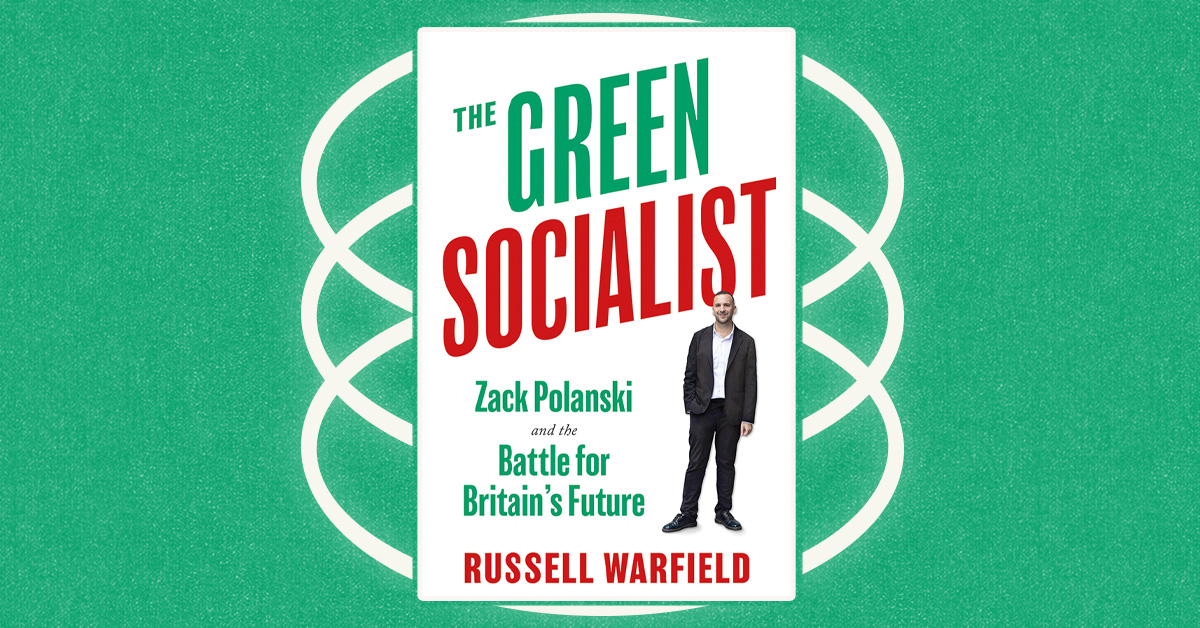
On 20 September this year, Russell Warfield’s The Green Socialist: Zack Polanski and the Battle for Britain’s Future was published by Pluto Press.4 It is the first book to examine the nature and opportunities presented by Polanski’s new Green Party in relation to the “British Left” (p. 18). To make sense of the current moment, communists and republicans must understand why and how Polanski has successfully galvanised several people and what this means for us in particular.
Warfield’s book is split into two sections; the first half gives us, in reverse-chronological order, a history of the Green Party. He starts with the victory of Hannah Spencer in the Gorton and Denton by-election in February 2026, goes back to the start of Polanski’s leadership and his campaign against those backed by the party establishment (p. 51), in which he is presented as the natural culmination (pp. 16, 65) of its long-term development. He goes all the way back through the years of the Green Party’s former leader Natalie Bennett as an anti-austerity precursor to Polanski’s ecosocialism and to the party’s founding by “distinctly rightwing people” such as Teddy Goldsmith and former Conservative councillor Tony Whittaker (pp. 91-93); “small-c conservatives”, people who would identify as “Left-Liberal”, and many others (pp. 91, 94).
The second half of the book asks key questions about the nature of Polanski’s Greens; for example, are they “really left-wing” or do they “still care about the environment?” Here, we are introduced to the inner struggles of the Green Party with groups like Green Left and Greens Organise (pp. 116-117), and we are confronted with questions like “how a slew of newly elected Green councils ought to actually administer state power” (p. 168). Throughout we find references to countless writers and activists, some more directly associated with the Greens than others, who make up part of the general ecosocialist current that Warfield describes, from Derek Wall (p. 115) and Grace Blakely (p. 131), to Matthew T. Huber (p. 123), Joel Wainwright and Geoff Mann (p. 133).
The book “tells the story of how Zack Polanski was propelled to the leadership of the Green Party of England and Wales at this extraordinary political juncture, and argues that the Greens can be a vehicle for transformational politics in the years ahead” (p. 14). Because the book is situated in a temporary political juncture, and because of the reliance on vague language like “transformational politics” and “left-wing” throughout the book, we encounter two distinct problems:
- Much of it is already outdated by Andy Burnham’s rise to power; the author anticipates this and therefore makes many errors by overstating the left-wing, socialist and democratic credentials of the Green Party in general, Polanski individually, and understating the respective credentials of the Labour Party.
- Despite portraying Polanski and the Greens as socialist and left-wing, the author makes it clear in the introduction that beyond the scope of “social democracy” (p. 5) he has no intention of treating the socialist movement as a serious political subject and therefore entertains no critique of Polanski from the left.
A spectre is haunting Polanski – the spectre of Burnhamism
Warfield does acknowledge how quickly things change in politics and that his analysis may have fallen out of date by the time of publication (pp. 8, 219). Much of the author’s argument for the relevance and continued strength of Polanski’s Greens, however, rests on their ability to “move into a political space vacated to the left of Labour” (p. 87) in their rightward shift under Sir Keir Starmer. In this way, Andy Burnham haunts Warfield’s argument – waiting to pounce back into the “gap in the political landscape” (p. 80) the Greens had claimed for themselves.5
Discussing how the Green Party fared poorly after Corbyn’s Labour shifted leftwards in the 2010s, Warfield asks, “is Polanski’s surge vulnerable to the same risk?” (p. 79). A Burnham-led Labour “presents the most obvious danger to the Greens”, he remarks (p. 82). In the past, Labour had a better offer than the Greens because it “was a vehicle through which you could plausibly win state power and form a government” (p. 78). Surely, this is an even bigger problem for Polanski than it was for Bennett, as Burnham’s Labour is now in government?
Warfield preemptively shrugs off the Burnhamite threat to Polanskism. He claims that it “will no longer fully satisfy a segment of the electorate whose horizons have been broadened” (p. 83). Labour’s politics under Corbyn are correctly understood as “not socialism but a radical social democracy” (p. 5), but he argues that it is not Burnham’s Government but Polanski’s Greens who are now the inheritors of Corbynism (p. 83). As I will demonstrate in the next section, Warfield overstates the left-wing, socialist and democratic credentials of the Greens throughout the book. By contrast, he both rightly criticises the Labour Party’s anti-democratic and anti-socialist limits and sometimes understates Labour’s socialist and democratic credentials by comparison.6
Green Radicals and Labour Centrists
While both leaders share a fundamentally social democratic programme, Warfield argues Polanski is the titular “Green Socialist”, and Andy Burnham is “soft left” (p. 173).
On ideology, Warfield writes of a Green Party where an explicitly ecosocialist outlook is in the ascendancy and which has always offered a deep-rooted critique of capitalism (pp. 100, 120). Labour, by contrast, is a party of failing social democratic centrism (p. 150). The Greens “do not imagine themselves as being merely the most effective managers of capitalism in the way that Labour has for most of its history” (p. 100), we are told.7
On trade unions, Warfield claims that Labour’s relationship with the unions has been “fraying for decades” (p. 126), with union leaders even making “public remarks about the real possibility of disaffiliating” (p. 127). Polanski’s Greens, by contrast, have “been rewarded” with “best wishes” and podcast appearances from union leaders (p. 124).
On the traditions they represent, Warfield claims Polanski’s Greens are Corbyn’s “inheritors” (p. 83). The careers of “avowed” and apparently “undeniable” socialists Tony Benn, Ken Livingstone and John McDonnell are provided as examples of Green principles in practice (pp. 132-133). This is even though Benn died a Labour Party member and McDonnell continues to be one.
On party democracy, Warfield quotes the Morning Star’s Andrew Murray discussing the near-complete autonomy Labour MPs have from advisory party bodies (p. 106). The Green Party’s lack of party whips is recognised as a tension where “all elected representatives are effectively free to ignore” the party’s internal democracy (p. 105). This is, however, still considered an example of the Greens’ “pioneering democratic approach” of “putting into Parliament a cohort of independently minded people” (p. 105). That being said, when comparing Labour and the Greens, there are aspects of Green Party internal democracy that Warfield is right to highlight positively, notably open selections (p. 106).
On each party’s right-wing aspects, Warfield rightly criticises Labour for capitulating to the right on immigration (p. 10). By contrast, the author writes that the Green Party has only one right-wing grouping, Gender Critical Greens (p. 120). He claims that the influx of members since Polanski’s leadership has marginalised these right-wing Green Party members, though many will call the author’s claim into question in light of the suspension of Eleanora Folan following transphobic backlash from right-wing media.8 Furthermore, Warfield admits that the left-wing faction Greens Organise lacks great representation on leading party bodies but suggests they might already be hegemonic within the party (p. 119) somehow.
Looking at specific MPs, Warfield portrays Green Party MP Hannah Spencer as “unconditionally representative of the British working class” (p. 40), despite her being a business owner.9 By contrast, Steve Reed is described as wearing a “MAGA-aping hat”, performing in political theatre at a Labour Party conference (p. 150).
Even when pandering to a commodified sense of Northern hospitality, in place of serious political intent, Burnham’s Labour have Polanski’s Greens beat. As a marker of her supposed authenticity, Spencer is described as “in a minority of one among MPs whom you actually believe when they say they could murder a Greggs sausage roll” (p. 32). Spencer is a vegetarian, which technically makes her one of the few MPs you cannot imagine eating a Greggs sausage roll. Regardless, the fact that by now we all know the Prime Minister’s Greggs order should indicate that being an avid consumer of it is not a marker of authenticity, nor a suggestion of meaningful left-wing commitments. Furthermore, Greggs is an exploitative, fast-food business the same as McDonald’s, Starbucks or Pret – not a bastion of proletarian socialism.
What we can say is that Warfield has thus far been proven wrong. The political space that was being vacated by Starmer’s Labour is now being closed down by Burnham, not Polanski. As of writing, Burnham has clawed Labour back to the top of national opinion polls; Polanski’s Greens are almost back to where they were when Polanski took over.10
With the first budget soon-to-come and conference announcements of a new Help to Buy scheme that leaves much to be desired, perhaps Burnham is about to show his true colours, and Polanski will be able to attack him from the left, as he did with Starmer. When taking power, Burnham offered reindustrialisation and public control,11 shortly after he committed to fiscal rules which would make this impossible – communists must ask, as a former advocate of austerity whose councillors up and down the country enact budget cuts on behalf of His Majesty’s Government, would Polanski be any different?
Furthermore, Burnham is as much of “a national class political communicator” (p. 53) as Polanski is, if not more.12 This is part of the reason why Polanski is not weathering the Burnham storm as well as Warfield hoped he would, but it is not the full picture. The question of Polanski’s diminution is perhaps best answered by exploring the central question that the author asks.
Is the Green Party Really that Leftwing?
The fifth chapter asks Is the Green Party Really that Leftwing?, to which we might add – in light of Burnham’s premiership – is the Green Party any more left-wing than the Labour Party?
The relativist “left-wing” and the vague title of “socialist” are used extensively throughout the book. Both terms can include anyone from liberal monarchists who favour Keynesian state activity to anarchist guerrilla fighters. Figures throughout history from David Lloyd George to Adolf Hitler have called themselves socialists,13 so we must delve deeper into what the politics of Polanski and his Greens actually are.
Labour and the Greens are described as social-democratic, but where Labour is “social democratic centrism” (p. 150), the Greens are “radically social democratic” (p. 108). Though making overtures to a socialism “which is about workers’ control” (p. 121) in an interview with the author, Polanski’s anti-capitalist commitments do not go any further. “For Polanski, the difference between radical social democracy and socialism is not a hard distinction; both sit on a spectrum along which we are trying to move our politics along, towards a place where the profit motive is eroded, undermined and displaced” (p. 121). Polanski’s vision of ecosocialism, we are told, is “‘ultimately about making sure that we’re not socialising risks and privatising rewards. We need to be socialising the rewards’” (p. 120) — not about abolishing capitalist exploitation or the state.
Warfield seemingly views anti-capitalist socialism as an unserious political subject. He writes that “ecosocialism can only be realised through a process of social and political transition, strengthening social democratic principles” (p. 5). His defence of this is that this book is a study of the Green Party, which therefore does not consider the prospects of violent revolution (p. 5), but this view suffers from three errors. First, the debate between socialists on transforming capitalism into socialism through constitutionally legal reforms or revolution against the existing state has no bearing on the question of violence. Many reformist struggles have used organised violence as a form of leverage within negotiating. For example, in 1921 around 10,000 armed mineworkers fought in the Battle of Blair Mountain; the storming of the Winter Palace in October 1917 was, by contrast, remarkably peaceful. Second, there are members, however few, within the Green Party who identify as Marxists or otherwise believe a revolution is necessary for a socialist transformation, and view the idea of transforming the Green Party into an anti-constitutional party as the best prospect for the socialist movement. Third, the book is actually about Polanski as both the leader of the Green Party and, from the author’s perspective, as a socialist and therefore how he relates to the socialist movement in Britain — it is not just a “study of the Green Party” (p. 5).
The socialist movement in Britain is home to many failures. The constant support for the Labour Party from the Communist Party of Britain and the dogmatic adherence to antiquated tactics like fruitless university campus book stalls by the Socialist Workers’ Party or the industrial colonialism of the Spartacist League are some such failures. As are the embarrassingly poor quality of amateurish propaganda materials, like the Weekly Worker front pages featuring South Park’s Tolkien Black, Ian McKellen’s Gandalf, or YouTube channel OverSimplified’s cartoon Trotsky.14 So, it is quite understandable that the author would view the socialist movement in Britain as a deeply unserious political subject. The problem with this is that Marxism’s political ideas are fundamentally at odds with those of Warfield’s conception of social democracy.
Social democracy and 1689
“Social democracy”, as a popular term, has its origins in the 19th-century socialist and democratic-republican movements, meaning republican movements committed to universal (male) suffrage, direct civic participation in administration and the civic militia in place of the standing army.15 The Social-Democratic Party of Germany’s early party programmes were characterised by similar democratic-republican demands.16 Despite this origin, the term is now commonly used to refer to a political movement which focuses on using the existing state apparatus to regulate in capitalist economic settings and provide state welfare – often leaving anti-capitalism off the table.17
This usually implies that social democratic movements accept the constitutional politics of the state which they would like to use for economic regulation. Warfield himself defines Corbyn’s radical social democracy with no reference to any sort of constitutional politics but rather as an “interventionist state willing to tax, invest and regulate in the public interest” (p. 5). In Germany, the Social Democratic Party is, under the Federal Republic of Germany, therefore naturally republican.18 The social-democratic tradition in Britain, however, is largely de facto monarchist.
Since William of Orange’s conquest of Britain and Ireland and relegation of Stuart absolutism to the history books, every government of the United Kingdom, and those of England and Scotland before the Acts of Union 1707, has broadly upheld the political settlement set about it in the Declaration of Right and the subsequent Bill of Rights 1689. All UK governments have been de facto liberal monarchist, so-called social-democratic governments included. British social democracy, like British liberalism or British conservatism, therefore must be understood as a subsection of liberal monarchism. Polanski is an advocate for radical social democracy, but he leads a party whose “animating purpose” is to “form the first ever Green government” (p. 178), on behalf of the King. He is fundamentally committed to the project of liberal monarchism.19
How then must communists relate to Polanski’s Greens?
Warfield’s Green plea
The stated aim of Warfield’s book was quoted above as an attempt to argue that the Greens can be a vehicle for transformational politics. The author’s constant exaggeration of the Green Party’s socialist and democratic credentials and his downplaying of the Labour Party’s respective credentials, however, reads like an attempt to convince the reader of something more than this.
Warfield hesitates to commit to anything bolder, writing in the abstract that “one can see the opportunity for the Greens to not only replace Labour as the foremost electoral force on the Left of English politics, but to be a central node in a revitalised and re-politicised network of organised labour” (p. 129). He continues, tentatively stating that there “is a route to the Green Party laying legitimate claim to being the party of UK workers at the next general election” (p. 129). The furthest he goes is stating that the Green Party “hovers over the possibility of becoming the primary party of the Left in England” (p. 163). Despite this, the author has made stronger claims elsewhere. He told PoliticsJOE he thinks “the Green Party of England and Wales is now the foremost electoral project of the left in the UK”.20
Though settling for social democracy, and therefore liberal monarchism, Warfield dresses up his analysis in the language of class struggle with references to an incompetent “ruling class” (p. 1), the struggle to “loosen the grip of capital” (p. 18), as well as the “changing class composition” of the Green Party and the juxtaposed alliteration of “sending a plumber to Parliament” (p. 42). Assuming the target readership of a book published by Pluto Press is in large part left-wing activists, much of Warfield’s book then reads like a plea for the left to get behind Polanskism the way we got behind Corbynism.21
It is an understandable argument in a sense. Warfield himself points out that the organised left projected their own hopes onto Corbyn (p. 77). Polanski is a better political communicator than Corbyn ever was, and if he’s just as left-wing, then he deserves our backing too, right?
Most of the socialist movement did get behind Corbyn uncritically. For example, the Communist Party of Britain contested no seats in the 2017 and 2019 general elections; neither did the Trade Unionist and Socialist Coalition. The problem is that the socialist movement was wrong to do so.22 Instead of another failed attempt at “radical social democracy”, this time swapping the red flag for the green, we need class independence. This means we need a movement opposed to subordinating socialist, democratic and republican political demands to coalitions with liberal capitalist parties in favour of piecemeal reforms. The pursuit of socialism through long sustained reform, either in coalition with other left-wing forces or represented by a broad workers’ party, has been the dominant strategy of the British socialist movement inside and outside of the Labour Party since its inception.23 Unfortunately, it has gotten us no further from capitalism and no closer to a workers’ republic.
No matter how impressive Polanski’s communications and propaganda material is, we need to build a movement of opposition to capitalist rule; we cannot limit ourselves to becoming His Majesty’s Green Government. Instead, we need a socialist-republican movement opposed outright to coalitions with liberal monarchism. We need this because only through majoritarian republican democracy can capitalist exploitation and oppression be done away with.24 In order to bring the socialist-republican project forward, we need a unified socialist-republican workers’ party, based around majoritarian democracy. We need to end both the sectarianism and tailism of the extant socialist movement. We need to forge a unified communist party.
- https://greenpartytracker.co.uk/ (accessed 28/09/26). ↩︎
- Examples of this would be the Morning Star endorsing a Green candidate, for the first time, with Hannah Spencer in the Gorton and Denton by-election; the Socialist Workers’ Party also endorsing Hannah Spencer, and the CPGB-PCC reluctantly calling for a Green vote in the Holborn and St Pancras by-election; see https://morningstaronline.co.uk/article/vote-green-gorton-and-denton, https://socialistworker.co.uk/sw-view/dont-let-racists-win-in-gorton-and-denton/, https://weeklyworker.co.uk/worker/1603/vote-for-palestine/ (all accessed 06/10/26), ↩︎
- ‘Holborn and St Pancras By-Election Tips: Zack Polanski Set for Huge Win?’, Ladbrokes News, 22 September 2026 https://www.ladbrokes.com/en/news/holborn-st-pancras-by-election-tips-zack-polanski-2026-09-22/ [accessed 28 September 2026] ↩︎
- Russell Warfield, The Green Socialist: Zack Polanski and the Battle for Britain’s Future (Pluto Press, 2026) ↩︎
- Seemingly Warfield completed his final draft of the book in the days immediately after Burnham’s by-election victory and Starmer’s subsequent resignation; see: https://x.com/russellwarfield/status/2097053601273143650 (accessed 28/09/26). ↩︎
- That is not to suggest the Labour Party is a bastion of socialism or democracy, but that they have no less of a claim to the descriptions of “socialist” and “left-wing” than the Greens, being a social-democratic party. Neither the Green Party nor the Labour Party are particularly democratic. Green Party MPs are free to ignore conference decisions entirely, having no whip; as are Labour MPs, having no democratic whip. ↩︎
- Green Party councils certainly manage capitalism in localities as it stands, and the dramatic effects of this can be seen, for example, the implementation of £80 million budget cuts between 2011 and 2015 in Brighton; see: https://www.brightonhovegreens.org/2015/05/10/we-are-proud-of-our-track-record-in-difficult-times-for-city/ (accessed 06/10/26). ↩︎
- https://x.com/LeftieStats/status/2097001651735343119 (accessed 06/10/26). ↩︎
- https://www.manchestereveningnews.co.uk/news/greater-manchester-news/remarkable-rise-hannah-spencer-plumber-33366397 (accessed 28/09/26). ↩︎
- YouGov had Labour and the Greens at 22% and 11% respectively on the 29 September 2025, the Greens hit 21% on 2 March 2026 but as of 21 September 2026 they are back down to 14%, see https://yougov.com/en-gb/trackers/voting-intention (accessed 28/09/26). ↩︎
- General reindustrialisation is not something a national government can really offer. Without the corresponding offer of economic autarky, it would mean British industry competing on the world market and would necessitate British labour accepting global market wages. This would not be possible to live on and even if it were, it would require changes to minimum wage legislation because it would not, otherwise, be legal. ↩︎
- As noted by Robert Shrimsley, Burnham is a talented political professional. His communications style is characterised by “ease and confidence”, he has a “clear central thesis” and “knows the importance of a consistent narrative”. That is not to suggest he is any more of a socialist than Zack Polanski. See: https://www.ft.com/content/d6926044-2e10-4f8d-ae1e-16218307b840?syn-25a6b1a6=1 (accessed 06/10/26). ↩︎
- Willie Gallacher, Revolt on the Clyde, p. 136; available online https://www.marxists.org/archive/gallacher/1936/revolt-clyde.pdf (accessed 28/09/26). ↩︎
- Weekly Worker editions 1561, 1471, and 1591 respectively. All available at https://weeklyworker.co.uk (accessed 28/09/26). ↩︎
- This was a republican movement which was both anti-monarchist and opposed to what could be called the aristocratic republic of antiquity. It would be identified the ideas of Jean-Jacques Rousseau and the 1793 Jacobin Constitution of the French Republic. ↩︎
- As noted in a previous article, the Gotha Programme of 1875 and the Erfurt Programme of 1891 both contained the demand for the abolition of the standing army, in differing words, as well as other democratic-republican demands. See: https://prometheus-mag.com/2025/06/13/programmes-uncombinable-theory-and-demands/ (accessed 06/10/26). ↩︎
- For example, see: https://www.britannica.com/topic/social-democracy (accessed 28/09/26). ↩︎
- See: https://www.spd.de/fileadmin/Dokumente/Beschluesse/Grundsatzprogramme/hamburger_programm_englisch.pdf (accessed 06/10/26). ↩︎
- Polanski told Times Radio “I am a republican […] but I also think that people have much more pressing issues right now”, see: https://www.youtube.com/watch?v=i8qBC7ovIb4 (accessed 06/10/26). Jeremy Corbyn similarly disregarded his personal republicanism for a social-democratic, de facto monarchist project a few years earlier, see: https://www.independent.co.uk/news/leadership-debate-latest-jeremy-corbyn-jeremy-paxman-monarchy-not-on-my-agenda-a7762281.html (accessed 06/10/26). ↩︎
- https://www.youtube.com/watch?v=9SYicZoj2PE (accessed 28/09/26). ↩︎
- At an event promoting the book with Zack Polanski, Warfield said “for the people that were happy to pursue to the project of Corbynism as if it was in pursuit of socialism, that’s roughly what I’m sort of like drawing an equivalence with as a political project for the Greens, right? Like if you’re happy to call that socialism, I’m calling this socialism”. See: https://www.youtube.com/watch?v=8uLaadrAliQ&t=3740s (accessed 06/10/26). ↩︎
- Much can and has been said in this debate, but I will succinctly outline my view as follows. The reformist strategy of arriving at communism through a series of increasingly progressive socialist reforms over a long historical epoch has proven futile, so subordinating a communist political project to social democracy in the long term based on immediate interests is overall misconceived. That being said, there was scope to make short term gains in things like membership and relevance and organisations like the Morning Star likely did benefit from their support of Corbynism, but such short term gains can and perhaps have been lost. ↩︎
- It is of course the strategy within Labour Party socialist groups such as the Socialist Campaign Group, but also of the Communist Party of Britain’s proposed “left-wing government” as per Britain’s Road to Socialism, p. 59, as well as the Socialist Party of England and Wales’s “left government” or “socialist government”, as per Part Five of its What We Stand For, see: https://yclbritain.wordpress.com/wp-content/uploads/2020/06/britains_road_to_socialism.pdf, https://www.socialistparty.org.uk/articles/98325/30-05-2022/a-socialist-programme-for-victory/ (all accessed 06/10/26). ↩︎
- As such, the bureaucratic, anti-democratic, and sectarian nature of most socialist groups, for example the Socialist Workers’ Party, is inadequate. There are, of course, many other things wrong with such groups. ↩︎