Climate change is killing people and fucking up our lives. I’m writing in late summer, a little over a week after a derecho – an inland hurricane – hit parts of the Midwestern US, leaving some of my family members without electricity for an extended period of time. Not long before, in June, a heat wave across Europe caused over ten thousand deaths. The International Labour Organisation has been sounding alarms for a while now that heat stress is an occupational hazard intensifying as a result of climate change. Severe weather is on many of our minds in this brutal summer, pointing out the frightening, dangerous climate situation we are in.
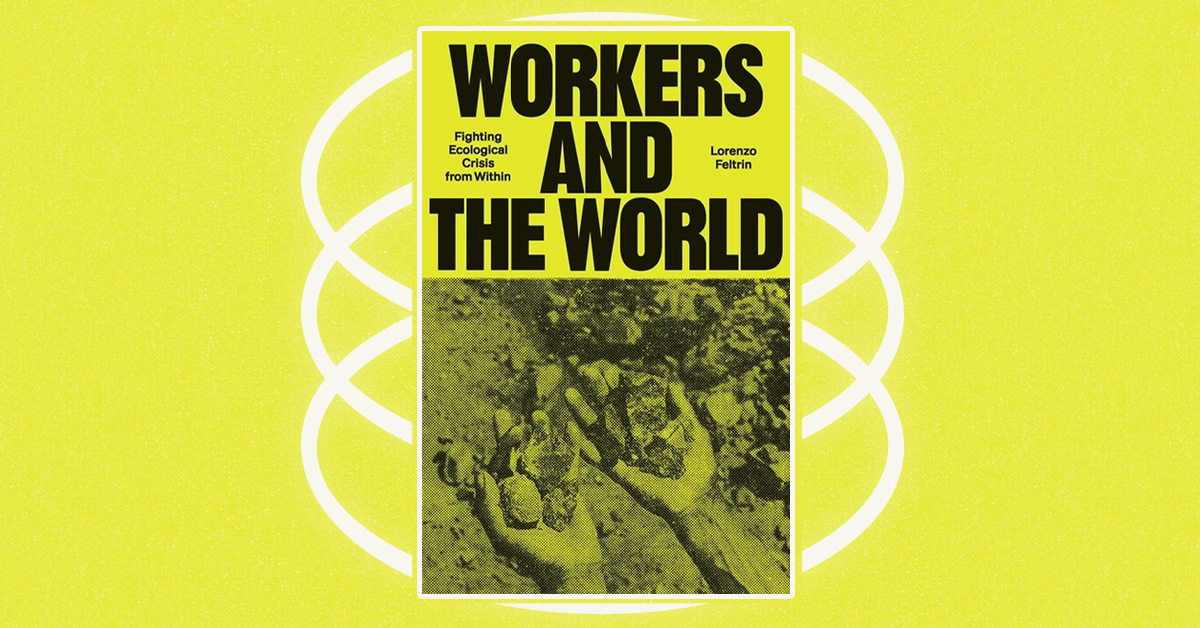
As I worked on this review, I saw headlines about air pollution from growing wildfires, and increasingly dire water quality issues and rising cancer rates in Iowa where I live. I did not see those headlines because I was actively looking for climate news – I wasn’t. In important respects, ‘climate news’ no longer exists as a distinct category; the climate crisis is one of the defining conditions of the world we are in now. Dire weather events no longer feel atypical, because terrible uncertainty has become just part of what our world is. I started doing a mental count of people I know who have expressed worry about climate change and realised the far shorter list would be people I’ve not heard voice such anxiety. We are in, as the subtitle of Lorenzo Feltrin’s important Workers and the World states, an ecological crisis.
The ecological crisis derives from the fact, as ecologically inclined Marxists have demonstrated for a long time now, that capitalism is destructive of non-human nature, of people themselves, and often both simultaneously. Søren Mau summarised some of this literature in his fine book Mute Compulsion by describing nature as having undergone what Marx called real subsumption, meaning, in short, a kind of remaking in capital’s image. At this point, it would not be an exaggeration to say that in encountering the ‘climate’ we are, in fact, in a mediated relationship to capital: heatwaves are reverberations of capitalist social relations across the planet and in our lives. It is deeply urgent that we all come to understand these realities.
That understanding is daunting in part because of the sheer scope of the problems and the amount of information involved. As such, simply for the amount of material about climate harms that it summarises, Workers and the World is an important contribution. The book does far more than simply summarise, however. In a little over two hundred pages, Feltrin conveys a great deal about the dire ecological situation we are in, presents an overview of theory drawn from three relatively distinct corners of Marxism, links them together along with site-specific empirical inquiry, and connects facets of the ecological crisis that the dominant ideology tends to encourage us to think of as separate. What’s more, he provides examples of contestation against capital’s deadly climate-wrecking tendencies, which is important for helping us resist the sense that it’s too late to address the crisis, a sense that is one of the major demobilising ideologies of the present.
In terms of its theoretical basis, Feltrin draws on the traditions of operaismo (sometimes known in English as autonomist Marxism), Marxist criticisms of imperialism, and ecological Marxism. Operaismo in its earlier emergence tended to emphasise the immediate waged point of production. Feltrin pays a good deal of attention to Marxist feminists who further developed this tradition. Those writers theorised the role of unwaged activities and social locations linked in a complex division of labour with waged workplaces, like the household and community. Operaismo has also tended to emphasise the political nature of technology. That is, technology is not solely technical, so to speak, but expresses and reproduces the social relations of the mode of production from which it arises. The tradition also places strong emphasis on the emergence of new figures of class struggle as part of dynamic processes of crisis and conflict over time.
Feltrin works with a variety of ecological Marxisms (the book’s list of works cited is very valuable and will help future researchers) as well as this engagement with operaismo. He doesn’t just look to different corners of Marxism, however. He braids together different traditions that are in a sense external to each other. In doing so, he highlights significant and largely unappreciated ecological aspects of operaismo, namely robust engagement with the systematic production of occupational hazards on the job in industrial work and pollution in the surrounding vicinity, and the challenges people in struggle face in response to those problems. This is closely related to a second element of operaismo, an element often somewhat understated even within the major works of the tradition. Namely, the tradition, for all its tendency to emphasise the immediate waged point of production, situates the wage as a political process that produces and is produced by the whole totality of capitalist social relations. The critique of waged work is fundamentally a critique of the society which imposes waged work and the inhumane textures of that society in all of its facets. Feltrin draws out how this holistic emphasis, by making connections across received conceptual divisions, is especially valuable for thinking about ecology and work hazards.
‘The environment’ or ‘ecology’ is not somewhere out there, away from where people are, but is in an important sense everywhere. Furthermore, the waged workplace is itself part of the environment: occupational hazards, heat waves, and polluted city streets are all different facets of the same phenomenon, namely capital’s destructive effects. Feltrin calls those destructive effects “noxiousness.” Capitalism is a noxious or noxiousness-producing society. Feltrin’s analysis here resonates with work that others have done leaning on Engels’s account of capitalism as having a tendency toward social murder.1 Simply at the grammatical level, having a noun and an adjective – capitalism produces noxiousness; capitalism is a noxious mode of production – is a valuable contribution for making a fundamentally deadly aspect of the system clearly nameable. Being able to speak directly and straightforwardly about systemic realities is incredibly important for political purposes and enriches our theoretical and empirical inquiry as well.
Feltrin develops his account of capitalism as noxious in part through a reading of untranslated writings within operaismo, specifically a far-left milieu in the Porto Marghera industrial district of Venice. This milieu took changing organisational forms and different names over time, the earliest and most well-known being Potere Operaio (Workers’ Power). Feltrin draws out a valuable insight of the operaists on ecological matters. That is, this work helps us to avoid falling into the readily available ideological segmentation wherein we have occupational hazards on the one hand and environmental hazards on the other. As I said, and as Feltrin makes clear, these are both facets of the same fundamental reality of capital conditioning our world. At the same time, Feltrin also makes clear that these facets do differ in real ways: the division between occupational and environmental is not solely ideological but reflects differences in political emphasis rooted in the contradictory character of life in capitalist society.
Part of the horrible reality of capitalism is that workers often need the jobs that poison them and their environment because while that poisoning brings very serious chances of long-term harms, losing a job, and thus access to a paycheck, almost inevitably brings harms. Thus, workers are often inclined, under the weight of immense pressure, to negotiate in one direction – toward preserving jobs and making sure that mitigation of noxiousness does not put them out of a job – while people living near those workplaces and so facing the pollution they cause tend to demand more intense mitigation up to and including closure and job losses. These political differences cannot be simply wished away or resolved through mere rhetoric. They must be worked through in processes of political organisation, constructing a constituency with a shared set of values.
This necessary political working-through occurs in the context of, and sometimes runs aground upon, hierarchies internal to the working class. Feltrin acknowledges this reality and discusses the contributions of operaismo to understanding and addressing it, with the tradition’s emphasis on demands that erode hierarchies within the working class. He also notes this tradition’s limitations, as a tradition largely focused on Europe, which he helps overcome by serious attention to the realities of imperialism. This is creative at the level of theoretical interpretation, as it means Feltrin links operaismo with dependency theory and other accounts of imperialism and the Global North/South divide.
Feltrin does not intervene solely theoretically; he also interrogates various case studies. These case studies serve three important functions. They concretise the theoretical analysis, showing how the big picture account plays out at the scales of individual and community lives in real times and places. They amplify the key points Feltrin stresses about real hierarchies within the working class and the urgency of addressing them practically. Finally, the examples of serious, practical militancy against capital and for a new world strike me as an especially valuable part of the ensemble of contributions this book makes.
Feltrin conducted 120 interviews and documented struggles in four locations, Tunisia, Chile, the United Kingdom, and Italy. In each case – gas workers and copper workers in the first two, and petrochemical workers in both of the latter, and life in the surrounding neighbourhoods in all four cases – Feltrin discusses health and environmental harms that capitalism produces. Feltrin’s approach of looking at cases in both the Global South and Global North lets him explore differences and commonalities and discuss how they are conditioned by respective locations in the global economy. Feltrin stresses that we must be internationalist politically and analytically, which requires understanding how capitalism creates and sustains – or, more simply, just is – a set of interlocking hierarchies distributed across the planet.
One element which should be highlighted is Feltrin’s account of deindustrialisation. He summarises multiple bodies of literature on the topic, noting that the term has more than one meaning, with differences in usage sometimes fostering confusion. Simplifying somewhat for brevity’s sake, deindustrialisation sometimes means ‘less industry’ and other times means ‘less employment in industry.’ Capitalist industry itself is noxious, causing climate and occupational harms, and, as Feltrin discusses, the closure of industry is often noxious in another sense, as unemployment in capitalism involves significant hardships. In some cases, Feltrin stresses, these two realities happen simultaneously: an industrial area will increase production and thus pollution while simultaneously reducing the number of jobs available. The result, then, is a population subject all at once to the harms of unemployment, the harms resulting from close proximity to industrial production, and harms from the larger effects of climate change across our world.
The ecological crisis reverberates today at a pitch and volume such that ecological anxiety is now a core element of many, maybe all, contemporary structures of feeling. The anxiety can work against us when it’s turned into a despair that nothing can be done – after all, we confront the powerful on a playing field massively tilted to their advantage. The despair, in turn, is more effectively produced when climate concerns are directed down pathways which are actually dead ends – we can sort our own recycling and call the offices of our elected representative all we want; the data centre boosters and oil companies will keep stomping the accelerator while steering all of us toward the edge of a cliff. In important respects, ecological despair is both an ideological condition deliberately cultivated by capitalists and their allies, and a situationally reasonable spontaneous reaction to the world we currently live in. This context makes Feltrin’s book, with its mix of analytical clarity about real political obstacles and its empirically grounded and theoretically robust account of more meaningful political action, all the more valuable as a resource for left politics.
Nate Holdren is a Marxist historian. He keeps an occasionally updated and drafty blog with a recurring emphasis on thinking about social murder, and his most recent academic work is an article called “The Work of Forgetting.” He lives in Des Moines, Iowa.
- Among other things, I’m thinking of the analysis in Artie Vierkant and Beatrice Adler-Bolton’s Health Communism and some work that I’ve done, partly in dialogue with Vierkant and Adler-Bolton via their podcast Death Panel. (Artie Vierkant and Beatrice Adler-Bolton, Health Communism (Verso, 2022); Nate Holdren, ‘Social Murder: Capitalism’s Systematic and State-Organized Killing,’ in Marxism and the Capitalist State Towards a New Debate ed. by Rob Hunter, Rafael Khachaturian, Eva Nanopoulos (Palgrave Macmillan 2023), pp. 185-207.) I’m unsure if Feltrin’s emphasis on noxiousness is merely terminologically different from analysis in terms of social murder – such that we can move between the different terms seamlessly – or if there is some conceptual difference here such that dialogue on the matter might be theoretically enriching for those of us trying to develop and popularise an account of capitalism’s lethality. Nodding to my own work here feels unseemly, but I flag the matter here in the hopes that perhaps someone else will have clarifying insights. ↩︎