Introduction
The role of the socialist artist1, like that of any politically committed intellectual, is simple: to serve the movement. Yet, this simplicity is deceptive. Hidden behind that truism is a labyrinth: how does one serve the movement? Politically committed artists, be they socialists or otherwise, do not have the luxury of an ambiguous answer to this question. Their objectives and methods must be derived from clear formulations of who their art is addressing and what it seeks to accomplish; otherwise, their efforts cannot be judged vis-à-vis the ultimate goal: serving the movement. This, of course, does not mean the art itself needs to be stylistically obvious in an immediate sense. Rather, without transparent objectives and methods, the efficacy of politically committed art remains opaque and unmeasured. One cannot determine whether the artists’ work is serving the movement.
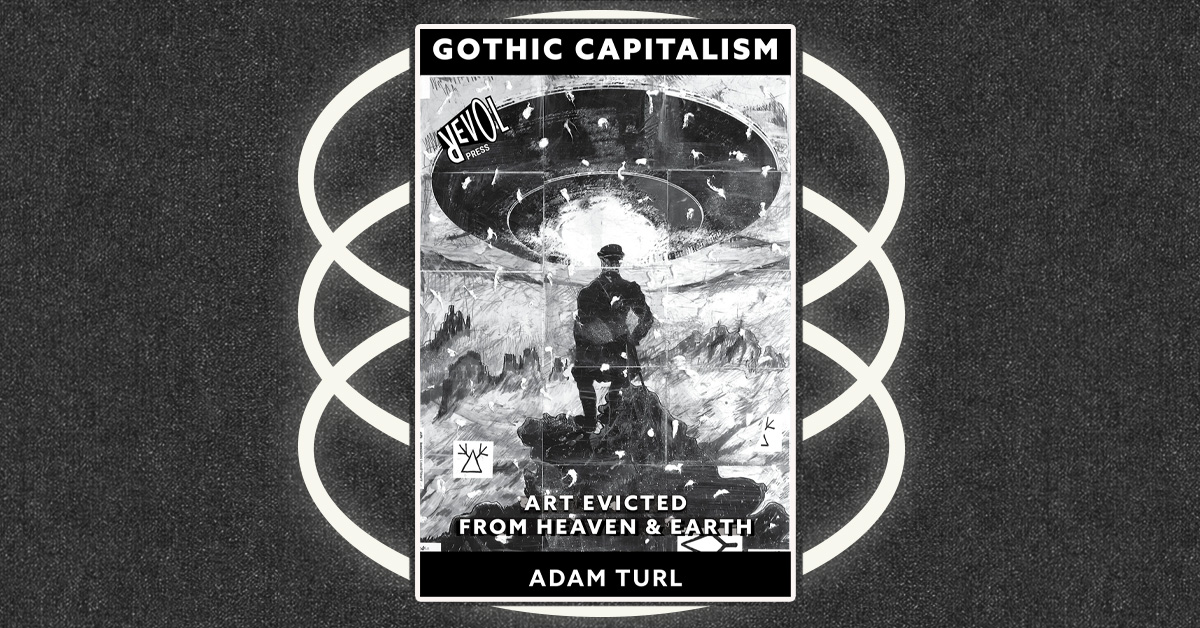
Contemporary socialist art theory suffers from an instinctual aversion to this transparency. Socialist artists and art theorists eschew lucidity in favour of ersatz philosophical rambling, deploying waves of ill-defined, marxisant terminology to describe the always-supposedly new, art-apocalyptic means by which abstract capital is commodifying contemporary art. The best of this literature leaves the reader dazzled by beautiful prose, though no more informed about either socialism or contemporary art. The worst alienates anyone who comes close enough to recognise their parochial pedantry. Socialist artist Adam Turl’s recent work, Gothic Capitalism: Art Evicted From Heaven & Earth, is an archetypal example of the latter.
Gothic Capitalism, which nominally proposes an analysis of contemporary art-making and an aesthetic proposal for politically-committed, socialist artistic activity, is a fundamentally derivative work trapped in an aesthetic cul-de-sac. Its derivative status occurs at two registers. The first register is Turl’s prose, which uncritically reproduces excessive amounts of contemporary art theory jargon, quoting and paraphrasing other art theorists so extensively that it leaves the reader confused as to what is and is not written in Turl’s own voice. The second register is that of Turl’s theoretical orientation. Despite their nominal opposition to Soviet socialist realism, Gothic Capitalism largely reproduces socialist realism’s aesthetic postulates. This seemingly paradoxical aesthetic convergence is perfectly explicable: the aesthetic proposals of Gothic Capitalism are fundamentally romantic. Unbeknownst to Turl, who clearly has not engaged with the ideas they nominally oppose, socialist realism is left-wing romanticism par excellence.
Register I: The Reproduction of Jargon
Gothic Capitalism’s central chapter, “Against The Weak Avant-Garde,” is representative of the book’s derivative quality. In it, Turl argues that contemporary artists produce “weak images.”2 By avoiding the temporal specificity that comes with producing art that engages in aggressive signification, i.e. “strong images,” contemporary artists attempt to create “transtemporal” art; art that can transcend its moment. The paradox of the “weak image,” however, is that it becomes a “tautophrase.”3 Because this art avoids signification, it can make no rhetorical claim on the viewer, effectively rendering it atemporal, its presence a mere “zombie formalism” that, in its quest for transtemporality, finds it can make no temporal claim at all.
These terms accomplish little besides cloaking a straightforward argument in jargon designed to mystify the reader into believing the text is more complex than it seems. Let us put this more simply: Turl claims contemporary artists seek to make lasting art by relying on established forms (“weak images”). This, however, has the opposite effect. By privileging established forms over content, contemporary artists produce art that has no effect at all (“tautophrases”). Although this strategy fails, artists continually attempt to make lasting art using the same means (“zombie formalism”).
The irony of Gothic Capitalism is that it suffers from the same failure for which Turl chastises contemporary art-making: it is a quintessentially weak image of socialist art theory. The above thesis is not Turl’s own, but a word-for-word recapitulation of a well-known argument made by art critic Boris Groys in 2010. “Against The Weak Avant-Garde,” rather than providing an intervention, simply regurgitates the common-sense post-Marxist art theory of the past two decades. Groys is cited, of course, but Turl’s perpetual reliance on quotation and paraphrase makes it virtually impossible, if one does not know the literature in question, to tell what ideas are their own. Indeed, the reader’s immediate experience of Gothic Capitalism is that of a list of ill-defined jargon deployed through these means. Thirty-two of the book’s one hundred and twenty-nine pages feature extended block quotes, and Turl constantly makes use of in-line quotations and paraphrase. Turl even treats their own words in this copy-paste fashion, recycling verbatim sections across chapters numerous times.4
This has a negative, disorienting effect on the reader. Even reviewers have struggled to identify Turl’s ideas in the quotational soup that is Gothic Capitalism. For instance, in her positive review of the book, artist Laura Fair-Schulz unintentionally reveals the extent to which Gothic Capitalism is a massive paraphrase.5 Her review is effectively a list of prefaces, through which she makes constant reference to the other theorists Turl is ‘quoting from,’ ‘drawing on,’ ‘echoing,’ or ‘turning to,’ which, ironically, represents well Gothic Capitalism’s anaemic, paraphrasal style. The extent of Gothic Capitalism’s derivative status is made apparent when Fair-Schulz, clearly confused as to what is and is not actually attributable to Turl, accidentally credits an important reflection on the work of communist dramaturg Bertolt Brecht made by British translator Stanley Mitchell to Turl.6 Indeed, Turl’s reliance on paraphrased jargon borders on the “tautophrasal.”
Register II: The Seductive Quality of an Unwitting Socialist Realism
Turl claims a few original contributions. These represent their nominal intervention into the analysis of contemporary art-making and proposals for socialist artistic activity. Although dressed in the novelty of a twenty-first century art-critical lexicon, these contributions unwittingly reconstruct the standard postulates of socialist realism. If one strips away the contemporary jargon, the jejune anti-formalism of “Against The Weak Avant-Garde” is shockingly similar to socialist realist arguments against modernism. This is quite startling given Turl’s open antipathy to the Soviet Union. But it is unsurprising considering Gothic Capitalism’s reliance on an art-theoretical common sense that remains largely ignorant of socialist realism’s founding texts, to the extent that aesthetic ideas quite like socialist realism are often unwittingly proposed by those claiming to be its opponents.
A particularly revealing example of this is Turl’s discussion of “outsider art,” a term coined in 1972 by art critic Roger Cardinal. Inspired by art brut (“raw art”), an art movement spearheaded in the late 1940s by French artist Jean Dubuffet,7 Cardinal intended the term to be a starting point for a similar movement in the Anglophone world. Originally, art brut and “outsider art” were concerned specifically with bringing the amateur art of prisoners, children, and those suffering from mental illness into a museum and gallery context. Today, however, “outsider art” has become a catch-all term for any art produced outside the established gallery, museum, or educational exhibition circuits, and is often used interchangeably with terms like “folk,” “visionary,” and “naive” art.
According to Turl:
“Outsider art tends to emphasize content… outsider artists engage in world-building. They present a counter-narrative to the world as is… these artists present a totalizing mythology. The art world has been trained to disbelieve such things. This disbelief makes it much easier for the artifacts of the weak avant-garde to be incorporated into the art market and the totalizing mythologies of neoliberal capital. Many outsider artists, by contrast, have a mission. Indeed this is a part of their great appeal in an art world that has been trained by school and conditioned by capitalist realism to be suspicious of larger purposes. Something can be learned from them… the working-class artist should take from so-called outsider art its tendency toward the construction of mythologies. Building myths will focus on the intersection of the subjective individual with collective emancipation…”8
This is Turl’s only lucid aesthetic proposal. Compare it, however, to an important section of Maxim Gorky’s presentation to the 1934 Soviet Writers Congress, a classic text of socialist realism, in which he argued for the positive mythological content of the “folk” arts:
“I again call your attention, comrades, to the fact that folklore, i.e., the unwritten compositions of toiling man, has created the most profound, vivid and artistically perfect types of heroes… since olden times folklore has been in constant and quaint attendance on history. It has its own opinion regarding the actions of Louis XI and Ivan the Terrible and this opinion sharply diverges from the appraisal of history, written by specialists… this same folklore in our days has raised Vladimir Lenin to the level of a mythical hero… myth is invention. To invent means to extract from the sum of a given reality its cardinal idea and embody it in imagery—that is how we got realism. But if to the idea extracted from the given reality we add—completing the idea, by the logic of hypothesis—the desired, the possible, and thus supplement the image, we obtain that romanticism which is at the basis of myth and… it tends to provoke a revolutionary attitude to reality, an attitude that changes the world…”9
The well-known interest in folk revivalism amongst Popular Front Communists was in part an effect of Gorky’s comments, and a concerted turn toward the “mythological,” “folkloric,” and “naive” supposedly found in amateur art was a fundamental part of Popular Front socialist realism in several of the Third International’s constituent parties. The striking similarity between the arguments of Turl and Gorky should be apparent: the authentically mythological character of “outsider art” and “folklore” holds the promise of providing socialist artists with the means to produce an affect that can link “the subjective individual with [the project of] collective emancipation.”
Take another example, however. Earlier in the book, Turl attempts to theorise an artistic practice that can effectively “connect the precarity of the present to the past and future” by “mixing what may be considered weak and strong [images] in an attempt to recover lost meaning – to recast the strong politics and strong images of the past in the context of a weak present.”10 The proposed “strong-weak image” is a:
“..transcendent image… [that] connect[s] our weaknesses to imagined, projected, or historic strengths… [an] image that alternates between weak and strong, like the breathing of a lung. The future does not belong to poor imitations of Malevich, but to men who fly into space from their apartments and women who crawl out of the sea… the transcendent image is a column pointing to heaven with its pedestal covered in excrement…”11
This section of Gothic Capitalism is relatively eloquent. However, it is again an inadvertent reconstruction of a classic socialist realist position, though proposed from the perspective of political powerlessness.
From the very beginning, the architects of socialist realism aggressively advanced a form of ‘muted utopianism,’ in which a dim, but powerful affective sense of utopic futurity was generated in the artistic spectator by mixing the weak image of the capitalist past with the strong image of the Soviet present. Examples of this conception of socialist realism abound, from early articulations to later proclamations. I will provide a few pertinent instances from the writing of Gorky. In his 1933 essay, “On Socialist Realism,” Gorky attempted an initial articulation of this linkage of past, present, and future:
“If the poisonous, grinding baseness of the past is to be revealed and comprehended fully, it is essential to develop the ability to look upon it from the height of the achievements of the present and the noble goals of the future. Such a view from above must and will evoke a… new tone to our literature, aid it to create new forms…”12
At the Congress a year later, Gorky would develop this idea further, arguing that the mythological, utopic character of the folk arts was the result of their successful production of a strong, contemporary image, the classic one being that of the divine:
“God, in the conception of primitive man, was not an abstract concept, a fantastic being, but a real personage, armed with some implement of labour, master of some trade, a teacher and fellow-worker of men. God was the artistic generalization of the achievements of labour, and the ‘religious’ thought of the toiling masses should be placed in quotation marks, since it represented a purely artistic creativeness. In idealizing the abilities of men, and having, as it were, a premonition of their mighty future development, mythology was, fundamentally speaking, realistic.”13
For Gorky, the mythological produces a strong image of the present that, through its practical idealism, grapples with the weak image of the past. The alternating struggle between strong-present-image and weak-past-image produces the muted, but discernible outline of a utopic future.14 Turl proposes the same idea but reversed. In their version, the past is strong and the present weak. Herein lies the only difference between the aesthetic position of the socialist realists and that of Turl. The socialist realists lived in a strong present, and Turl does not. They had political power to wield, and Turl has none.
“Wait, It’s All Romanticism?” “Always Has Been.”
I am not a partisan of socialist realism, which I believe largely failed to produce a dynamic socialist aesthetic. This failure was a result of its own status as a “weak image” of left-wing romanticism, an image mobilised against the tactical instrumentalism that had defined Soviet agitational propaganda in the 1920s. Indeed, socialist realism was an aesthetic retreat, since romanticism was part and parcel of socialist artistic practice long before the proclamation of an “official aesthetic” by Soviet cultural bureaucrats.15 Socialist realism’s version of left-wing romanticism was steroidal, but fundamentally vague, and remained characterised by romanticism’s typical aesthetic preoccupations, in particular its resistance to the sedimentation of content into form through expression,16 as well as its fixation on the fetishised representational power of art.17 Like the socialist realists, Turl’s aesthetic remains fundamentally committed to these ideas.
Political theorist Jordy Cummings made this explicit in his positive review of Gothic Capitalism in the Locust Review.18 Fundamental to Cummings’ defence of Turl is an appeal to the work of Walter Benjamin, specifically his notion of the aura. Cummings claims that Benjamin’s concept of the aura is:
“…that which remains after commodification. The entire theme of this work is how maintenance of aura, of affective contagion, is far more of a clear cultural focus than simply ‘having the right politics.’ That special quality embedded in the best cultural production that we cannot simply say has been subsumed, and in a sense, is unsubsumable, inalienable.”
Cummings is correct that this way of mobilising Benjamin is at the root of Turl’s approach. Since 2015, Turl has argued for a socialist romantic aesthetic by appealing to the aura’s “resilien[ce] to shifting contexts.” This is nothing other than a return to a fetishised notion of art as, in the words of Cummings, “special… unsubsumable, [and] inalienable.”
There is a significant problem with this use of Benjamin’s concept, however. Although Benjamin’s prose can be somewhat ambiguous, on the concept of the aura, he is explicit. It is not an “inalienable” quality of art “which remains after commodification,” but a form of cultic, ritual fetishisation of art objects. In other words, it is a particular way of valuing art. Far from believing the aura to be “unsubsumable,” Benjamin claimed the aura was largely destroyed in the early twentieth century. Commodification was a necessary but insufficient condition of this process, which was only fully accomplished by the development of specific, technological means of audiovisual reproduction.
For Benjamin, the destruction of the aura was progressive, for it “brush[ed] aside many outmoded concepts, such as creativity and genius, eternal value and mystery-concepts whose uncontrolled… application would lead to a processing of data in the Fascist sense.”19 The concrete process of aura-destruction is the qualitative cheapening of art that results from the expanding quantitative capabilities of the technology of artistic reproduction. This cheapening makes art newly available for the kinds of politically strategic instrumentalisations Benjamin was attempting to theorise, such as those pursued in the “epic theatre” of Piscator and Brecht.20
If we reverse this argument to valorise the aura as an inalienable quality of art or seek to reintroduce it as a positive category, the whole thrust of Benjamin’s argument collapses. In particular, jettisoning this from Benjamin’s theory of aura renders meaningless his famous analysis of fascism as an “aestheticization of politics,”21 since the argument runs that fascism was an attempt to maintain the fetish of the aura through a rapid massification.
Though not explicitly intended as such, the Situationist theory of the “spectacle” is quite clearly a reckoning with this process of massifying aura. For Guy Debord, Asger Jorn, and others in the Situationist International, the “tendency of use value to fall”22 as a result of a prolonged crisis of mid-century metropolitan overproduction cheapened not just art, but all commodities,23 necessitating massive capital intervention into the subjectivity of workers that transformed them into pathologically chronic overconsumers.24 The aesthetic strategy of détournement, that being the construction of “situations” by means of appropriating devalued art, was an embrace of this cheapening contra the auratic capabilities of the spectacle.25 By accepting art’s depreciation and exploring the consequent aesthetic possibilities, both Benjamin and the Situationists took firm stances against the romanticism typical of socialist artistic activity.26
The point, however, is that Turl claims in Gothic Capitalism to be transcending a common sense they are in fact reproducing. They butcher Benjamin’s theory of the aura in the service of a romanticism that is fundamentally the same as that of socialist realism. In the end, Turl provides us with a series of empty romantic truisms, well-worn by over a century of use.
Whither Socialist Art Theory?
Gothic Capitalism is representative of the miasmic state of socialist writing on art, in which tired theories of aesthetic representation are substituted for theories of artistic activity. Endless handwringing over content, form, and art’s supposedly special representational power prevents meaningful discussion of its immediate social function. Art historian Patricia Manos’ recent mixed review of Gothic Capitalism focused specifically on this issue.
Much of Manos’ critique overlaps with my own, especially our shared concern with Turl’s allergy to transparency regarding how best to engage in politically committed artistic activity and the necessity of such transparency to politico-artistic success. Although Manos readily acknowledges Turl’s unique position and expertise to write a work of socialist art theory, she argues that Gothic Capitalism fails to provide. Manos’ demand for transparency reflects a common desire for something useful to socialist artists searching for a means to successfully engage in politically-committed activity, and Gothic Capitalism’s lack of any theory of practical activity is its primary shortcoming. While Turl’s own artistic output is impressive, their desire to theorise a new art movement does not include a serious elucidation of how they and their colleagues have successfully organised themselves as politically-committed socialist artists. For Manos, any attempt to theorise an art movement that leaves these questions unaddressed runs the risk of becoming a vanity project.
The consistent presence of the problematics of romanticism in socialist art theory has, in my opinion, been, at the root, a means of avoiding these questions. It is a cul-de-sac within which artists can continually cover the same ground without having to answer to the movement they are nominally committed to.
However, there are answers if one is willing to give attention to those artists who have abandoned the abstract problematics of romanticism in favour of practical activity. For example, the JustSeeds Artists’ Cooperative is one such group that can provide a useful foil against which to compare Gothic Capitalism. Originally founded in 1998 by anarchist graphic designer Josh MacPhee, over the past two decades JustSeeds has grown into one of the most dynamic, politically committed, left-wing artist organisations in the world.
Much of this success can be traced to the founding members’ commitment to transparency and their willingness to ask themselves simple, but difficult questions regarding their artistic objectives and methods. For instance, in 2007, following JustSeeds transformation into a fully functioning artists’ cooperative, MacPhee and JustSeeds co-founder Erik Ruin co-edited a collection of pieces on anarchist art theory titled Realizing The Impossible: Art Against Authority. Their co-written introduction engaged with some of the same issues as Turl, specifically “the dichotomy between pure aesthetics, unmoored from a societal context, and purely utilitarian art.”27 But where Turl becomes enamoured with romantic cobwebs, MacPhee and Ruin attack the problem head-on by centring “a concern with [artistic] efficacy.”28 This cuts through the dichotomy by returning to the fundamental questions that guide the activity of politically-committed artists:
“Although our art might be rooted in an attempt to achieve some sort of liberated self-expression, as artists we also create in order to communicate. It is not surprising, however, that we have little sense of the influence of anarchist art, since there is hardly any discussion about art within anarchist and anti-authoritarian circles (or any Left political circles beyond Marxist academia, for that matter). We want to interrogate this here: What is the impact? Who is the audience? What are anarchist artists trying to say, to whom, and why?” [emphasis mine]29
JustSeeds members’ recognition of the complexity hidden behind the simple interrogatives of ‘what, whom, and why’ has led them to develop an incredibly dynamic political practice. Both the Interference Archive, an NYC-based archive of social movement culture, and Common Notions Press, a left-wing publisher run out of the Archive’s space, are outgrowths of JustSeeds’ activity. These organisations oversee a wealth of politically committed, public-facing arts and culture education in the form of numerous regular workshops, exhibitions, conferences, and publications, all of which are organised in close contact with left-wing activity on the ground.
Given this practical dynamism, it is unsurprising that the theory of JustSeeds artists, especially that of MacPhee, who writes prolifically, is far more developed than anything found in Gothic Capitalism. Though he remains anarchistic in orientation, MacPhee has drifted away from his early, more sectarian aesthetic rhetoric and toward a subtle, synthetic theory of art as an activity of “social enactment.”30 In other words, MacPhee prioritises the social function of art-creation and art-consumption as activities that can concretely connect people. The representational powers of art are subordinate to this objective: creating sociality through art. This orientation is clearly derived from JustSeeds’ success at laying the initial groundwork for a democratic socialist arts movement suited to the current moment. Turl’s aesthetic theory, focused as it is on returning a representational aura to the artistic experience, has little space for the kind of instrumentalisation of art that JustSeeds pursues in the service of social enactment.
This is not to say that JustSeeds represents an apotheosis of socialist artistic practice, but the Cooperative’s transparency and readiness to answer the fundamental questions of politically-committed art-making have resulted in a foundation from which a meaningful socialist arts movement can be built. This foundation should be critiqued, but such a critique, one based on transparency of objectives and methods, can only be positive. Gothic Capitalism, however, provides us with nothing to critique; its “theory” is a weak image of a socialist shibboleth fit only for dismissal.
- By “socialist artist,” I simply mean an artist who links their artistic work to their political commitment to the socialist movement. ↩︎
- Adam Turl, Gothic Capitalism: Art Evicted From Heaven & Earth (Revol Press, 2025), p. 38. ↩︎
- Ibid, p. 36. ↩︎
- For the sections of text that are reproduced verbatim in multiple chapters, see: Ibid, 7-8, 17, 19, 46, 48, 84-85, 94. ↩︎
- It is worth pointing out that Fair-Schulz, as a member of the Locust Review is a professional connection of Turl is also a member of the Locust Review. See: https://www.locustreview.com/about-lalc-1. ↩︎
- See: “In a dialectical fashion, Turl sets the stage to illustrate how art must creatively rally our mutual energies rather than providing a mere recipe book for revolutionary agitprop. They finish with the thoroughly Marxist sentiment: ‘only the working-class can save us,’ mentioning that the ‘pessimism of [Bertolt Brecht, Antonio Gramsci, and Walter Benjamin] was strategic, designed to engender hope…for the survival of the species as such.’” ↩︎
- Roger Cardinal, Outsider Art (Praeger Publishers), 24-34. ↩︎
- Turl, Gothic Capitalism, pp. 109-110. ↩︎
- Maxim Gorky, “Soviet Literature,” in Soviet Writers’ Congress 1934, p.35 & pp. 43-44. ↩︎
- Turl, Gothic Capitalism, p. 47. ↩︎
- Ibid., pp. 47-49 ↩︎
- Maxim Gorky, “On Socialist Realism,” in Socialist Realism in Literature and Art, ed. M. Parkhomenko and A. Myasnikov (Progress Publishers, 1971), p. 39. ↩︎
- Gorky, “Soviet Literature,” in Soviet Writers’ Congress, p. 30. ↩︎
- Gorky was not alone in his theorization of socialist realism art as a ‘muted utopianism’ resulting from the linking of a strong image of the present with a weak image of the past. Similar articulations can be found throughout the literature. See: Anatoly Lunacharsky, “On Socialist Realism,” in Socialist Realism in Literature and Art, p. 58; Zhdanov, “Soviet Literature: The Richest In Ideas, The Most Advanced Literature,” Soviet Writers Congress 1934, p. 22; Bukharin, Poetry, Poetics and the Problems of Poetry in the U.S.S.R, pp. 253-254. ↩︎
- For an informative work on the fundamentally romantic aesthetics of socialist artistic activity prior to the First World War, see: Stefan Arvidsson, The Style and Mythology of Socialism: Socialist Idealism, 1871–1914 (Routledge, 2018). ↩︎
- Regarding expression, Bukharin makes clear its indispensability when he posits the dynamic “revolutionary romanticism” of socialist realism against the normal tendency of literary “structural principles [to] become a ‘congealed’ method.” See: Bukharin, Poetry, Poetics and the Problems of Poetry in the U.S.S.R. p. 249, p. 255; the origin of socialist realism’s fixation on the contemporary, as demonstrated by socialist realist literature’s tendency toward roman à clef, is largely derived from the mistaken romantic idea that by engaging solely with immediate experience, presumed to also be immediately, experientially multiplicitous, one could avoid the problem of form altogether. Indeed, literature considered archetypically socialist realist is often either explicitly autobiographical or lightly fictionalized accounts (i.e. roman à clef) of an author’s own experience. For instance, Soviet author Nikolai Ostrovsky’s 1935 How the Steel Was Tempered, considered a classic socialist realist novel, is a thinly veiled account of the author’s early life. This was the case for socialist realist literature both in the Soviet Union and internationally. Of course, for the architects of socialist realism, a focus on the immediate did not preclude the possibility of a broader, world-historic viewpoint, since “within the microcosm of the word is embedded the macrocosm of history.” The issue was not the possibility of such an approach, but how to do it well. See: Bukharin, p. 195. ↩︎
- Of course, Gorky’s above comments on the positive aesthetic value of religious thinking reveal how this fetishization was important to socialist realism. For Gorky, the role of art was its power to represent something. This language is repeated regularly in the literature. As Zhdanov claimed, the purpose of art was to “portray our heroes… [and] glimpse our tomorrow.” The paradox represented by necessitating art be both infinitely expressive and immediately representative should be apparent. Indeed, how does one represent anything without form? See: Zhdanov, “Soviet Literature: The Richest in Ideas, the Most Advanced Literature,” in Soviet Writers Congress 1934, p. 22. ↩︎
- It is worth noting that, like Fair-Schulz, Cummings is a professional connection of Turl, having been involved in Red Wedge magazine. ↩︎
- Walter Benjamin, “The Work of Art in the Age of Mechanical Reproduction,” in Illuminations: Essays and Reflections (Schocken Books, 2007 [1969]), p. 218. ↩︎
- For more on the role that “epic theatre” played in the development of Benjamin’s mature aesthetic theory, see: Erdmut Wizisla, “IV: Benjamin on Brecht,” in Walter Benjamin and Bertolt Brecht: The Story of a Friendship (Yale University Press, 2009), pp. 98-143. ↩︎
- Benjamin, “The Work of Art in the Age of Mechanical Reproduction,” p. 241. ↩︎
- Guy Debord, The Society of the Spectacle (Black & Red, 1970), p. 47. ↩︎
- Editorial, “Détournement as Negation and Prelude,” Situationist International Anthology, ed. Ken Knabb (Bureau of Public Secrets, 2006), pp. 67-68. ↩︎
- As Debord states, taken in the most “limited sense,” the spectacle refers to the massive advertising industry made possible by the technical development of the “means of communication.” See: Debord, The Society of the Spectacle, p. 24. ↩︎
- Guy Debord and Gil J. Wolman, “A Users Guide To Détournement,” Situationist International Anthology, pp. 14-21. ↩︎
- It should be noted that in the post-1962 “political” period, Situationist theory, particularly under the influence of Raoul Vaneigem, returned to certain tropes of romanticism. ↩︎
- Josh MacPhee and Erik Reuland, “Introduction: Towards Anarchist Art Theories,” in Realizing The Impossible: Art Against Authority (AK Press, 2007), p. 3. ↩︎
- Ibid ↩︎
- Ibid ↩︎
- Josh MacPhee, “Introduction,” in Graphic Liberation: Image Making & Political Movements (Common Notions Press, 2024), pp. 9-21. ↩︎