I
The question of whether contemporary far right movements either are or are heading in the direction of fascism is one which frustrates theoretical analysis. We often agree on the object of analysis–the novel far right movements of the 21st century, epitomised in the anglosphere by Trump in the US and parties such as Reform in the UK–but the diagnosis of fascism nonetheless remains riddled with historical and conceptual ambiguities. As David Renton noted in a recent piece for Spectre, this ambiguity is often the symptom of an overreliance on taxonomy as a substitute for a political explanation of the current conjuncture.1 What I aim to argue here is that the failure of taxonomy, the ‘is it fascism’ question, is exacerbated by the conditions under which the new authoritarian and militant right have emerged. The ambiguity does not simply reside in our way of knowing these forces as objects of study, but is constitutive of their existence both as movements and as a genre of political communication. As I will show, this dialectical investigation will demonstrate the following: those conditions which proliferate the ideology of fascism today and institutions which pursue its ends simultaneously frustrate its re-emergence.
The relation that the ascendant political right has to its own ‘mass’ base is ambiguous when it comes to the kinds of mass activity which were previously channelled and intensified by fascist organisations. Take activities such as pogroms, the clothing of entire areas in racist or nationalist signifiers (explicit or barely implicit, as in the case of the ‘raise the colours’ campaign), and the implementation of ultra-nationalist policies and establishment of paramilitary units such as ICE. These acts can and are currently occurring in the absence of a mass base who are organised towards this end through traditional vehicles such as a new Sturmabteilung attached to a fascist party. Even Nigel Farage, as one of the most successful political leaders on the contemporary far right, has no interest in appropriating the mass base of figures such as Tommy Robinson, and the explicitly fascist element of the movement has been essentially externalised into the much smaller Restore Party. This essay contends that the ambiguity of the term fascism is symptomatic of the conditions under which masses of individuals can be organised under the historical conditions of neoliberalism, which in its ascendancy from the defeat of the labour movement actively organises society against such militant forms of mass social organisation.
When it comes to militancy on the far right today and even from openly fascist political forces, I argue that it operates with more compact organisational forms even if the activity is to be adopted at a wider level of social participation. Small groups erect flags or put out general briefs for racist activity in campaigns based around an open form of participation rather than being restricted to organisational members or party cadres. There is an invitation to act rather than an invitation to join an organisation which would co-ordinate these actions via their own political discipline and internal policy. Such activities are mediated by legacy media such as newspapers and television as much as by social media platforms (which often allow for the rapid dissemination of messages from legacy media without requiring one to tune in or purchase a paper copy). In the case of anti-migrant violence in the UK, in which we now see a regular summer occurrence of racist and fascist unrest, lists of hotels where migrants are being housed have been circulated like menus of potential targets. These acts of publication and circulation are predominantly stochastic–being incited from within civil society such that they become increasingly likely to happen–or are directed by the state itself through existing organisational apparatuses such as ICE in the USA. When such movements align with or feel represented by the forces in charge of the state (something which, despite the best attempts of the Labour Party to present a ‘social’ version of the vision of the far right, has not won them over), they tend to supplement state power or dissolve themselves into it rather than forming mass organisations antagonistic to state institutions under ‘their’ control. For example, in Trump’s America, when considering fascist or proto-fascist paramilitary organisations such as the Proud Boys and the Oath Keepers, we should note that they have not been successful in expanding themselves into a mass organisation, and instead have often partially liquidated themselves into the state via integration into ICE. Parliamentary political parties such as the Republican Party and Reform UK (including its side project, Restore) constantly signal a barely implicit rightist politics which skirts yet eludes a point at which we can point at them and say ‘yes, this is the repetition of fascism!’
This ambiguity is not simply the consequence of a failed set of analytical tools, applied to fascism as an abstract definition, but is rooted in the history of the object itself and the social and economic factors which could condition its reemergence. These factors condition the possibility of a mass base which could be mobilised by a recurrence of fascism as a new conservative revolution. Or rather, as I will argue, they are preventing its formation, leading to a fascism which is incomplete and ambiguous, unable to match our analytic categories; both easy to recognise and impossible to confirm.
This is not to say that such forces do not mobilise sections of society en masse. The forces of the enemy mobilise a political subject, but not in a history of their choosing. The specific historical character of those mobilised by such ambiguous fascism(s) is determined by their specific social and economic context in the time at which they are being mobilised.
II
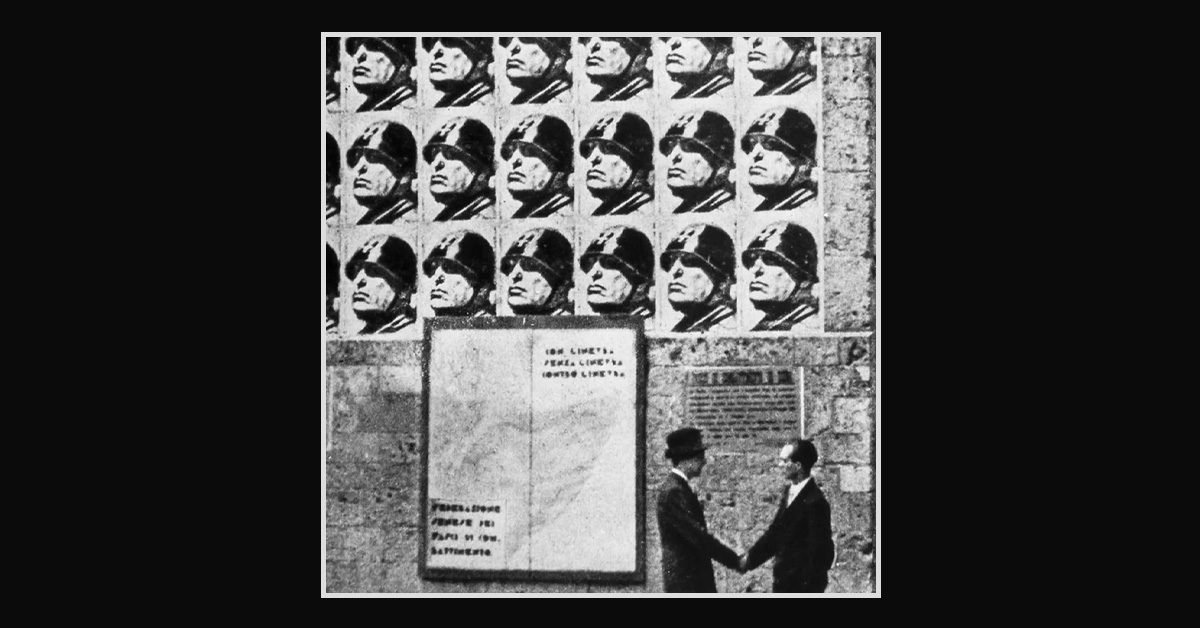
Previous iterations of fascism inherited their political subjects from the contradiction which they aimed to supersede through the medium of race and nation. That is, they attempted to subvert the antagonism between capital and labour, or between the subject of social life as owner and as worker. This conflict was mediated through the ideological and libidinal contours of the race-nation. Political competition between capital and labour became reterritorialised onto the world stage in the form of a competition between other race-nations (enemies without) and against racialised enemies within (who are also presented as hostile to the nation and therefore outside of it) in their supposed common ground of blood and soil. The mass of society was already stratified by divisions of racialisation, gender, and ableist normativity by which the labour values of segments of the working class were not only devalued, but were also rendered both internally competitive as well as subservient to each other within the racialised labour market and the patriarchal household respectively. It is these divisions which were intensified and raised to the level of a political essence, of a nature of the Volk, by fascism. Whilst politically independent trade unions were banned under the Nazi regime, the importance of the worker as a subject was nonetheless seen as essential to Nazi political organisation. Hence the formation of the German Labour Front and the Strength through Joy programs, which aimed to organise workers as workers mediated through a racial-national vision.
Classical fascism displaces the collectivity of the political subject articulated in the capital-labour antagonism as the ‘worker’ taking part in a larger social whole. As Mussolini articulated this in a speech of 1926:
“We have constituted a Corporative and Fascist state, the state of national society, a State which concentrates, controls, harmonizes and tempers the interests of all social classes, which are thereby protected in equal measure.”2
The problem for fascism today is that it does not seek to establish itself in a time in which this collectivity can be displaced, because the working classes have not been able to develop into a political subject as an active and transformative force in society, at least not to the same extent as those eras in which fascism previously arose. Traditional fascism lacks the raw materials for its own production, and as a political force, it exists as ambiguous today because it has not inherited such a subject. Fascism is a parody of itself; it haunts neoliberalism and seeks to possess it as that system which vanquished its most potent fuel and deadly foe–the organised masses of the oppressed.
III
The inheritance of the post-Fordist or neoliberal model of capitalism in the West is a political subject summoned to itself after decades of class compromise and national welfarism at the same time as this previous compact is being dissolved. Post-War Social Democracy or social welfarism formally made the working class of a nation a stakeholder in the future stock of care, education, and return on the social investment of taxation. At the same time, this compromise between opposing class forces refused to abolish the root of working class destitution, and displaced the dispute between worker and capital into a dispute between shareholders in the same project. Both worker and boss came to the table in the appearance of equal partners (if you want a picture of this ideology, the 2012 Olympic Opening Ceremony is an excellent example). As Jonas Marvin elaborates in his recent work The Breaking of the English Working Class, “the decomposition of the politically and culturally militant class agent which challenged the system through the late nineteenth and early twentieth centuries was the condition of possibility for this new social-democratic class subject.”3 Yet given the impoverishment of the former’s worker-stakeholder position as opposed to that of the owner-stakeholder, and the national occlusion of the fact that it was only class struggle which forced bosses to the table in the first place, the latter pole of the dialectic gained the upper hand.
In believing that national enterprise and national welfare were the same, the imagined bourgeois ground of welfarist societies, the liberal ‘social contract’ became a business deal. Where elements of the bourgeoisie had previously been able to buy large sections of the working class out of the enterprise of militancy, instead the neoliberal turn led to the buying-out of fractions of the working class as workers, or as workers for-themselves. Turning again to Marvin: “For the first time, on a mass scale, proletarians became working-class propertarians, having something to lose other than their chains.”4 It was on this basis that they have become shattered and recomposed.
Consequently, sections of the working class were taken up into deregulated industries less constrained by organised working class power, into managerial roles within these, and into markets such as housing and stocks. They were integrated into these new tertiary economies and into the sphere of property in exchange for the intensifying liquidation of their fixed capital in the national enterprise—regional industrial economies, social housing, public services such as healthcare, etc. In the name of national enterprise, workers are summoned not as subjects who produce this socialised body of national capital but are called forth according to the activity through which the capitalists themselves relate to the institutions of the welfare state. For capital, this is liquidation and recirculation. The working class was subsequently divided into the beneficiaries and victims of this dissolution. What unified them under neoliberalism was the political construction of their subjectivity as something other than being a worker-stakeholder.
In either being made destitute or empowered into a post-proletarian petty bourgeois identity, what remains is the stakeholder component, expressed in conjunction with the identity of the subject as a consumer. The consumer purchases what is recommodified through welfarism’s dissolution by capitalist forces, in part making such a purchase through the liquidity produced by this dissolution. The proliferation of consumer goods, including the commodification of social housing, increased the purchasing power of a fraction of the working class, allowing for parts of the working class to even achieve the ownership of property and other financial assets. Even where this increase was not universally distributed, a consumer nonetheless has a libidinal stake in the continuation of consumption even if this is not expressed in fixed financial assets or property. This is because consumption becomes increased in the poorest parts of the class (because poverty is expensive) at the same time as certain forms of consumption themselves can be sold as an aspirational standard of living (a standard of luxury) to be achieved through aspects of conspicuous consumption (signalling social status). Consumption becomes necessary for the circulation of capital through trends in consumer goods and the proliferation and creation of new markets from the desire of consumers in proportion to the defeat and devaluation of labour (and indeed, its displacement to the relatively cheaper labour pools of the Global South). To this extent Baudrillard is entirely correct when he posits that “consumption is social labour. The consumer is required and mobilized as worker at this level too (perhaps as much today as he is at the level of ‘production’).”5
As Kian Aspinall and John Duncan have highlighted in their research on the development of new fascisms from neoliberalism, this decline in the political subjectivity of the worker leads to their identification as a consumer-stakeholder in the national, and therefore imperial, project, which is stratified according to axes of exploitation on which traditional articulations of the worker as a political subject, especially in Western nations, were historically weak. Hence, after the defeat and fragmentation of the worker’s movement into precarious individuals by ascendant forces such as Thatcherism and Reaganism, they were “reabsorbed as consumers of commodities produced by racialized, super-exploited labour, and of services provided by gendered and often racialized reproductive labour.”6
The preservation of this position and the political hegemony of the capital-pole of capitalist social relations requires that the conditions of consumption be reproduced and extended, especially in times of economic crisis, and in a politically reactionary relation to new movements which set themselves against the regimes of gender and racialisation. Consumerism replicates the antagonism between labour and capital in its racialised and gendered modes within the identity of the consumer. Neoliberalism treats the consumer economy as a national asset and consumption itself as a national institution under threat by subversive forces. As Aspinall and Duncan summarise, this allows the organisation of society around consumption to achieve the national mediation of class antagonisms in the manner previously achieved by fascism, in a political settlement where “class relations of society are here obscured as a vestige of the past, holding back one singular national project, while a glorious future is dependent on an invisibilisation of national class antagonisms. We are not segments of labour with conflicting interests, but a collection of consumer entrepreneurs dependent on a racialized imperial division of (re)production.”7
IV
First Hypothesis: Today’s ambiguous fascisms exist in such an ambiguity because the political subject which such forces mobilise is that of a consumer-stakeholder. Where fascism cannot cannibalise class consciousness, it must cannibalise consumer consciousness.
The society which defines its subject as a consumer of national capital has already won a great battle in the name of anti-communism and against the proliferation of class struggle, especially within its own national political territory. As such, neoliberalism can achieve the anti-communist, anti-worker ends of fascism through its own techniques.
Capital as of late is more than capable of liquidating enough of the welfare state to reduce racialised communities’ abilities to socially reproduce themselves, to force them economically into further destitution and to distribute the illegalism of modern slavery, to cause mass death of the disabled through austerity measures. Neoliberalism does not require fascism anymore to redistribute social murder rates in more eugenic, racist, or authoritarian directions.
Further, as we saw in the case of the miners in the UK, capitalist economies under neoliberalism remain able–but most importantly are willing–to dissolve entire industrial sectors to reshape society according to a new subject, a new anthropological vision; and towards a society in which labour’s leverage is displaced overseas to more authoritarian regimes down the value chain. Not only this, neoliberal regimes have been successful in doing so, and so feel emboldened to return to these tactics (as we may be seeing in the accelerating dissolution of higher education). As Thatcher once put it, economics is the means to changing the soul. If the soul is mediated entirely by economics, then its life and death belong to capital. Consigning the ‘unfit’, dissident, potentially anti-national aspects of the national body to destitution is something the fascisti only could’ve dreamed of happening amidst such pretences of ‘peacetime’ governance. What is terrifying is that fascism as a process might not need to resolve itself into a fascist state to achieve its ends.
V
Second Hypothesis: The ambiguous fascisms of today call upon a subject determined by its consumer-stakeholder status, mediated through the consumption of commodities where consumption has become increasingly abstracted into that of commodified signs, an activity engaged in by the vast majority of society today. They summon a subject increasingly mediated by the consumption of media objects. The primary medium through which this occurs is the internet in its integration into everyday activities of subject-formation.
Insofar as the internet is a medium overdetermined by the capitalist mode of production, the distribution of signs occurs via capitalised zones of the production of digital commodities, data, and content, which are called platforms. Platforms are productive enterprises and are themselves private property at the same time as they provide zones for smaller capitalist operations to occur.
One can be a consumer-stakeholder (a passive consumer of content from the site of one’s own account), a consumer-owner (in the case of Elon Musk) and a consumer-proprietor in the sense of an artisanal ‘small business’ of content production and circulation. One can be petit-bourgeois, an imprint on a platform as a site of publication and hence the production of online commodities in general. One can be a proletarian, but never on the terms of the platform, only on its underside in the highly precarious and underpaid labour of data and content moderation. The internet is a medium, but only insofar as it is always immediately mediated by capitalist social relations; the medium is the message and the message is the same as before. What the internet—or as Tiziana Terranova calls it, the Corporate-Platform Complex—achieves today is the expansion of capital accumulation even further into the realm of signs and their circulation.8
VI
Third Hypothesis: The internet, as a Corporate-Platform Complex, perpetuates radicalisation and mobilisation, but does not foster political organisation en masse beyond mobilising radicalised peoples as consumers of the content of their radicalisation.
The Corporate-Platform Complex, as a medium of the mass consumption of signs, is better at establishing and intensifying consumptive habits (your information flow is presented to you in the form of a ‘feed’) and mobilising people as consumers than it is at organising them.9
Here I must clarify, one does become an ‘organ’ of a sort when one is mobilised by media consumption, but primarily a reproductive organ of a minimal kind: you reproduce the signs, recirculate them, repeat them across different modes of social activity, and even financially contribute to the reproduction of where they are produced through subscription and patronage. In this sense, one is included under the colloquial term ‘fan’ or ‘follower’, in exchange for the enjoyment and satisfaction of media, one becomes part of its reproductive organs.10 When something ‘goes viral’, it organises its consumers into bearing its meaning and reproducing it as we repeat this meaning in communication with others in a given medium.11
But reproducing the commodified sign is not the same as reproducing what it signifies. In the mass consumerism of signs—and here we have to sadly hand it to Baudrillard once again—what the sign refers to is often little more than itself and its production as a sign to be consumed and recirculated.
As a consequence, one can consume these signs and be mobilised into the street to repeat them without being mobilised towards enacting or participating in what these signs signify. After all, not every Beatles fan forms a tribute band even if the endurance of Beatlemania definitely makes their occurrence more likely. Not every Arsenal fan is in an organised fan club; even fewer join the team. Fans are consumers, and in producing acts of consumption as acts of exchange, the consumers are themselves consumed by that which constitutes them as fans. Consumers, especially as fans, bear the exchange value of a reproductive expenditure—of time, money, circulation of the sign, production of the signs as indicative of their origin, which inspires such fanaticism.
With the digitisation and mass online proliferation of a whole history of fascist signs—or signs which call for a political order to enact racial, national, and militaristic policies for which a fascist state historically would’ve been suited—fascism can be consumed by a mass body of consumers without their enthusiastic adoption of these signs (in which they have a stake, as ‘fans’) manifesting in a separate political organisation.
The detachment of fascist signs and their consumption from their own history presents the history of fascism with its own absorption into simulation—fascist signs as copies of copies (simulacra) of historical tropes which are divorced from their original political milieu because they circulated in an economy designed to dissolve mass political organisation rather than facilitate it. This is what I call Simulacral Fascism.
Fascism’s petty bourgeois character is in tension with neoliberalism’s capitalisation upon everything, in that fascism is more profitable for many of its most enthusiastic fans as a business of content within the existing social order than it is in the transformation thereof. Fascism is good for business as a simulacrum and yet bad for business as a state formation. We can see this clearly in the split between content creators who peddle racist, far right, or fascist content for the sake of their own enrichment (a mobilisation of consumer-stakeholder fandom), versus those who seek to use the medium to draw not simply followers, but recruits. Daniel Katz has shown this dynamic developing in the dispute between more ‘classical’ fascists—those often tied to older forms of organisation seeking to form a mass base, the BUF, C18, the National Front etc.—and the subculture of ‘auditors’ and political entrepreneurs aiming to promote such actions as vehicle for content production (which often leads to experienced cadre members and new recruits alike getting swiftly arrested).12 The latter’s actions can grow the consumer base of the movement but threaten to dissolve its solidity into the unceasing circulation and proliferation of digital commodities–they are more interested in clicks than cadreising a new vanguard for a mass fascist movement. For classical fascists, the libidinal economy of racial agitation and cultural proliferations of ultra-nationalist ideas are the medium for organising. For today’s digital provocateurs, the medium is the message, and this requires little more organisational activity than giving them money and spreading the word.
VII
Fourth Hypothesis: Simulacral fascism frustrates the attempts of historical fascist movements to form militant mass organisations at the same time as it provides an increasingly authoritarian and openly racist neoliberalism opportunities to mobilise support for its own hegemony.
Simulacral fascism allows for a new expression of fascism by liberating its signs, representational objects of desire, its narratives of race and nation, from their limitations in historical fascism. This energy and attention can therefore be reterritorialised in the presentation of neoliberal methods of governance as having the unifying meaning of fascism, without a re-organisation of society and its key apparatuses in order to fulfil this meaning in the sense of an essence or definition of fascism. Our analysis, which so often relies on taxonomy, therefore struggles to pin it down. The struggle to determine whether or not fascism is mediated by the conditions under which this object is communicated to us and becomes politically meaningful. Fascism’s meaning as expressed through signs becomes displaced by what fascist signs can do in the current conjuncture.
This is how an authoritarian neoliberal like Elon Musk can throw a Sieg Heil whilst essentially becoming an austerian budget manager with his DOGE program, leading to thousands of deaths internationally in the destruction of aid initiatives. This is no fascist method; any bureaucrat post-2008 has done the same. Any Chancellor of the Exchequer can and has enacted this power; there has been no revolution here other than in the representation of this redistribution of social murder as a redistribution of the national lifeblood–its finances–away from those separate to the race-nation. It is austerity as fascist content creation, without the need for this content to be rooted in a fascist form of government, as long as it can be circulated as the fascist representation of a new regime without a revolutionary conservatism. This is because simulacral fascism is a counter-revolutionary expression of a crisis in the political and economic reproduction of the capitalist state.
It is the consumption of his fascist significations which attempts to mobilise a fandom around austerity, presenting value for the consumer-stakeholder’s taxes (and every American feels this because tax is always added on top of the display price). Trump is more interested in the circulation of the sign of his own name than he is in the historical destiny of the American Reich, and it is through the circulation of his own signs of constitutional despotism that fascism can become a mobilising force without deferring any fealty to historical fascism (with the Donroe Doctrine, he has only given a nod to Teddy Roosevelt). Fascism is here a matter of style, of flavour, an intense and transgressive pleasure to be consumed as a mediation of ecstatic national misery driven by capitalism in its neoliberal mode. It is a response to reality itself: that we cannot eat consumption.
Fascist signs are mobilised in order for the conditions of consumption to be reproduced, especially in a cost-of-living crisis. The ruling class will not allow profits to be diminished by political intervention; capital cannot be allowed to be affected by crisis, and so it is on the side of labour that value will have to be more intensively generated. This requires devaluing labour in order to cheapen the costs of consumer goods. As already noted, due to the history of capitalism, they already exist. Therefore, they are mobilised against movements which combat the devaluing of labour on gendered and racialised lines as well as against the worker’s movement in general. Given that this crisis is not getting any better, because the root cause of capital accumulation is simultaneously sold as the only solution, then consumption will increasingly be displaced into a realm of circulation further detached from immediate material needs and into the realm of simulation and the digital mediation of desire. The consumption of signs maintains a circulation in the place of consumption, and mobilises consumption against the crisis of its own conditions, against its own insufficiency. Consumption and capital accumulation can therefore occur in the circulation of content which is highly addictive and extractive based on its appeal to the conditions of contemporary consumption and the way that it addresses this crisis and explains it to consumers. Enter simulacral fascism.
Simulacral Fascism requires mass movement like its namesake, but minimally organised as the mobilisation of mass consumption. Events such as the Unite the Kingdom rally and the January 6th riot should be comprehended as an insurgency of fans, of agitated consumers wishing to speak to the managers of political reality. Simulacral Fascism makes the circulation of fascist and fascist-adjacent signs into a business concern within a pre-fascist economic paradigm, indefinitely postponing its actualisation at the same time as this constant circulation and proliferation makes such manifestations of fascist organisational forces more likely as a consequence.
VIII
The disruption of Simulacral Fascism requires a disruption of circulation and the platforms on which such objects are disseminated and produced. At the same time, there is a necessity to return these signs to their own history, not on their own terms, but as a public understanding of their operations and the history of fascist sensibilities. But disrupting the economy of signs is not an activity which can be solely fought on the terrain of signs. Fundamentally, Simulacral Fascism poses an even greater problem for antifascism than the simple repetition of historical fascism. Simulacral Fascism is an expression of fascism through neoliberalism, not through Fordism or any preceding era in which fascism successfully actualised itself. A more recent and dangerous form of predatory capitalism is wearing the face of an old enemy, giving us the false security of a victory already secured.
The bleak picture is not that what we are seeing is truly adequate to the historical category of fascism, but that forces which aim to fulfil the goals of fascism are re-emerging, transformed by a form of capitalism which we have been even less successful in defeating or even constraining with organised class power. The simple identification of what is occurring today as fascism would be only the appearance of antifascism for the same reason that what it would identify is only the circulation of mere fascist appearances rather than fascism proper. It would be a strange and false comfort to witness the reappearance of an enemy whose defeat we have narrativised without end for almost a century. True antifascist seriousness requires us to realise that there is no true fascist essence, no in-itself of the far right as a mass movement of Volkisch genocidaires or conservative revolutionaries. If we focus too much on identifying the direct repetition of a historical enemy, emergent from a different configuration of capitalist antagonisms, then we will be looking for Hitler in a Ford, whilst Thatcher speeds past us in a Tesla.
- David K Renton, “Fascism without a Mass Movement?”, Spectre, https://spectrejournal.com/fascism-without-a-mass-movement/ ↩︎
- See the addenda to Mussolini’s The Doctrine of Fascism at https://worldfuturefund.org/wffmaster/reading/germany/mussolini.htm ↩︎
- Jonas Marvin, The Breaking of the English Working Class (Verso, 2026), p. 78. ↩︎
- Ibid, p. 83. ↩︎
- Jean Baudrillard, The Consumer Society (SAGE, 1998), p. 84. ↩︎
- Kian Aspinall & John Duncan, “The ‘hidden roots’ of neoliberal fascism: race, gender and the intensification of neoliberal hegemony”, Distinktion: Journal of Social Theory (2016), pp. 1–24 (p. 2) https://doi.org/10.1080/1600910X.2025.2587703 ↩︎
- Ibid, (p. 8) ↩︎
- Tiziana Terranova, After the Internet (Semiotext(e), 2022), pp. 8–9. ↩︎
- The original formulation of this phrase was that the internet was better at radicalising than it was mobilising; I thank comrade Archie Woodrow for his correction here. ↩︎
- By Deleuze and Guattari’s definition, the consumer society is therefore a completely demonic banality. ↩︎
- See Adam C. Jones, “Major and Minor Virality”, Ill Will, https://illwill.com/the-new-flesh ↩︎
- Daniel Katz, “‘Stop filming us’ – why the far right is turning on auditor ‘grasses’”, Searchlight Magazine, 10 June 2026, https://searchlightmagazine.com/2026/06/stop-filming-us-why-the-far-right-is-turning-on-auditor-grasses/ ↩︎