1.
Everyone is so sensitive these days, aren’t they? You can’t go anywhere without encountering someone’s feelings, their lived experience, or God forbid: their trauma. Thankfully, the mainstream press has noticed this and set about correcting it. For years now, they have been attempting to stymie the flow of this abundance of emotion with opinion pieces and news segments. According to them, the problem of oversensitivity is especially acute in certain corners of society: university campuses, social media platforms, and most of all amongst the young and the left. Yuck.
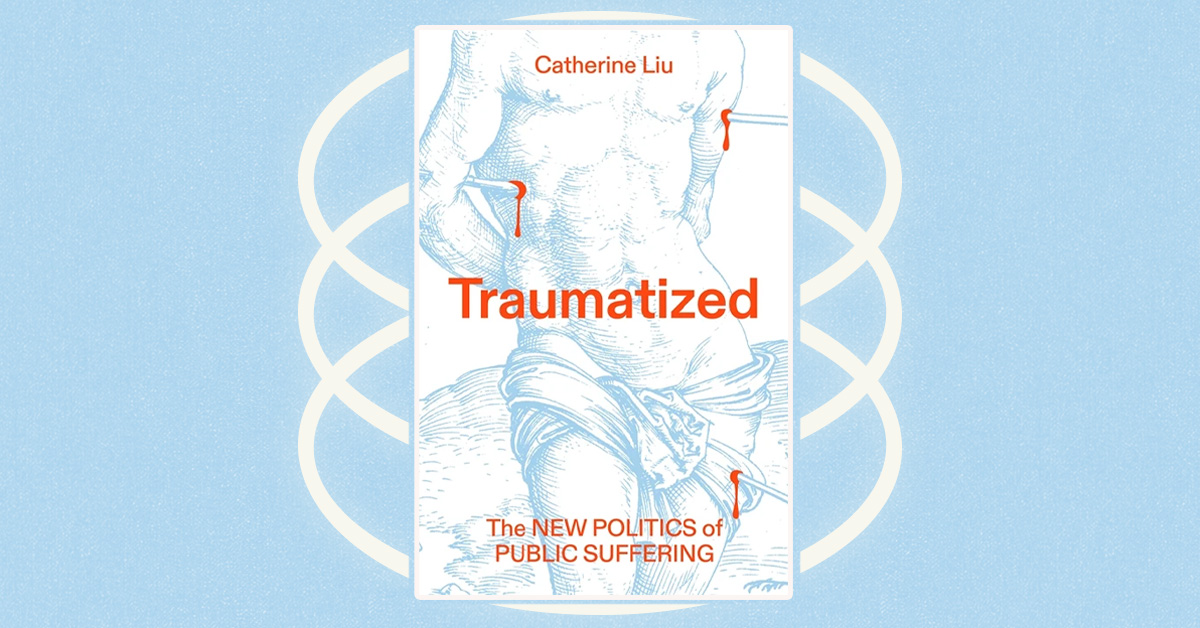
Much ink has been spilt over this question. Endless articles consider who has the right to offend or be offended. Terabytes of online content contesting the correct relationship between facts and feelings. More commentary than anyone could wish to consume in a single lifetime. A defining cliché of our moment, it hangs like an albatross around all of our necks. Thankfully, unafraid of cliché, Catherine Liu enters the fray with her latest offering: Traumatized: The New Politics of Public Suffering.
2.
For those who have evaded her influence, Catherine Liu is a senior academic who teaches cultural studies at a prestigious American university. She is the author of several books, most notably Virtue Hoarders: The Case Against the Professional Managerial Class, published in 2021.
Liu has a wide readership. But her work is especially popular among fans of the recently developed archipelago of socially conservative outlets, such as the allegedly Peter Thiel-funded Compact Magazine, the hedge fund manager-owned UnHerd, and Damage Magazine (which is sort of like someone tried to reconstruct Parapraxis magazine using an LLM trained on Nina Power’s leaked WhatsApp messages).
What these publications all share, beyond their conservative bent, is an obsession with talking about the shortcomings of a vaguely defined ‘left’ which they see as moralistic, censorious, and middle class. And Liu is no different. The Telegraph calls her the woman revealing how the Left weaponised ‘trauma’ and she’s happy to get a jab in whenever she gets the chance.1 Far be it from me to dissuade someone from complaining about the left, but we should always be wary when someone claiming to speak both to and for the left does so in the pages of the billionaire-owned press.
3.
Through the book, and her media appearances promoting it, Liu seeks to diagnose a malady under which we are all supposedly suffering, what she calls trauma culture. Trauma culture is her catch-all term for everything that is wrong with how society metabolises pain and suffering today.
In her telling, there was once a better time, in which working-class people across the world lived in more organic, less disrupted, communities which allowed them to deploy far more successful approaches to managing painful experiences.
But then everything changed and we fell into the trap of trauma culture. Now, she tells us, every traumatic experience becomes a “consumable narrative” that generates pseudo-political authenticity for speaker and listener alike.2 People hide behind their traumatic experiences, using them as tokens by which the status of authenticity and marginality, and therefore prestige, can be gained.
The first real example of this that we are given in the book is from the depths of the pandemic. Liu is in isolation and she’s watching Alexandria Ocasio-Cortez go live on her Instagram account to talk about the January 6th riot at Capitol Hill. AOC describes “the harrowing experience of hiding in the bathroom of her office, listening to the rioters banging around outside, loudly asking where she was.” She then relates this to an earlier experience of sexual violence, sharing this information for the first time publicly.
For Liu, this is a classic “trauma narrative.” By which she means a “public confession of a private trauma [that] converts a shattering personal story into a standardised narrative of rupture and reintegration.” These are bad, according to Liu, because they turn experiences into commodities via online platforms, grant the person who is sharing them a form of social prestige, leading us to abandon class politics in favour of our “feelings.”
4.
In providing an account of how this all came to be, Liu looks to the struggles and transformations of the long 1970s. As the post-war class compromise fell into disarray the world was remade. A new period began, one marked by austerity, financialization, mass unemployment, incarceration, industrial collapse, and a social malaise.
As this new world was built, everything changed. Work, family, culture and technology all rapidly transformed as workers flooded out of the factories and into different lives. White collar jobs in finance, insurance, or real estate, service sector jobs in restaurants and hospitals, a place in prison or simply destitution waited for these workers (depending on their race, class position, and relative misfortune.) Even those who kept their jobs in manufacturing had to reckon with new computerised labour processes, their collars threatening to look more white than blue.
It may not have felt this way for all of them, but this was class war. And we lost the war. According to Liu, amid this defeat an “increasingly powerful class of ideologically driven medical and media professionals” fought over the meaning of pain, the mind, and traumatic experience.3 In the wreckage of social democracy, members of the “professional managerial class” (PMC for short) as well as anti-war liberals and second-wave feminists changed the meaning of trauma.
Specifically, Liu gives us accounts of feminist groups who began to discuss their experience of sexual violence in more public and less shameful ways. The feminist movement paralleled the work of veterans in the anti-war movement who began to demand that society register their experiences in new ways.4 Liu frames all of this as a turning away from “class politics.” Against the incoming tide of an emergent neoliberal regime of austerity, middle-class professionals simply looked away from redistributive demands, settling instead for a form of official recognition shown in “policy changes and medical and political attention.”5
This:
“new realm of politics was emptied of thorny problems like class, while a myriad of critiques of “power” would abound and flourish. The spaces of feminist activism moved from factories and workplaces to bedrooms and classrooms; when professional-class feminists rediscovered the workplace as a site of abuse, it was the movie studio and the casting couch that caught their attention.”6
All of this, we are told, has led to the irrevocable state of trauma culture that we now find ourselves in.
5.
The book reiterates this thesis across a set of more focused polemics. First, she addressed the paternalism and depoliticisation of NGOs working to prevent child sex abuse, arguing that after being taken up by the new left, the cause was defanged and emptied of political-economic analysis. Then she goes on to explore the tensions and conflicts between different sections of second-wave American feminism. Arguing that an explicitly class-based politics was abandoned in favour of a cross-class focus on sexual violence and abuse.
Then she moves on to address the changing status of PTSD as a diagnostic category in the wake of the anti-war veteran movement. Leading to the expansion of the category of PTSD, to the point at which it has become “a concept that continues to dilate, almost to the point of meaninglessness.” Finally, she sets her sights on Oprah, the billionaire TV personality who publicly shared her experience of childhood abuse in 1986.
All variations on a theme. Trauma culture rears its head when anyone (usually a professional) tries to achieve any kind of political outcome by organising people on the basis of an experience of suffering not class-writ-large. Everywhere she looks, Liu finds the same thing. And whilst it contains interesting moments of cultural and intellectual history, the weakness of her political argument becomes clear in its repetition.
6.
We have heard all of this before. Not only the long-standing debates of this nature that surround the work of figures like Christopher Lasch.7 But much more recently. 5 years ago, we were subjected to another wave of this debate, with essays from liberal commentators such as Will Self and Parul Sehgal published to wide engagement and debate. Liu cites both of these texts herself, wishing that this had been “peak trauma culture.”
Liu is certain that the “trauma script has been fully metabolised into the cellular structure of professional-class liberalism.” But isn’t the exact same thing true of the anti-trauma script? Railing against sensitive young people, middle class professionals, and naval gazing leftists is all the rage, and has been for years. If the anti-trauma polemic was as countercultural as she claims, it wouldn’t find such sympathetic readers in the pages of The Telegraph.
Whilst she is correct in stating that “the political and moral malleability of psychiatry is one of its most shameful sins, and one that cannot be redeemed by the introduction of new, more politically progressive diagnoses.” She fails to realise that the inverse is also true, psychiatry cannot be redeemed by simply tightening the aperture of diagnostic frameworks either.
We know, from the work of French Marxist Louis Althusser, that “in political, ideological and philosophical struggle, words are either weapons and explosives or tranquillizers and poisons.”8 The concept of trauma can be used as a tranquilliser, but it can also be used as a weapon, and it’s a weapon that Liu clearly knows how to wield.
People do, and perhaps always will, deploy their personal experiences of trauma in ways that can feel transactional, insincere, politically motivated and frustrating. But rather than acknowledge this fact and continue to battle in public over these questions, to struggle over the resources required to overcome suffering in collective ways, Liu would rather have us abandon the field. Arguing in the pages of the Telegraph for a conception of mental distress that keeps the clinic and the class war cleanly divided. Telling us that “in a therapeutic context – the right context – it is appropriate to share.”9
7.
The deep irony of Liu’s work is that she assigns so much blame for trauma culture’s tranquillising effects to a poorly defined Professional Managerial Class of which she remains a card-carrying member. Perhaps, ensconced in the elite institutions of the American academy, Liu has forgotten what it is like to work a job not amongst this milieu. The fact is that whether your boss is a liberal who wants to hear about your trauma or a conservative who thinks you’re soft for wanting a day off when your dog died: you’re not going to get better pay and conditions for you and your fellow workers without organising alongside them.
Much like your manager, Liu doesn’t really care about you or your co-worker’s feelings. She is uninterested in anyone else’s experience. Perhaps, contrary to her argument, this attitude has contributed to her success as an author and academic. Unfortunately, I can’t imagine this makes her a very good organiser. If you’re interested in class politics, real class politics, then you should care about the experiences of your fellow workers: even the traumatic ones.
In 1968, when militant communist and journalist Maria Antonietta Macciocchi returned to Napoli to run for election with the Italian Communist Party, she wrote to Althusser, asking for advice. She wanted to know how to do useful political work at a time when the party was drifting from its roots in the working class. She was concerned about succumbing to ‘electoral cretinism’ and falling into bureaucratic politicking.
Althusser advised her to listen. Telling her that “you cannot learn anything from the people if you are talking to them. You have to learn things from them by listening directly.” He told her that she needed “to know what the people have on their minds.” But, he said, this should not be a passive process but one in which she must listen “politically” so she might “discover which are the points on which you ought to push farther.”10
This is important, he said, because there are things that people “hide or disguise, things they often consciously, but most often unconsciously, avoid.” For Althusser, the militant needs to act in a way that is “somewhat analogous to a psychoanalyst.”11
Furthermore, it is essential that the communist militant “does not ‘know’, a priori and in specific detail, just what the lives of the persons he listens to are made up of and what the major contradictions are; [she must] learn this by listening to them and discovering a great many things [she] previously did not know.”12
In her letters to Althusser, Macciocchi describes the experience of listening endlessly to the workers and the unemployed in Napoli. As a result of this listening, she wins her electoral victory. But more importantly, she taps into the same upward surge of working-class militancy that is visible in the May revolt in Paris. In doing so, she glimpses a possible alternative path forward for a communist party that went on to drift even further away from its working-class base.
Catherine Liu doesn’t want to listen. Despite her confessed love of psychoanalysis, she fails to follow the advice given by Althusser all those years ago. She wants to tell you what your so-called trauma means. She wants to tell you that you’re just using it to try and get ahead, get attention, and act like a martyr. In fact, she’d rather not hear about it in the first place.
8.
A friend of mine was recently made redundant. He’s a trade unionist and he tried to organise his workplace well enough to fight brutal job cuts. During the struggle he told me about a colleague. This colleague had been against the union for a long time, but once the threat of redundancy became clear he confided in my friend. This colleague realised what his life might be like without this job and began to cry. My friend told me how, after consoling this colleague, he passed him the paperwork to join the union and he did.
My friend and his fellow workers lost that fight. He was made redundant along with almost everyone else who was active in the union. I can tell that when he talks about it, this loss has hurt him in a very deep and profound way. Maybe he would call the experience traumatic, maybe he wouldn’t. But if he did, would he, or I, become better organisers by refusing to engage in good faith with these experiences of pain? If he shared this experience in a public forum, would he simply be trying to get ahead and perpetuate a “trauma narrative”?
Perhaps things would be simpler and easier if everyone just kept their feelings to themselves. But whether we like it or not, trauma isn’t going away. And as communist militants, we need better ways of dealing with it than simply telling people to shut the fuck up and go to therapy.
- Celia Walden, ‘The woman revealing how the Left weaponised ‘trauma’’, The Telegraph, Sept 2026. ↩︎
- Catherine Liu, Traumatized: The New Politics of Public Suffering (Verso Books, 2026), p.5. ↩︎
- Ibid., p. 6 ↩︎
- It is worth noting that the sections of Traumatized that address these histories often re-tread ground covered, much more deftly, by Nadia Abu El Haj in Combat Trauma: Imaginaries of War and Citizenship in post-9/11 America (Verso Books, 2022). ↩︎
- Catherine Liu, Traumatized, p. 68 ↩︎
- Ibid, p. 87 ↩︎
- Matthew Sitman and Sam Adler-Bell, ‘Know Your Enemy: Christopher Lasch’s Critique of Progress, with Chris Lehmann’, Dissent Magazine, August 11, 2022, https://dissentmagazine.org/online_articles/know-your-enemy-christopher-lasch/ ↩︎
- Maria Antonietta Macciocchi, Letters from Inside the Italian Communist Party to Louis Althusser (Verso Books, 1973), p.16. ↩︎
- Walden, ‘The woman revealing how the Left weaponised ‘trauma’’ ↩︎
- Macciocchi, Letters p.22. ↩︎
- Macciocchi, Letters p.51 ↩︎
- Ibid. ↩︎