Britain finds itself in a sort of liberal-democratic interregnum with the election of Greater Manchester Mayor Andy Burnham back to the House of Commons on the 18th of June and the resignation of the Prime Minister, Sir Keir Starmer, on the 22nd1. It is increasingly likely that Burnham will be Prime Minister before Labour’s autumn conference. Some on the left may be content with a Burnham premiership. Many, however, question his credentials. As MP for Leigh and a member of Tony Blair’s government, he supported the criminal invasion of Iraq in 2003; until recently, he was a longstanding advocate for British membership of the European Union.
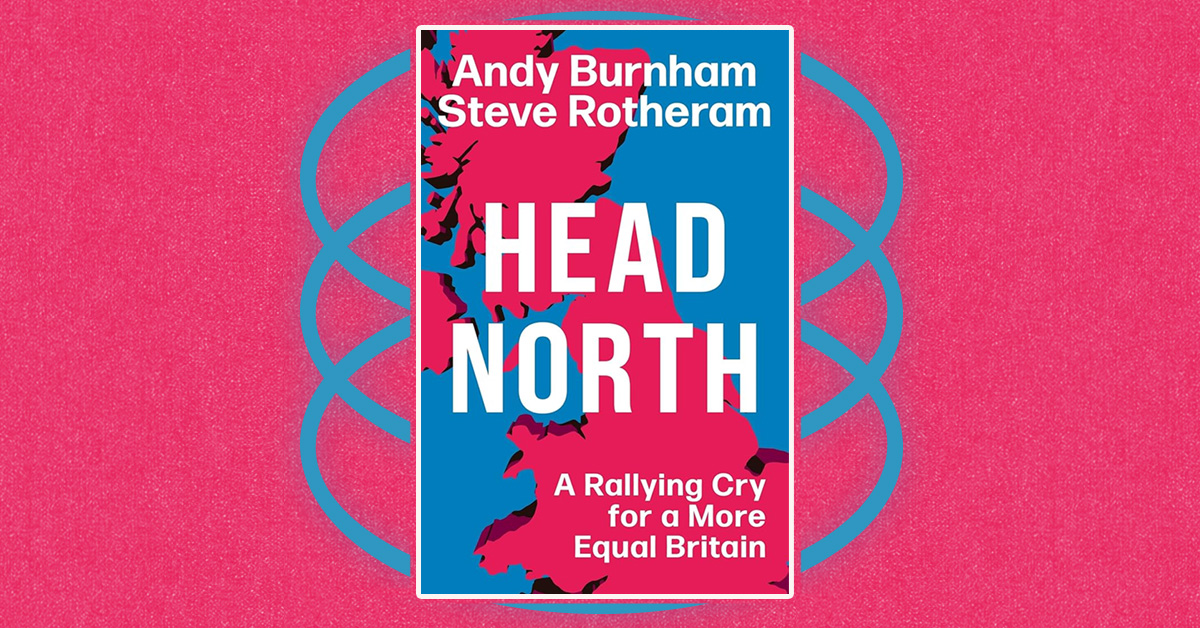
To make the case for a republic and for communism, we must be able to counter the ideas of our political adversaries. Infamously, Andy Burnham is at any time a Blairite, a Brownite, a Corbynite and a Starmerite (or so the joke goes). With this in mind, an examination of his 2024 book Head North2, which he co-authored with Liverpool Metro Mayor and former MP Steve Rotheram, will be a good place to start investigating Burnham’s ideas.
Head North, shall we?
The first half of Head North is effectively a joint biography, filled with nostalgic images of late 20th-century life in between Liverpool and Manchester. Picture The Smiths live at Salford University (p. 31); Tetley’s bitter (p. 7); nights out at Eric’s (p. 27) and days out at Anfield and Goodison Park. This is all well and good, but as the public has learned with Keir Starmer being a passionate Arsenal FC fan; being an avid consumer of popular culture (or “normal” as some commentators so often term it)3, does not amount to very much.
The latter half is a joint manifesto of sorts. They provide a 10-point plan that they think would be a “positive step forward” (p. 191) for our political system. The first six of which are directly political: a written constitution, a Basic Law, reform of the voting system, removal of the whip, a senate of nations and regions, and full devolution. The latter four are more tailored to legal, social and economic reform. These are: two equal paths in education, a Grenfell law, a Hillsborough law, and net zero to reindustrialise the north; however, these four points would need to be dealt with individually and in more detail in a separate piece.
A Written, or Codified, Constitution and a Basic Law
The first demand of their manifesto is a written constitution, something republicans and communists can surely get behind, but the authors provide almost no details of what this might contain. The main aim of their written constitution is to establish what they call a Basic Law on the model of Germany, committing the state at its most fundamental level to regional support4. Burnham characterises Germany at one point as “a country that has actually done the heavy lifting of levelling up.” (p. 168) This is unfortunately not the case; the regional divide in Germany is still very substantial5.
The obvious difference between England and Germany is that our political capital is also our economic capital. The industrial belt of western Germany is richer than Berlin, as is Bavaria in southern Germany6. The areas of Lancashire and Yorkshire have been economically less developed than London and the rest of the South since the Roman occupation of Britain, starting in the first century AD7. Furthermore, the reason the Rhineland remains so rich today is that the German industrial production based there is still, for a variety of reasons, competitive on the world market8 – something that cannot be said of northern England in the age of globalised production. What is important about this, however, and it is key to why the Rhineland is not a model for us, is that the Rhineland is only relatively competitive at the expense of other places, such as northern England – all Burnham and Rotheram’s demands amount to is a desire for us to play the capitalist game more efficiently and productively.
The main takeaway from this is that a political or even a constitutional commitment to regional equality or minimum regional support is not necessarily detrimental to our cause, but Germany provides no model for us9.
Beyond the idea of the Basic Law, Burnham and Rotheram provide basically no details of what this written constitution would consist of; they do go on to discuss political reform of various types, but it is not clear that these would be considered more constitutional than the already partly-written but uncodified constitutional documents we do actually have, like the Bill of Rights Act 1689. We can perhaps infer, however, from Burnham’s remark that “Britain sits alongside Saudi Arabia, Israel, Canada and New Zealand in being one of the five countries that doesn’t have a constitution” (p. 164). Looking at the 187 UN-recognised nation-states that the authors presumably consider to have written constitutions, we see a massive range of political characteristics from presidential republics such as France or Kenya, to liberal monarchies like Spain or Japan, or even more absolutist monarchies like Oman or Brunei. The idea of a written, or more properly a codified, constitution is clearly pretty flimsy for Burnham and Rotheram, and it is only part of their project insofar as it allows social and economic reforms to be cemented long-term.
The fact that absolute sovereignty in any one person, whether to be passed on to someone else through election or inheritance, does not seem to be in contradiction with the sovereignty of a constitution, tells us that these questions have not been thought out by our soon-to-be PM very deeply, and this will likely mean a continuation of business-as-usual with regards to the monarchy.
If a Burnham-led Government does seek to introduce a form of Constitution Act that codifies British constitutional law into one document, communists would be compelled to expose it as a sham constitution, leaving fundamental sovereignty in the will of an unelected monarch, divinely appointed by a god that many in Britain no longer believe in.10
Parliamentary Reform
The package of reforms that Burnham and Rotheram propose for Westminster can be summed up as such:
- The abolition of the whip system in favour of more freedom for MPs (p. 188).
- The abolition of first-past-the-post in favour of Proportional Representation voting (p. 195), the authors disagree on the details (p. 193).
- The abolition of the House of Lords in favour of a Senate of Nations and Regions (p. 196).
Banning parties from using a whip system is effectively an attempt to ban political parties from ensuring representatives actually do represent the party they stand for. The problem with this is that it functions as a soft ban on sections of the population organising to have their interests represented; consequently, leaving politics to independent people with know-how, already enmeshed in important (and ironically in Westminster and Whitehall-based) political circles.
There would, of course, be no greater gift to the economically powerful people of this country, as they could still pay to have individual MPs do their bidding, whereas the vast majority of propertyless workers must come together to have their views represented. This includes making sure those we send down to the Westminster bubble are forced by a democratic whip to continue representing our views, rather than getting sucked into a life of rubbing shoulders with the powerful, earning £98,599 for a relatively easy job with flexible hours and no boss to shout at you, and living in the capital city with the best cultural and subsequent career opportunities.
That being said, Burnham is not entirely wrong when he states that the “whip system transfers powers from the elected to the unelected” (p. 188), but this is only because the political parties, from which these “unelecteds” come, are almost exclusively much less democratic than the House of Commons11. It is unclear if the Parliamentary Labour Party, being in a sizeable majority, would support abolishing the whip and, in doing so underminding its own majority. But, if a Burnham-led Government seeks to bring legislation to the House of Commons banning political parties from using a whip system on their Members of Parliament, communists must oppose this as a restriction on our political freedom to organise.
Communists and socialist republicans should support the abolition of the first-past-the-post voting system, being used in many places across the globe to maintain liberal hegemony through (mostly) two-party systems and working to prevent any genuine mass, socialist parties from developing without degenerating into liberal, eurocommunist, social-democratic or otherwise pro-capitalist parties12.
The alternative that Burnham might put forward as future PM is unclear beyond his calls for Proportional Representation. This would likely allow for a wider range of political ideas to be represented in the House of Commons, and so communists should support it, again as a short-term improvement on the existing political infrastructure under which we can challenge capitalist rule. Of course, this is all hypothetical and without details, but we would anticipate that a Burnham government would not go far enough and would settle for a system that only marks a minor improvement on first-past-the-post, as such communists should again criticise it as a sham reformation of the electoral system.
The abolition of the House of Lords, even in its reformed non-hereditary form, is a central tenet of communist politics in Britain. This demand featured implicitly in the Communist Party of Great Britain’s For Soviet Britain13, as well as in every version of its British Road to Socialism14. This continues today15, with the demand featuring explicitly in the 1988-founded Communist Party of Britain’s Britain’s Road to Socialism16, the Communist Party of Great Britain (Provisional Central Committee)’s Draft Programme17, and the Socialist Party of England and Wales’s What We Stand For18.
Communists and republicans should seek to abolish the House of Lords, as was done in 1649, because it stands as a bulwark against democratic impulse. The tempering effect it has, vetoing and watering down legislation, means that it functions as a backstop that allows capitalists to rule over Britain while granting universal suffrage in elections to the House of Commons. A recent example of this would be the House of Lords scrapping the “day-one” right to challenge unfair dismissals as part of the Employment Rights Act 2025, agreed by the House of Commons. Whether it is filled with religious leaders, hereditary peers or senior statesmen, its undemocratic nature robs the people of Britain of the liberty to govern themselves and maintains the chains of oppression characteristic of class society.
Burnham and Rotheram propose in place of the House of Lords a Senate of Nations and Regions. The first issue with this is that there is no reason that we actually need a bicameral legislature for revising bills; this can be done by the elected representatives in a unicameral legislature. Furthermore, a second or upper chamber only seeks to disperse legislative power, making government more complicated and bureaucratic, and ultimately less democratic. It is worth recalling Karl Marx’s remarks on the separation of powers in the French Constitution of 1848, published in Ernest Charles Jones’s Chartist paper, Notes to The People:
“Here we have the old constitutional folly. The condition of a ‘free government’ is not the division, but the unity of power. The machinery of government cannot be too simple. It is always the craft of knaves to make it complicated and mysterious.”19
Devolution reform and extension
Regions and nations having devolved powers have increased the democratic autonomy that people living in places like Scotland, Wales, and northern England have – if only in a limited capacity. In that sense, the mayoral duo are right.
“It is probably fair to say”, Burnham remarks (p. 201), “that English devolution is the most notable, and important legacy of this period of Conservative-led government.” The reforms that could enhance devolution for Mr Burnham would be: localising the funding of the Department for Work and Pensions and giving devolved powers “greater fiscal autonomy” (p. 202). The latter of these is, of course, correct; the centralisation of HM Treasury obviously does contribute to the regional underdevelopment of places like northern England, but there is a bigger problem concerning the lack of democracy in mayoral devolution in particular.
Mayoralist devolution, as it exists, is elected one-man rule. It is local presidentialism20. The concentration of power in a directly elected mayor reduces regional democracy to one election over the course of several years. The SNP Government in Edinburgh faces opposition and criticism in Holyrood from Labour, Reform UK, the Greens, the Conservatives, and the Liberal Democrats. The Plaid Cymru government in Cardiff faces opposition in the Senedd from Reform UK, Labour, the Conservatives, the Greens, and the Liberal Democrats. Compared with this communists must ask where the opposition to Labour is represented in Greater Manchester or the Liverpool City Region21?
It must be remarked that devolution in the North of Ireland is obviously very different to devolution in Wales, Scotland or the English regions and that it is nothing but an extension of British rule. Burnham’s remark that “it is important for […] Northern Ireland to pass down more of the devolved powers they hold to their towns and cities” (p. 203) would only amount to legitimising British rule in Ireland and should be opposed.
What Can We Expect?
It is worth noting at this point that though Andy Burnham and Steve Rotheram are listed as Head North’s co-authors, the book was in fact ghost-written by the Political Editor of the Liverpool Echo, Liam Thorp22. To what extent this 10-point plan really does represent Andy Burnham’s ever-elusive worldview is then, unfortunately, still up for debate – though as his career suggests, we know it is not one that prioritises a republic, democracy or peace.
Are we likely to see these limited but substantial constitutional reforms if Burnham inherits Starmer’s strong majority in the House of Commons? Probably not. The electoral reforms are perhaps more likely, given the collapse of the dominant two parties during this sitting of parliament. Separately, the abolition of the whip poses the issue of whether the Labour PLP could use the whip to vote to abolish it, and if so, would they?
English devolution would likely be the principal policy focus of a Burnham-led government, and while communists might seek for communities to have their own say over matters that pertain specifically to them, we must fight against one-man rule mayoralism and for more democratic options, if only in the short term.
As a resident of the Greater Burnham-Rotheram Empire, I am personally sympathetic to reforms that will increase public wealth in this area of the country, but we cannot settle for electing a regional manager vying for investment and trying to increase the productivity of Burnham’s “UK plc” North West Division (p. 204). Insofar as communists should support devolution, we have to fight for a democratic devolution while still exposing the existing devolved authorities as an auxiliary arm of His Majesty’s Government and, ultimately, of capitalist rule.
Whether the PM is Burnham, Starmer, Streeting or someone else, the likelihood is that we will see very little constitutional changes, if any. Whig, Liberal, Conservative and Labour governments have reformed the “constitution” gained from the 1689 Glorious Revolution, but only in minor ways – it is likely that any Burnham government would continue down this road. If, like the Communist Party of Great Britain in the early 20th century, we did have Communist MPs in the House of Commons, we might consider lending Communist votes to a Constitution Act or an Act for Abolishing the House of Peers, like that of 1649. We would consider doing so only as a temporary improvement on the political framework under which we can fight capitalist rule, all the while criticising such changes as sham reforms that leave the monarchy and capitalist rule intact.
Liberal parties like Burnham’s Labour or the Polanski’s Greens seek to govern on behalf of capitalist rule, though in a more benevolent manner than conservative parties, so they provide no opportunity for socialist-republican or Marxist politics – regardless of any short-term ‘left’ surges in membership23. In order to actually have more prosperous regions, more meaningful local and regional democracy, a constitutional republic, the abolition of the monarchy, or a genuinely democratic voting system the working class does not need reformist career politicians like Burnham, who offer very little and then often go back on it anyway. The communist organisations we do actually have in Britain are also inadequate principally because they exist as group-think organisations rather than parties organised around a certain idea of political change24. Instead, the working class needs political independence from capitalist rule and a political programme that fixes these constitutional demands into the identity of a political party. This can only be provided by a unified socialist-republican workers’ party.
- As of 22/06/26 William Hill has Burnham at 1/50 for next PM, far more likely than the other contenders. https://news.williamhill.com/politics/andy-burnham-next-prime-minister-odds-after-keir-starmer-resigns/ [accessed 22/06/26]. ↩︎
- Andy Burnham and Steve Rotheram, Head North, 2024, Trapeze. All subsequent page references, however, will be made to the 2025 paperback edition, also published by Trapeze. ↩︎
- See Aaron Bastani for example: https://x.com/AaronBastani/status/2033278200013369457 [accessed 04/06/26], a wider discussion of the left’s fetish of fictitious ‘normal people’ is increasingly required. ↩︎
- As has been pointed out in The Morning Star by John Green, the Basic Law in Germany is the constitution, not a statute of it or an appendix committing the state to regional development. Available online at https://morningstaronline.co.uk/article/good-instincts-bad-analysis [accessed 04/06/26]. ↩︎
- Eastern Germany, where Berlin is situated, consistently performs higher for unemployment rates, relative poverty rates, and elderly dependency rates, while performing lowering on metrics like GDP per capita when compared with western or southern Germany; see: https://www.oecd.org/content/dam/oecd/en/publications/reports/2024/11/oecd-regions-and-cities-at-a-glance-2022-country-notes_00a3f24b/germany_2214888f/c0553d2d-en.pdf [accessed 04/06/26] ↩︎
- There are many reasons for this, not least the Eastern Front of World War II and the Holocaust. Some aspects of regional inequality go back further, however. For example, the vast majority of the free imperial cities of the Holy Roman Empire would today be found in western and southwestern Germany. ↩︎
- The River Thames is geographically well placed for trade with the continent, and though this is not the only reason for London’s development in Roman times, it is probably a major one. ↩︎
- After China and the US, Germany was 3rd for leading export countries in 2025, see: https://www.statista.com/statistics/264623/leading-export-countries-worldwide/ [accessed 04/06/26]. ↩︎
- While heeding Marx’s words about creating recipes for “cook shops of the future”, we can imagine that by subordinating administration to popular control, socialist-republican democracy would make sovereignty over regional issues much less centralised than it currently is. However this might look, we would imagine that, with genuine democratic sovereignty, regions would be able to increase their public wealth without just competing better on the world market. ↩︎
- 22.2 million people in England and Wales chose the “no religion” option in the 2021 census, see: https://www.ons.gov.uk/peoplepopulationandcommunity/culturalidentity/religion/bulletins/religionenglandandwales/census2021 [accessed 04/06/26]. ↩︎
- The Green Party, which is wrongly sometimes considered the most democratic party in Britain, already has no whip system – meaning its representatives in parliament and council chambers are free to do whatever they like and completely ignore the demands of its membership or the policy decided at its conferences. ↩︎
- First-past-the-post being a winner-takes-all system encourages strategic voting. The left sometimes continues this logic by tailing liberal parties in order to defeat conservative parties. This ends up undermining its own political independence; for example, the Communist Party of Britain is completely dependent on the Labour Party, even if it does maintain its own external membership lists. First-past-the-post is not the only system to have this effect; however, liberal-capitalist hegemony can be maintained in other ways. ↩︎
- The Government that British workers would establish in a revolution “will not maintain the present parliamentary system”, For Soviet Britain, 1935, available online at https://www.marxists.org/history/international/comintern/sections/britain/congresses/XIII/soviet_britain.htm [accessed 04/06/26]. ↩︎
- It features implicitly in the 1951 BRS and explicitly in the 1958, 1968 and 1977 BRS editions all available online at https://www.marxists.org/history/international/comintern/sections/britain/documents.htm [accessed 04/06/26]. ↩︎
- There are unfortunately many communist political organisations in Britain today that prefer ambiguity over clarity and, as such, have no programmatic document, often instead having a ‘What We Stand For’ section in their newspaper or ‘About Us’ section on their website. These range in their programmatic quality but many of them do call for the abolition of the House of Lords, for example that of Socialist Alternative, and some do not, for example that of the Socialist Workers’ Party. Likewise, the communist political organisations that do have programmes often use such documents to define themselves not by their demands but rather to list the views that members or recruits are expected to hold. As such, important political issues like the House of Lords go unmentioned; examples of these organisations and programmes would be the Communist Party of Great Britain (Marxist-Leninist)’s Party Programme or the Revolutionary Communist Party’s ‘10-point communist programme’. ↩︎
- Britain’s Road to Socialism, 2020, p. 55 available online at https://yclbritain.wordpress.com/wp-content/uploads/2020/06/britains_road_to_socialism.pdf [accessed 04/06/26]. ↩︎
- Draft Programme, Communist Party of Great Britain, 2023, p.20, available online at https://communistparty.co.uk/wp-content/uploads/2023/08/Draft-Programme-Post-print-With-Cover-August-2023.pdf [accessed 04/06/26]. ↩︎
- What We Stand For, Socialist Party of England and Wales, 2021, p. 2 available online at https://www.socialistparty.org.uk/txt/611.pdf [accessed 04/06/26]. ↩︎
- Karl Marx, ‘The Constitution of the French Republic Adopted November 4, 1848’, in Notes to the People, available online at https://marxists.architexturez.net/archive/marx/works/1851/06/14.htm [accessed 04/06/26]. There is a compelling discussion of how Marx’s position was one of “radical constitutional thought that can be traced back to the Convention period of the French Revolution and the 1793 Jacobin Constitution” in chapter four of Bruno Leipold’s phenomenal Citizen Marx, 2024 (p. 235). ↩︎
- Both authors refer to their collaboration with the US centibillionaire, mayoralist advocate and former Mayor of New York City Michael Bloomberg, early into their time as mayors. (p. 115, 203) That mayoralism is against the principles of self-governing democracy is perhaps more obvious when thinking about the incredibly powerful Democrat mayors in places like New York City, Los Angeles or Chicago. ↩︎
- The reality is that many local councillors, particularly Liberal Democrats, focus their time and energy campaigning publicly on Combined Authority level issues rather than council issues. This creates a tendency for wanna-be mayors to spring up, in place of local councillors. ↩︎
- As the founder and editor of STAT, Pete Mercer, ironically remarked when reviewing the book in 2024 this “speaks well to our independent press”, see: https://statmagazine.org/review-head-north/ [accessed 04/06/26]. ↩︎
- The likelihood of changing this is so low because both the Labour Party and the Green Party are, in their own ways, undemocratic. Regardless, any attempt to force a serious left-wing agenda on them would likely result in a top-down split, as happened to many European socialist parties who voted to affiliate to the Communist International. ↩︎
- As discussed in my previous article for Prometheus Magazine: https://prometheus-mag.com/2025/06/13/programmes-uncombinable-theory-and-demands/ [accessed 09/06/26]. ↩︎