Student politics and the memory of the Soweto Uprising
As a diasporic South African, part of the ‘born frees’1 – the generation of children born after the dismantling of apartheid in 1994 – I grew up hearing about apartheid South Africa in abstraction. Though I never lived through it myself, various members of my family have recounted countless stories on the dissonance of living with white minority rule in exclusively Black townships. They shared their memories of denigration and repression as a normalised part of their daily struggles in Johannesburg, where some of them worked, contrasted with the very rare humanised experiences from white people there and the obvious systemic reminders of the social order that treated them as lesser human beings.
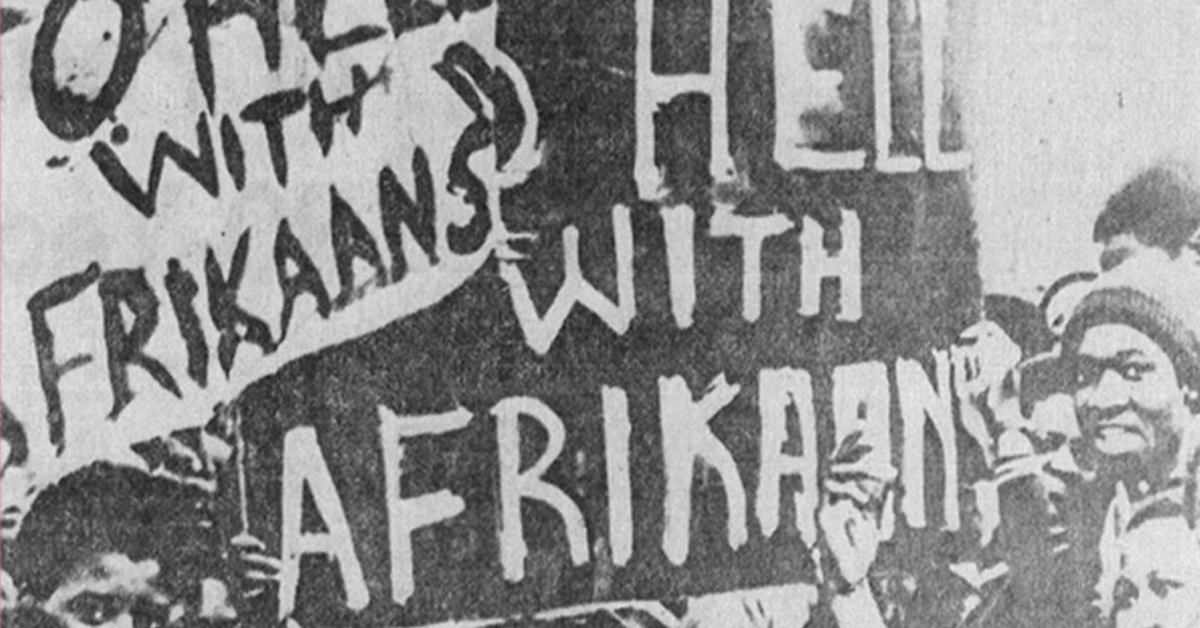
The haunting image of Hector Pieterson taken by Sam Nzima on 16 June 1976, then a 42-year-old photojournalist working for The World newspaper, crystallised what I could only ever imagine.2 Seared into the minds of every young South African from as far back as we can remember, the image forced us to bear witness to the day the streets of Soweto shook with the courage of young students, many of whom are now our parents. They took to the streets in protest of the apartheid regime’s oppressive education system language reforms imposing Afrikaans as the medium of instruction in Black schools.
This image, which became emblematic of the 1976 Soweto Uprising, only told part of the story. Anecdotally, people in Soweto have often shared that two students, Mahabane and Hastings Ndlovu, were shot long before Hector Pieterson; however, in both cases, there were no photojournalists present to historicise their deaths and contributions to the uprising. Confronted with armed police, over 20,000 secondary school students mobilised in their resistance to these oppressive educational changes, and were brutalised by dogs, tear gas, beatings and bullets, resulting in the needless deaths of between 500 and 700 children (although the official number given was 176 children, later revised to over 500 by the liberatory government).3
The omission of the true scale of the Soweto Uprising is largely due to a rewriting of apartheid history by the presiding African National Congress (ANC) government, focusing instead on the symbolism of Pieterson to align with the ‘rainbow nation’ ‘post-apartheid’ South African identity, negating its real roots in the Black Consciousness Movement (BCM). Pioneered in the 1960s by South African activist Steve Biko, the philosophy of Black Consciousness was informed by his experiences living through apartheid, where he witnessed the frequent racist police raids and brutality used to subjugate Black South Africans.
The focus of the BCM was the psychological liberation of the Black people in South Africa, who for decades had been relegated to the lowest social status by imperialist white power structures and made to see themselves as inferior. Biko recognised that the racial, socioeconomic and political interactions within South Africa reflected the global North-South divide. He aimed to encourage Black South Africans to link the ‘white-black power struggle as a microcosm of the confrontation between the third world and the first world’.4 His vision reverberated globally, including in Britain, where African-Caribbean teenagers in Notting Hill and the Asian Youth Movement in Southall took inspiration from the Soweto schoolchildren in staging their own uprisings against racial repression in ‘76. In South Africa, the foresight of an anti-imperialist Black Consciousness blossomed following the Uprising when young students realised the power of solidarity with racialised migrant labourers, as explored later in this essay.
Biko cofounded the South African Students Organisation (SASO) in 1968 to truly represent and prioritise the interests of Black students within the University of Natal (presently known as University of KwaZulu-Natal). SASO was formed as a direct response to what Biko saw as the inaction and neglect by the National Union of South African Students in supporting Black students.
Black Consciousness was prominent among students and influenced seismic shifts in South African student politics between 1976 and 1980. SASO was a proponent of Black students and graduates on campuses moving the Black consciousness ideology out of academia and into the townships, inevitably being the catalyst of the Soweto Uprising. Whilst the impact for young South Africans was immeasurable, they were still overlooked as crucial comrades in the resistance and the wider liberation politics by both the apartheid regime and the organised liberation forces of the ANC. The assassination of Biko in police custody in 1977,5 combined with ‘mass bannings’ – the repressive extrajudicial measures used extensively by the apartheid regime against its political opponents under the Suppression of Communism Act (1950) – diminished the influence of BCM in student politics and organising as it had done before, but it inspired student-worker unity in the 1980s.6
The aftermath of the Soweto Uprising
The aftermath of the Soweto Uprising forced the apartheid regime, the established anti-apartheid resistance movements and the wider public to acknowledge the power students across the country embodied, and how they were leveraging it to make themselves ungovernable. Ignited by the Uprising, young school students further defied the threats that followed from the apartheid regime by mobilising to form the Soweto Students Representative Council (SSRC), which called for further nationwide demonstrations. Tsietsi Mashinini, Murphy Morobe, Seth Mazibuko, David Kutumela and Isaiah Molefe, the co-leaders of the SSRC, realised the limitations of operating solely within the student movement and focused their revolutionary potential by collaborating with workers in August 1976.7
The SSRC organised a march to John Vorster Square – a notorious site of torture, executions and indefinite detention – on the 4th of August 1976. Over 20,000 students, accompanied by parents who formed the Black Parents’ Association, marched along the Soweto highway in support of the detained students from the Uprising. Although this action was squashed by the police, the unintended effect was that thousands of workers were prevented from getting to work, which led to establishing the foundations of solidarity between students, parents and the wider labour force.
Emboldened by this success, the SSRC called for a second strike in the form of azikhwelwa (we will not ride/stay at home) from 23 to 25 August.8 This was the first and clearest link the young students made between the capitalist apartheid state and the benefits of withdrawing workers’ labour, uniting them with clearly aligned political demands – the racist apartheid racism blocked from profiting off Black South African repression. On 23 August, 75% of Johannesburg’s African workforce did not go to work, representing the largest strike in Johannesburg since the early 1960s.
Yet, the students failed to include a large part of the workforce, who did not participate in the stayaway: the hostel dwellers – Black male migrant labourers. These workers were not politicised in the same way and were purposefully separated from the rest of the local Black residents, keeping them disenfranchised from township life and politics.9 Students also seemed to have made little effort to explain the campaign to them, which led the migrant workers to act as strikebreakers. The consequence of students choosing to confront them in retaliation led to unprecedented violence: hostel-dwellers broke into homes to rob, rape and murder township residents in the neighbouring Meadowlands and Orlando. This violence between hostel-dwellers and township residents, including students, continued for two weeks, with the consequence of seventy people dying.10 The apartheid government weaponised this turn of events to their benefit, to ignite tensions along ethnic and migrant/township resident lines to inevitably derail the student movement and prevent cross generational solidarities from being built.
The students of the Soweto Uprising represented an underestimated element of the resistance against apartheid, and catapulted them to the forefront of militant opposition. Connections that were formed among students, workers and Black communities were evidenced and strengthened by the entry of the 1976 generation, later joining exiled anti-apartheid liberatory movements, domestic organising, and particularly the armed wings of these groups. It proved that these students were political agents who had massive potential to reach the masses, which threatened the apartheid regime. The Soweto Uprisings fractured and reinvented the resistance politics of South Africa, as no one was prepared for the scale and influence it would have in shaping liberation politics and future student movements.
Failures of a compromised democracy for young South Africans
The road to a ‘free’ South Africa is often posited in history books as the white settlers in South Africa voluntarily giving up their monopoly of political, social and economic power peacefully, to give way for South Africa’s elusive ‘post-apartheid’ rainbow nation. Instead of taking the freedom that rightfully belonged to Black South Africans by any means necessary, the leaders of our liberation compromised for it.
Unlike the bold young students of the Soweto Uprising, several leaders of South Africa’s liberatory party, the ANC, compromised their resistance to the apartheid ideology for a ‘democracy’ with constitutional supremacy. This new constitution, initially hailed as one of the world’s most progressive in the world, contained the Bill of Rights, which included socio-economic autonomy, foregrounded dignity attached to a free and equal people, with non-racialism as a focal principle.11Whilst the constitution argues for the right for all South Africans to exist as they are, in truth, this did not transcend the reality on the ground for several Black South Africans to this very day.
Young South Africans have to reckon with an uncomfortable honesty on how far South Africa met its goals of liberation for them. The masquerade of a free, post-racial society covers up the evolution of a political ideology of apartheid into a social and economic apartheid of its people. This is clear in the ongoing exploitation of its constitution via the opportunism and bold corruption of the new black elites emerging in South Africa, ironically from the ranks of the liberation movement, aligned with those outside it and largely the white settler population still living in South Africa today.12
And yet, white settlers in South Africa continue to claim a victimhood of a ‘white genocide’13 because they are being held accountable for the land they stole, which rightfully belongs to Black South Africans.14 Feigning embarrassment at what they deem to be failures of the ANC government, whilst ignoring their role in apartheid and upholding its legacies, white settlers in South Africa have spun the narrative by creating a victim complex, which is now supported by the US Refugee Admissions Program for white Afrikaners.15
At the same time, Black communities continue to be separated from white communities, not only by distance but with as many physical barriers as possible – the more polluting, damaging and dehumanising, the better. Even though more Black South Africans have moved across to urban areas in the country and are no longer legally confined to townships, they are still bound by the lack of amenities such as ongoing water shortages16 and widespread load shedding.17
The combination of negligence from the current government and the debts which it is still paying back (over $850 million was used to oppress Black South Africans by the apartheid regime) has compromised the political will to expand connecting infrastructure like transport, technology, and know-how to these historically exclusive white affluent places.18 This stops many Black South Africans from being exposed to better opportunities: for education, employment and housing. Despite all the struggles to reclaim their autonomy and sovereignty, this is the legacy of apartheid and the new ‘democracy’ brought for young South Africans who fought then for those ‘born free’ today.
Black (un)consciousness in the South African classroom, black consciousness globally
Despite Biko’s philosophy of Black Consciousness influencing secondary school and university students through the church, through debating within cultural societies outside of state control, in the South African classroom, a different reality existed.
As Desmond Tutu once said:
“1976 caught most of us really by surprise …we hadn’t expected that our young people would have had the courage. See, Bantu education had hoped that it was going to turn them into docile creatures, kowtowing to the white person, and not being able to say “boo” to a goose kind of thing, you know, and it was an amazing event when these schoolkids came out and said they were refusing to be taught in the medium of Afrikaans. That was really symbolic of all of the oppression. Afrikaans was the language they felt of the oppressor, and protesting against Afrikaans was really protesting against the whole system of injustice and oppression where black people’s dignity was rubbed in the dust and trodden underfoot carelessly, and South Africa never became the same – we knew it was not going ever to be the same again, and these young people were amazing”.19
Afrikaans was the language of the white minority rulers, settlers and the oppressors. As my family describe it, its imposition was integral to the wider suppression of Black South Africans, especially from advancing educationally and socioeconomically – it was a language meant to normalise the idea of Black South Africans in perpetual servitude.
It is no surprise, then, that there was no immediate change to the nationwide school history curriculum when apartheid ‘ended’ in 1994. What was offered in the interim was the revision of school syllabuses, ‘remove inaccuracies, outdated and contentious content’,20 ‘cleansed’ of the most offensive bits of racism, and essentially buying time for a more radical education to catch up with the newly agreed and progressive 1996 Constitution. This ‘new’ curriculum aimed to expose young South African students to ‘multi-perspectivity’ and create nuance for their broader historical understanding of how this new state came to be.
The new national history curriculum for a ‘new’ South Africa was launched in 2003, coinciding with the year I started school. Converse to what my older sisters have shared about their apartheid-era curriculum, the 2003 curriculum was a useful form of propaganda to affirm the foundations of democratic principles and human rights values embodied in our new Constitution and to promote social justice by developing a new understanding of who was South African and what this meant in a non-racial South Africa. However, it remained optional, especially in the more formative years of education for young South Africans, and all of my textbook lessons ended with the historic election of Nelson Mandela in 1994.
The narratives that emerged in Kate Angier’s work on historical consciousness21 helps to illuminate how young people’s knowledge of South African history remains largely essentialized around racial classifications without contextualising them in relation to capital and encouraging young South Africans to start thinking critically about what this means for them materially. Thus, the curriculum interim reforms failed to deliver the nuanced thinking and the social justice intended by its creators. This is further compounded by the fact that generations of young South Africans had never been taught their history, and when the time came to actualise this, the liberatory government were more concerned with the politics of forgiveness and reconciliation over preserving collective memories and truth.
My own experiences of the primary school system reflect this as my history lessons continued to teach and emphasise a Eurocentric history over our own, and did little to nothing in improving my knowledge of the apartheid regime or about the critical role that African states played in supporting Black South Africans to dismantle it. To no one’s surprise, Afrikaans was also still a mandated subject across all schools and my indigenous language, isiXhosa, was not even a choice on the curriculum.
Today, the realities of coloniality are still palpable: many South African schools have been slow to desegregate, which has meant many of the racist apartheid policies have survived and are being abused in different ways. In 2016, protests erupted in schools where Black university students were still being expected to be taught in Afrikaans22 or young secondary school students were banned from speaking their home languages on school grounds or wearing their hair in natural styles.23 Black consciousness by way of the formalised curriculum continues to be a site of struggle.
Nativism and nationalism as xenophobia
As the aftermath of the Soweto Uprisings exemplified, young people’s organising continues to evolve as a key arm of the anti-apartheid struggle to a critical movement challenging ‘post-apartheid’ failures in democracy, governance and socio-economic equity. The Black (un)Consciousness of young Black South Africans via their education system is now evident in the growing populism of nativism and nationalism. Both of these are being externalised in problematic ways in contemporary South African politics grappling with complex social dynamics, including unemployment, inequality and political marginalisation. One of the most devastating implications of nativist nationalism is xenophobia.
This directly diverges from the radical anti-imperialism that was rooted in Biko’s original ideology of Black Consciousness, and is where the friction between the young students of the Soweto Uprising and migrant labourers arose. The lack of embodiment for the politics of ‘Black Nationalism’24 as informed by Black Consciousness, by migrant labourers living in Soweto at the time, is why students assumed they were deliberate strikebreakers. Biko proposed Black Consciousness as Black people’s philosophy for liberation and used it interchangeably with Pan-Africanism as he did not just see it as a movement to fight apartheid but to restore dignity to Black people globally by making indigenous African cultures and people of African heritage the standard with which Black people judge themselves – the first form of resistance towards imperialism and apartheid.
Operation Dudula – to ‘force out’ in Zulu, a longstanding anti-migrant vigilante group composed of Black South Africans and a by-product of the far-right Put South Africans First movement25 – has emerged as a movement that seeks to address high unemployment rates, rising crime, housing insecurity, widening inequalities and absolute poverty.26 Leaders of the movement have capitalised on these factors and have scapegoated migrants as the source of South Africa’s socioeconomic problems, including taking jobs, perpetuating crime and putting pressure on social amenities.
The anti-apartheid movement was historically informed by Pan-Africanism, a necessary philosophy emerging between the late 19th and 20th centuries, centred on all people of African descent uniting to develop strategies against racial, economic and political oppression in response to colonialism, slavery and imperialism. The Pan-Africanist Congress (PAC), founded in 1959, broke away from the ANC to advocate for a more purely Black Africanist vision, objecting to the ANC’s multi-racialism stance, and emphasising the liberation of indigenous Black African people from oppression. Despite this split, Pan-Africanism was embraced by all of the anti-apartheid leaders and movements, who understood that their own freedom was inseparable from that of the continent.
Yet, the expression of Pan-Africanism domestically has appeared fragmented despite the ‘end’ of the apartheid regime being rooted in its ideals. Today, the ‘post-apartheid’ era has presented challenges, as exclusionary nationalist and nativist sentiments expressed through violence have emerged cyclically. Recurring outbreaks of xenophobic violence against fellow Africans from Zimbabwe, Nigeria, Somalia, Mozambique, Malawi and Congo, among others, expose a deep severing between the ideological aspirations of young South Africans and social reality, completely contradicting their assumed principles of Pan-African solidarity.27
Black Consciousness is anchored by Pan-Africanism. The deliberate withholding of Black Consciousness from young Black South Africans through the apartheid-era education system is arguably the root that has normalised this, as Africans in the rest of the continent were portrayed as uncivilised and underdeveloped, leaving the majority of South Africans without a sense of Pan-Africanism by the apartheid government. Despite the presence of migrants’ narrative in anti-apartheid music, art and writings, there has also been a lack of knowledge about anti-immigrant sentiment during apartheid, especially Black migrant labourers who emigrated from neighbouring countries in South Africa to work as cheap labour in the mines and the agroindustrial industries.28
Operation Dudula is not new. In 1985, the Buyelekhaya (go back home) campaign29 named vigilante groups who forcibly marched immigrants to the police station, where they were detained and accused without proof by locals of sexually assaulting women. More incidents followed with the horrific deaths of a Mozambican and two Senegalese immigrants in September 1998, thrown30 from a moving train in Johannesburg after being attacked by a mob who were on their way back from a tense rally at which they blamed migrants for the country’s high unemployment rate. Many of the attacks against them went largely unreported, including the initial major waves of xenophobia, as hundreds of thousands of displaced Mozambicans and Somalis settled in South Africa following their civil wars.
The apartheid regime weaponised these attacks to their advantage but still allowed mass migration into South Africa as they aimed to balance the conflicting points of greater internationalistic solidarities and disenfranchising the local South African population out of the labour market and from their own economy. These sporadic forms of violence only gained momentum until they culminated in an infamous attack in July 2006 in the Cape Flats, where 21 Somali immigrants were killed. The May 2008 xenophobic attacks resulted in the death of 62 African migrants, a further resurgence of violence in 2012, all of which persists in 2026.31
While it demonstrates the capacity of young people to organise, mobilise and influence policy with the same urgency as the young people of the Soweto Uprising in 1976, it also reveals tensions between socio-economic grievances, nationalist rhetoric and pan-African ideals which are uncomfortable, but need to be resolved by us. It is evident from contemporary politics that some political groups have dragged progressive youth organising and lauded it into irredeemable disrepute for their own self-enrichment and to stifle what young South Africans can achieve with better direction and intentionality. Such discourses replicate colonial and apartheid logics, void of Black Consciousness and pan-Africanism, informing who truly belongs. These discourses and expressions of violence do not reflect the reality of what South Africa could be.
A revolution persevering
A complete revolution for South Africa as it is today requires everything from us, especially the whole truth. We should not lose the growing hope of change, however, as we saw with the transition in 1994, parliamentary politics will not bring us true liberation, and we need to embody the resolve of the students who led the Soweto Uprising. Our capacity to dream for a better South Africa has to be bigger than our sitting governments and has to be led by us, the people, because all of our radical leaders let that revolutionary vision for South Africa die in their parliamentary ambitions.
In 1994, millions of Black people who’d been oppressed for decades queued to elect Nelson Mandela and his ANC party as South Africa’s first Black president and the first liberated government. But the ANC’s promise of peace, jobs and freedom for all failed to materialise as white rule ended – instead apartheid lived on in its capitalist new form. Essentially, this maintained the native-settler relationship and further perpetuated the Black (un)Consciousness of the young South African mind. It normalised the inequality that has been the cornerstone of ‘post apartheid’ in South Africa and constitutionalised it. Inequality, therefore, became the law, and this has given rise to populist vigilante groups who have long forgotten their own history.
The students of the Soweto Uprising, who were 15 or 16 in 1976, are now in their mid-60s. Young people have been inundated with messages that they pale in comparison to young South Africans in 1976, who laid their lives on the line to fight for what they believed. Young South Africans have been told that this ‘democracy’ has made them apathetic and that they have no interest in the political and socioeconomic issues plaguing the country.
However, what is left out of this messaging is that political freedom for the ‘born frees’ means nothing without other structural forms of freedom. South Africa’s present rulers celebrate the Soweto Uprising whilst continuing to preside over a system where millions of young Black people still suffer from high unemployment, low wages and institutionalised racism. These issues are only made worse by the remnants of apartheid’s socioeconomic disparities and the sluggish pace of transformative policies. Who can forget #FeesMustFall32 and #RhodesMustFall33 movements of 2015-17, when scores of students took to the streets and spearheaded the call for the removal of oppressive colonial symbols and equitable access to education for all who live in South Africa?
None of these things reflects an indifference in young Black South Africans to the unrelenting issues of the nation. Five decades have passed, and the nature of forcing accountability from the South African government may have evolved from what it was in 1976, but one thing is guaranteed: if and when pushed, young Black South Africans are not afraid to be militant and demand better conditions for themselves just as the generation who came before them did.
Rightfully, this places an ever-present, unspoken expectation on young South Africans to live up to the legacy of the young people of 1976. Nearly four-hundred years of subjugation for Black South Africans can never be undone in 50 years since the Soweto Uprising. To truly honour the revolution those students imagined, the young Black people of South Africa today need to keep fighting for it to eventually materialise.
- Ashley Grandberry, “Understanding The Born Free Generation: Perceptions of Freedom and Identity”. South Africa: Multiculturalism and Human Rights, May 2025, https://digitalcollections.sit.edu/sfp/4 ↩︎
- Ewald Mengel , “The Iconic Hector Pieterson Photo and the Power of Adaptations,” Tydskrif Vir Letterkunde, 56.2, pp. 83–88, 2019, https://www.scielo.org.za/scielo.php?script=sci_arttext&pid=S0041-476X2019000200010 ↩︎
- “Truth Commission – Special Report – KETSHENGANA, Sigaqa Mziwandile.” n.d. Org.Za <https://sabctrc.saha.org.za/glossary/soweto_uprising.htm?tab=victims [accessed May 23, 2026] ↩︎
- Steve Biko, “I Write What I Like”, (London: Heinemann, 1987), pg 72 ↩︎
- “South Africa to Reopen Steve Biko Inquest 48 Years after Death in Police Custody,” 2025, The Guardian, 10 September https://www.theguardian.com/world/2025/sep/10/south-africa-to-reopen-steve-biko-inquest-48-years-after-death-in-police-custody [accessed May 23, 2026] ↩︎
- Edie Christian, “Steve Biko: The Black Consciousness Movement and Its Ideological Struggle against Apartheid.” 2025, Retrospect Journal, 30 March <https://retrospectjournal.com/2025/03/30/steve-biko-the-black-consciousness-movement-and-its-ideological-struggle-against-apartheid/> [accessed May 23, 2026] ↩︎
- Noor Nieftagodien, “The Stay at Home Strike.”, Africa Is A Country, July 2022, https://africasacountry.com/2022/07/azikhwelwa [accessed May 23, 2026] ↩︎
- John F Burns, “Soweto’s Blacks Succeed in Johannesburg Boycott”, The New York Times, August 1976,
https://www.nytimes.com/1976/08/24/archives/new-jersey-pages-sowetos-blacks-succeed-in-johannesburg-boycott.html ↩︎ - John Miller , “The Architecture of Apartheid: Hostels in South Africa”, Johnny Miller Photography, 2018, https://www.millefoto.com/the-architecture-of-apartheid-2 ↩︎
- “TRC Final Report.”1998, Org.Za, <https://sabctrc.saha.org.za/reports/volume3/chapter6/subsection18.htm> [accessed May 24, 2026] ↩︎
- “Constitution of the Republic of South Africa, February 1997,”, Gov.Za, <https://www.gov.za/documents/constitution/constitution-republic-south-africa-1996-04-feb-1997> [accessed May 23, 2026] ↩︎
- Lynsey Chutel, “South Africa’s Corruption Inquiry Leaves Few of the Nation’s Powerful Unscathed” The New York Times, June 2022, https://www.nytimes.com/2022/06/23/world/africa/south-africa-corruption-jacob-zuma-cyril-ramaphosa.html ↩︎
- James Pogue, “The Myth of the White Genocide”, Harper’s Magazine Archive, March 2019, https://harpers.org/archive/2019/03/the-myth-of-white-genocide-in-south-africa/ ↩︎
- Julia Lagoutte, , “The Facts: Land Reform in South Africa,” ACTSA, Action for Southern Africa, 19 February 2025, <https://actsa.org/the-facts-land-reform-in-south-africa/> [accessed May 23, 2026] ↩︎
- “Refugee Admissions Program for South Africans, 1996,”, Gov.Za, November 2025, <https://za.usembassy.gov/refugee-admissions-program-for-south-africans/> [accessed May 23, 2026] ↩︎
- Anja Du Plessis, “Water crisis in South Africa: damning report finds 46% contamination, 67% of treatment works near to breaking down”, The Conversation, December 2023, https://theconversation.com/water-crisis-in-south-africa-damning-report-finds-46-contamination-67-of-treatment-works-near-to-breaking-down-219350 ↩︎
- Mark Swilling, “South Africa’s electricity crisis: a series of failures over 30 years have left a dim legacy”, The Conversation, 2024, https://theconversation.com/south-africas-electricity-crisis-a-series-of-failures-over-30-years-have-left-a-dim-legacy-227936 ↩︎
- Patrick Bond. 2004. “From Racial to Class Apartheid: South Africa’s Frustrating Decade of Freedom,” Monthly Review, 2004, p. 45, https://monthlyreview.org/articles/south-africas-frustrating-decade-of-freedom-from-racial-to-class-apartheid/ ↩︎
- Archbishop Desmond Tutu, Academy Class of 2003, Part 12, 2003, https://www.youtube.com/watch?v=O9koeF3ZMUk ↩︎
- Rob, Siebörger , “History and the Emerging Nation: The South African Experience,” History Education Research Journal, 2000, pg. 26–32 ↩︎
- Kate Angier, . 2017. “In Search of Historical Consciousness: An Investigation into Young South Africans’ Knowledge and Understanding of ‘their’ National Histories,” London Review of Education, pp. 155–73, https://journals.uclpress.co.uk/lre/article/2422/galley/16396/view/ ↩︎
- Agencies. 2015. “Stellenbosch University Students Win Right to Be Taught in English,” The Guardian, 13 November <https://www.theguardian.com/world/2015/nov/13/stellenbosch-university-students-protest-english> [accessed May 23, 2026] ↩︎
- Agnes Frances-Press, “Racism row over South Africa school’s alleged hair policy”, The Guardian, 2016, https://www.theguardian.com/world/2016/aug/29/south-africa-pretoria-high-school-for-girls-afro ↩︎
- Knife Abraham, ‘The Politics of Black Nationalism: From Harlem to Soweto’, Africa Research and Publications, 1 June 1991 ↩︎
- Eyder Peralta, , “A Movement Gains Force to ‘put South Africans First,’ and to Drive Migrants Out,” NPR, 7 June 2022, <https://www.npr.org/2022/06/07/1103445432/south-africa-anti-immigrant-operation-dudula> [accessed May 23, 2026] ↩︎
- Thabi Mayeni, “What is Operation Dudula, South Africa’s anti-migration vigilante?”, Al-Jazeera, 2022, https://www.aljazeera.com/features/2022/4/8/what-is-operation-dudula-s-africas-anti-immigration-vigilante ↩︎
- Melody Mbwadzawo Siangombe, “Exploring the Ideology of Pan-Africanism and Operation Dudula in South Africa’s Political Landscape: Youth Activism in an Era of Xenophobia”, Accord, April 2026, https://www.accord.org.za/conflict-trends/exploring-the-ideology-of-pan-africanism-and-operation-dudula-in-south-africas-political-landscape-youth-activism-in-an-era-of-xenophobia/ ↩︎
- Carl-Ulrik,Schierup, “Under the Rainbow: Migration, Precarity and People Power in Post-Apartheid South Africa,” Critical Sociology, 2016, ttps://journals.sagepub.com/doi/full/10.1177/0896920515621118 ↩︎
- Kwangu Liwewe Agyei, “Xenophobia in South Africa Mimics Apartheid-Era Violence”, New Lines Magazine, May 2022, https://newlinesmag.com/reportage/xenophobia-in-south-africa-mimics-apartheid-era-violence/ ↩︎
- Ashwin Desai, “Xenophobia and the of the Refugee in the Rainbow Nation of Human Rights,” African Sociological Review, 2023 12.2,
https://journals.codesria.org/index.php/asr/article/view/3754/3494 ↩︎ - Khadija Patel, Azad Essa and Ihsaan Haffejee, “No Place like Home,” Al-Jazeera, AJLabs, <https://interactive.aljazeera.com/aje/2015/XenophobiaSouthAfrica/index.html> [accessed May 23, 2026] ↩︎
- Dominic Griffiths, “#FeesMustFall and the Decolonised University in South Africa: Tensions and Opportunities in a Globalising World,” International Journal of Educational Research, 2019, 143–49, https://www.sciencedirect.com/science/article/abs/pii/S0883035518312205 ↩︎
- Elelwani Ramugondo, “#RhodesMustFall: A distinct historical chapter in theorising black struggle, Uct.Ac.Za <https://www.news.uct.ac.za/article/-2025-03-18-rhodesmustfall-a-distinct-historical-chapter-in-theorising-black-struggle> [accessed May 23, 2026] ↩︎