My thanks to Adam Jones for his piece on fascism and social murder. It is depressingly rare to find any leftist discussion of fascism which adds something new, but his does. This is the most congested, sterile subject of left politics – an alarm intended to summon millions to the streets, which we’ve rung repeatedly, exhausting both the audience and us. I despair at much left discourse on fascism. Most often, writers draw up shopping lists of features which unite the right today and 100 years ago; the points they elevate have been a part of conservative politics for decades but weren’t ever previously seen as distinctively fascist, for example, the claim that Trump is a new Hitler just because he believes in strong borders. Or we say Tommy Robinson is a fascist, albeit one without an organisation, programme or desire to take over the state. Robinson has told his supporters he intends to be “the start of a counter-revolution”. But he doesn’t stand in elections, nor does he have a relationship with Reform. Compelling theory would ask of the right, just as we ask of our own side, how do its strategists intend to bring about change; what factors in society make it more or less likely they’ll succeed? We don’t make the effort to understand our opponent; we write theories which leave our own practice untouched. It’s a rare pleasure to find a piece which treats Marxist categories as if they’re real, living things to follow.
Yet if we think of fascism as a politics which is meant to expand the practice of social murder, it wasn’t clear to me from Jones’s piece how necessary he thinks that murder (specifically) is to that intensification of violence. As I read his article, I was thinking about practices which fall short of killing, but are intrinsic to how capitalists rule, in particular what capitalists do to workers in a society where most people lack capital, can’t afford a roof over their heads and are obliged to work. That’s a level of regular, background violence, which the media trains us to ignore. People consent to it because it is routine and invisible. But intentional killing is the ultimate taboo; it is, by its nature, harder to hide. The intensification of violence is, from this broader social perspective, both a strength and a weakness. When fascists kill and when they gloat, they give their enemies reasons to fight back.
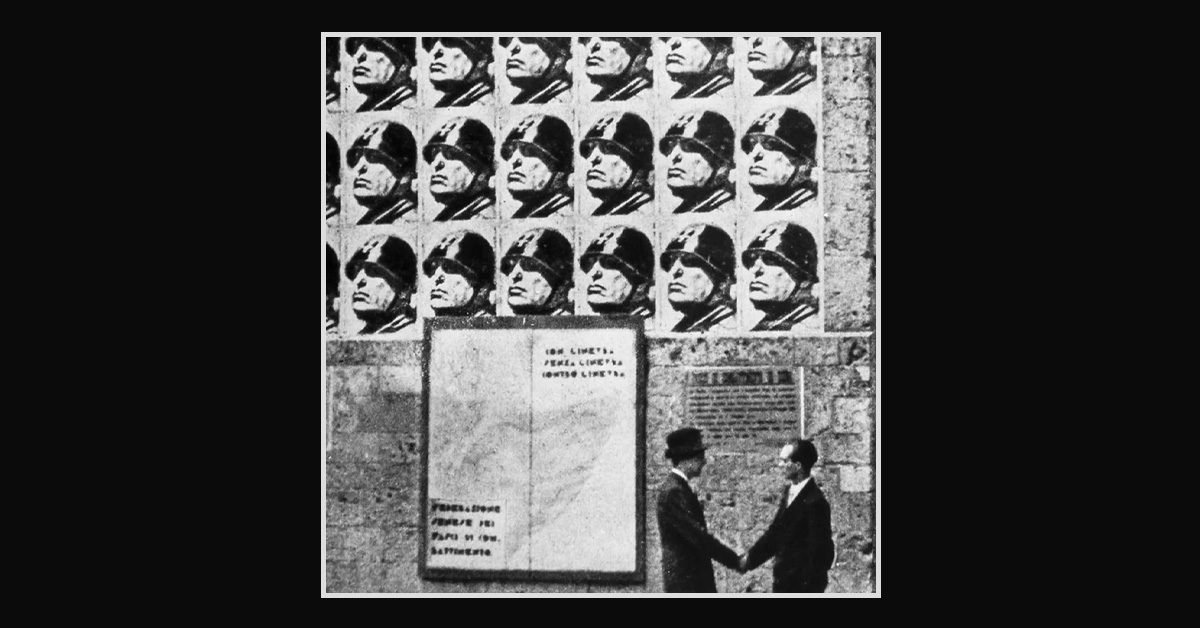
Before Mussolini came into power, his blackshirts destroyed the buildings which gave a home to the Italian left. One survey, conducted by the Socialist Party survey between March and May 1921, records that in those five months, fascists destroyed the offices of 17 left-wing newspapers, 59 People’s Houses, 119 Chambers of Labour, and 83 Peasants’ Leagues. Many leftists died in those attacks; no precise count has been made, but it’s of the order of around 300 people. That anti-socialist violence should be the first thing we look for in saying that one political form or another in today’s world is the inheritor of fascism.
From the perspective of the members of the fasci di Combattimento, those murders were intended to scare the left, clear the streets of any rivals, and make their leader a contender for power. Their toleration by the courts and centre-right politicians eased the transition from democracy to dictatorship. In May 1921, the parties of the centre and the right invited Mussolini to join a “National Bloc”. I can see an argument that to terrify the left, the violence needed to be unlimited: a beating, a few local instances of torture would not have the same deterrent effect. I don’t know if the parties of the right needed the same violence; surely, all they wanted was for there to have been a struggle, and for the far right to have won it.
At the start of September 1920, metalworkers throughout Italy occupied their factories, with over 400,000 militants involved in the protest. The directorate of the Socialist Party announced its intention to “assume the responsibility and leadership of the movement, to extend it to the whole country and the entire proletarian mass”. My best guess is that, in this period, what the business owners wanted most of all was a strike-breaking ally, and one capable of operating on a national scale, a partner who would bring the workers’ protests to an end. At that point, I don’t believe they were planning murders. What they wanted was their factories back, and it was that ambition which led them to tolerate fascism. Whether the far right had ambitions on state power, or not, was not the main concern to capital.
If fascism can be of use to a ruling class without necessarily having to take power, that potential would be relevant to movements such as Tommy Robinson’s, which don’t try to get anyone elected and take little if any interest in overthrowing the liberal state. We know how keenly the symbol of death’s head mattered to fascists; I’m suggesting that to capitalists, it meant less. It became powerful in interwar Europe even though the Italian elites saw democracy as a better long-term answer than fascism. They opposed the March on Rome, two years after Mussolini had come to power; they lobbied for a regime run by a non-fascist. What Mussolini offered them was violence against the left, which fascism, as a movement of outsiders, could take further than the employees of a democratic state. To help the fascists defeat Italy’s rebellious workers, the police loaned the fascists sidearms, supplies, trucks, cannons and (on one occasion) tanks. Those weapons were too lethal for the soldiers or the police to use themselves. In return for the chance to make unlimited profits, capitalists reached an accommodation with fascism. Afterwards, they owed Mussolini and Hitler a loyalty they could not take back without risking their own freedom.
How does fascism’s use of social murder – the cruelty Jones describes – connect to the use of similar methods by non-fascist politicians? I’m thinking here of the deaths carried out by forces, usually seen as non-fascist, the murder of 40 students by the Greek military junta at Athens Polytechnic in 1973. Or the 20-30,000 people who were disappeared by the Argentine generals between 1976 and 1983. So many of the dead were Jews that this process has been described as the worst wave of antisemitic killings anywhere since 1945. One answer is to collapse everything into an enlarged category of fascism, to say, for example, that the Freikorps were fascist because of their enthusiasm for killing, which has been so well documented by Klaus Theweleit. But the Freikorps didn’t believe in purging the state – they were reactionaries, not fascists, eager to bring back Germany’s pre-1918 rulers. If it’s true that other right-wing traditions which didn’t want to replace the traditional elites also practised social murder, then maybe the category shouldn’t be fascism exactly. Perhaps there is a wider group of reactionary mass movements which can also intensify the violence of capitalism.
I agree that fascism offers its service to capitalists as a force capable of intensifying social relationships which are already violent. I wasn’t sure, reading Jones, how that potential can be seen to shape our present moment. It isn’t clear whether he thinks the analogy with the 1930s is potential or actual. When I write about today’s world, with a consciousness of the history of fascism, I avoid looking for a politician – Trump, Farage or anyone else – to be this generation’s counterpart to Hitler or Mussolini. I don’t think they are trying to copy the past; they don’t seem to know the history, nor do they want to use it as a guide. Any analogy applies to the broad context, rather than its parts. The 1930s were an age of fascism, a period where politics moved to the right, which converted people who had voted for liberal, conservative or even socialist parties into members of Hitler and Mussolini’s parties. I am much more persuaded that a similar general dynamic of political radicalisation to the right applies than I am that one or another politician in the present moment corresponds neatly to the leaders of interwar Germany or Italy. Jones writes of a system which “always” bears within itself the capacity for fascism. The implication of his piece is surely that fascism is closer than just a constant possibility. As for the consummate anticapitalism which will bring our war to an end, I wasn’t sure whose anti-capitalism Jones had in mind, what practical steps we need to take. Yes, social murder is worth resisting – but what action should readers of Prometheus Magazine take to resist it?