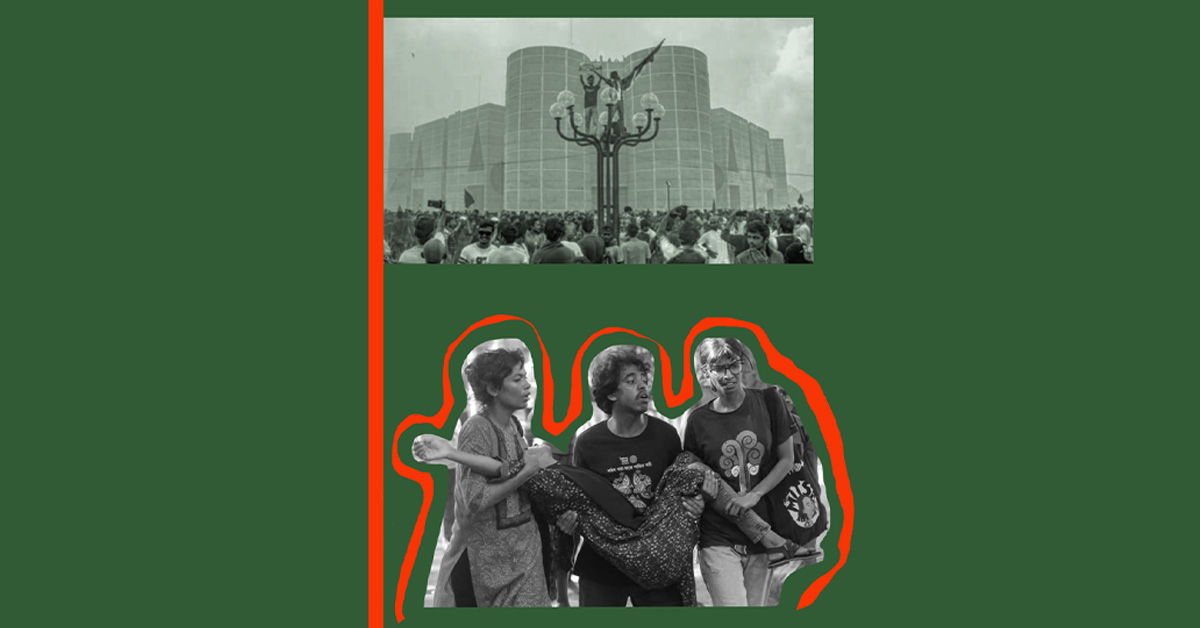
Inquilab Zindabad? brilliantly combines urgent analysis of the July Uprising and its unfolding aftermath with a searching historical inquiry into its political and economic background. Tell us how the book came about, and why you saw a need for its particular intervention.
Saif: The book actually began life as a much more modest attempt at a statement, then an FAQ, to cover what took place in Bangladesh between August 2024 and early 2025. But things quickly spiralled. Events unfolding in Bangladesh kept demanding that we extend the project further and further.
One of the things we really wanted to challenge was the pattern by which politics and social struggle in the Global South are reduced to a series of discrete events: they surface briefly in international headlines during moments of upheaval, only to disappear again once the immediate crisis passes. Bangladesh is particularly prone to this treatment. Major political developments – whether the July Uprising or earlier moments of crisis – are often presented in the diaspora without any serious engagement with the historical, social, or economic dynamics that produced them.
For Bangladeshis in Britain, much of the post-uprising discussion was trapped in a very narrow dichotomy: on one side – hysterical, hostile coverage (much of it originating from India) amplifying the biases of the former government and presenting the uprising as little more than chaos or conspiracy; on the other – an entirely uncritical celebration of the Interim Government and the coalition between student leadership and a Nobel Prize winning NGO-economist, still caught in the emotional afterglow of the uprising itself. Neither of these positions felt appropriate, nor did they do justice to the undeniable sacrifices of so many to overthrow the Awami League government.
What seemed missing was a more grounded attempt to understand what had actually happened: the social forces that produced the uprising, the contradictions within the student movement, and the uncertain political terrain emerging in its aftermath. The uprising was clearly an extraordinary event, but it also emerged out of much longer histories of political repression, economic restructuring, generational frustration, and unresolved questions about the legacy of 1971.
Individually, we continued to track developments in the country after the downfall of the Hasina government, and several of us visited Bangladesh in late 2024. Through conversations with comrades, activists, organisers, and ordinary people, and by following local media and political debates, we began to form a clearer picture of the emerging post-uprising landscape: the new student formations, the evolving role of the Interim Government, and the shifting political culture taking shape across campuses and cities.
Following those visits, we held several collective discussions within Nijjor Manush to identify the key issues we felt needed to be addressed. Out of those conversations came the decision to produce something more substantial than an internal statement: a book that could place the uprising within a broader political and historical framework, and communicate that analysis to a primarily Britain-based audience – especially to members of the Bangladeshi diaspora who were trying to make sense of events unfolding at home.
In that sense, the project has been both an attempt at documentation and an intervention, looking to capture the urgency of a rapidly changing political moment while also asking deeper questions about what the uprising represents, what forces are shaping the transition that followed it, and what possibilities (and limits) it reveals for political transformation in Bangladesh today.
The Uprising ended the traditional political dominance of the Awami League, formerly one of Bangladesh’s two ruling parties (alongside the Bangladesh Nationalist Party), and historically associated with the independence struggle. What were the sources of popular disaffection with the Awami League government headed by Sheikh Hasina?
Tasnima: Many of the tendencies exhibited by the Hasina government after its 2008 electoral landslide were not necessarily unique or novel to them, and corruption, repression and violence have long been mainstays of Bangladeshi politics.
But what the latter-day Awami League governments marked was a decisive break from the post-military rule period of democratic contestation, however fractious and violent that period may have been, and the consolidation of effective one-party rule. Between 2009 and 2024, all agencies, institutions and branches of the state became overtly politicised and subordinated to the Awami League. Opposition politics and civil society were ruthlessly suppressed (or co-opted), and the national political culture was reconstituted around the legacy of the Awami League, pre- and post-independence. State agencies such as the Rapid Action Battalion paramilitary force, introduced by the earlier BNP-Jamaat government, were expanded and became a byword for extrajudicial killings, while the Hasina governments also significantly ramped up digital surveillance and incommunicado detention.
As such, the flagrant displays of wealth by the Bangladeshi elite and the shameless corruption by state agencies and the League’s party wings were, very understandably, associated with the Awami League government. Hasina’s government made enemies across Bangladesh’s popular, political and civil society spheres, in addition to the layer of capitalists outside of its fold. The political disenfranchisement of the population by the government was met with an ideological delegitimisation of opposition as representing anti-liberation Razakar forces, most readily associated with Jamaat-e-Islami.
It is for that reason that the anti-quota movement that preceded the mass uprising resonated beyond students. The civil service quota itself was widely seen as a way for the Awami League to lubricate its patronage networks, while Hasina’s apparent portrayal of protesting students as “grandchildren of Razakars” in July 2024 was the moment that broke the floodgates.
The book situates social conflict in Bangladesh within the international political economy of global imperialism – including hyper-exploitation by its former coloniser, Britain – as well as ‘regional hegemonism’, particularly the role of India. How have these imperialist processes continued to shape or constrain liberation struggles in Bangladesh?
Azfar: Bangladesh’s economy has been conditioned by waves of colonial and neocolonial dispossession and indebtedness stretching back to the era of the East India Company. The British period saw (undivided) Bengal squeezed for revenue, its famous textile industry destroyed by colonial imports, and the region was made heavily dependent on agriculture. After partition, the East Pakistani (Bengali) economy was systematically subordinated to the needs of West Pakistan, effectively subsidising the country’s development while being subject to under-development itself.
These sets of dispossession and dependencies have brought mass suffering to the people, but also spurred transformative movements in their own right, including the eventual independence struggle in 1971.
Upon Bangladesh’s independence, the Awami League government of Mujibur Rahman attempted to chart a course similar to many other Third World countries at the time; namely, a mixed economy at home and non-alignment abroad, in an attempt to establish some degree of self-sufficiency and build up a domestic market. Like other contemporary governments in the subcontinent, such as Indira Gandhi in India, Zulfikar Ali Bhutto in Pakistan, and Sirimavo Bandaranaike in Sri Lanka, Rahman’s government adopted a soft ‘socialism’, marked by nationalisation, import substitution industrialisation, welfarism and aspirations towards, ultimately, a Scandinavian-style social democracy.
Also similar to those other countries in the neighbourhood, early Bangladesh’s practice of both socialism and non-alignment was mixed, contradictory and constrained by the petit bourgeois nature of the Awami League. But after the series of coups that culminated in the military rule of Hussain Muhammad Ershad in the early 1980s, Bangladesh took a decisive turn to the right, embracing neoliberalisation and an export-oriented economy. This has fundamentally shaped the mould of the country since then, with the Bangladeshi economy being restructured around low-wage manufacturing for global markets, including the emergence of the ready-made garments industry, which now constitutes its chief export, while simultaneously becoming trapped in IMF and World Bank-led aid and debt dependency.
While operating within this framework, Sheikh Hasina made “development” – including through eye-catching infrastructural mega-projects like the Padma Multipurpose Bridge, developed through international partnerships – her signature directive post-2008. But while there was undeniable progress in the country’s development during this time, the most visible symbols of this era were the rise of obscenely wealthy industrialists who made their money from export industries, or Awami League-linked politicians and capitalists siphoning funds from these mega-projects to store it in assets abroad.
Tasnima: Bangladesh has long been victimised by imperialism. In 1971, the US supported their regional beachhead, the Pakistani government, as they massacred Bengalis with the blessing of Nixon and Kissinger. Just years later, and less well-known, Bangladesh became a casualty of US sanctions on Cuba after it made a trade deal with the country, with the US withholding food aid to Bangladesh even as it was devastated by famine in 1974. As mentioned by Azfar, the shadow of neocolonialism still hangs over it today through its subordination to the low-wage manufacturing industry, as well as the export of labourers to punishing conditions in the Gulf monarchies.
But to bring something more recent into the discussion, too – in its very last days, the Interim Government signed a shockingly one-sided trade agreement with the US to relieve Trump’s reciprocal tariffs, which mere days later were struck down as unlawful themselves.
Under the terms of the agreement, Bangladesh must:
- Endeavour to purchase $15 billion of US liquified natural gas, as well as prioritise Boeing aircraft and military equipment sales from the US;
- Uphold the US’s ‘national security interests’ by adopting border measures or trade measures undertaken by the US;
- Liberalise the foreign equity cap to enable greater US ownership in Bangladesh’s energy and telecommunications sectors;
- Strengthen commercial and enforcement data-sharing with US agencies;
- Accept American agricultural biotechnology for sale within Bangladesh without demanding any local testing or approval from Bangladeshi agencies;
- Weaken food safety standards, and accept the US Food and Drug Administration’s standards for US-exported food and pharmaceuticals without testing by local agencies;
- Avoid pursuing its own national interest or alliances with China and other ‘non-market economies’.
Without any mandate, and negotiated under a non-disclosure agreement, Yunus’ administration effectively signed a surrender document on Bangladesh’s economic and diplomatic sovereignty, and pre-emptively hamstrung the now-elected government from exercising meaningful latitude in its political and military policymaking.
With the reciprocal tariffs themselves being struck down by the US Supreme Court earlier this year, the new government has avoided ratifying the agreement for now – but has indicated that it intends to go along with it.
There are definitely accounts to be settled with India and the way it has imposed itself upon Bangladesh in myriad ways – but examples like this trade agreement underscore the way that US-led imperialism still weighs heavily upon the country and truly shapes the terms upon which sovereignty can be exercised.
Since 2024, Bangladesh has been seen as the prototype of anti-corruption revolts across South and Southeast Asia, grouped under a nebulous label of ‘Gen-Z protests’ that usually ignores the underlying traumas of imperialism and capitalism. How do you see Bangladesh fitting into this wider pattern of popular revolt?
Tasnima: There are clear connections between Bangladesh and other mass mobilisations in which youth have led or played a large part in recently – be they Chile, Sri Lanka, Kenya or more recently Nepal. These include the bottom-line issues of inflation, unemployment, as well as repression and corruption of the political class. They represent, in part, a revolt against the long-broken political compact of postcolonial states in the Global South as they cast their populations out into the storm of globalisation.
But there is a certain shallow, liberal mystification built into the ‘Gen Z uprising’ framing favoured by the media, that is matched by a liberal-democratic sensibility that reigns over large parts of Bangladesh’s student leadership and its civil society today. Both obscure those deeper traumas, as you put it, and are structured on an ahistorical, idealistic notion that all would be well in Bangladesh if it were able to implement proper capitalism and its associated norms of liberal democracy.
This was the historical role that the Yunus administration was meant to play: it failed. This was the ideological glue of the NCP party and its promise of a ‘new settlement’: it failed.
There cannot be any procedural shortcuts or technocratic fixes to the problems facing Bangladesh or those other examples of youth protest, and continuing to operate on that basis will only feed cycles of disillusionment.
Azfar: Young people mobilising politically is a social fact. It is one we can expect to see increasing in an era where old strategies of maintaining or enforcing consent and buying off discontent have grown brittle and ineffective – in Bangladesh, and beyond. There is nothing intrinsically good or bad about this fact, and it should not be idealised at the expense of a rigorous interrogation of the ideologies and forms of consciousness that drive such mobilisations – but this appears to be exactly what is happening.
The subjective embrace of the “Gen Z uprising” frame by its participants in Bangladesh appears to be organic – murals across the country are testament to this. But the way it has been mobilised politically and been folded into the NCP’s project of a ‘new (constitutional-political) settlement’ only served to obscure the presence of deeply reactionary ideological trends present within Bangladesh’s “Gen Z”: up until the point that those trends consumed the party itself.
All that aside, the notion of youth leading uprisings isn’t new to Bangladesh, nor is it novel to “Gen Z”. Students and youth played a central role in the Bengali language movement of the 1950s, the independence struggle and the anti-dictatorship movement of the 1980s. But importantly, in many of those earlier movements, it was the youth of the left that shaped their ideological precepts. Today, significant sections of the students and youth in Bangladesh appear to have imbibed the more readily-available politics of liberal NGOism or reactionary Islamism as their horizons.
I think there’s a deeper issue at hand here, in that the ideological narrowness of the student leadership in Bangladesh today speaks to a wider crisis of consciousness in the Global South. There seems to be a growing “post-postcolonial” consciousness across Southern nations whereby educated youth look more to Dubai, Singapore, or World Bank myths of a corruption-free, democratic capitalism as their models of statecraft – far away from the ideals of the national liberation state of previous generations.
So I believe this is the ideological struggle that confronts youth in revolt today, particularly in the Global South: how can they reconnect to (and renew) the worldmaking projects that once moved us towards struggle and sacrifice? How can they grapple with the failures and shortcomings of the past without disavowing those struggles? And does the ‘generational’ framing of their current battles enable or obstruct that process?
You carefully distinguish the revolutionary process that played out on the streets – the resilience and self-activity of the poor, students, and women, and the creative possibilities when ‘time itself was malleable’ – to the formation of the National Citizen Party (NCP) that became the Uprising’s official spokesperson, and supported the Interim Government led by social entrepreneur Muhammad Yunus. What are your criticisms of the NCP and its ‘post-ideological’ politics?
Azfar: Ultimately the basis of unity for the NCP (and its predecessors, the Students Against Discrimination political platform – SAD – and National Citizen Committee) was fragile and unstable, resting largely on faith in technocratic reformism, hatred of the Awami League, an amorphous notion of pro-Bangladeshi sovereignty and fealty to the 2024 uprising, while skirting around more substantive ideological divisions that exist within the party in the name of preserving ‘centrism’.
That ideological indeterminacy may have been an asset for a single-issue movement in July 2024, but it quickly became a liability for a political party trying to strike a broad appeal while developing its own identity. The sources of discontent against the old government were diverse, ranging from righteous to deeply reactionary, but little attempt was made to parse those out upfront by either the SAD or NCP. Instead, it inherited some very suspect politics (especially on gender and social issues) into its ranks to battle out in behind-the-scenes factional fights.
It’s more liberal figureheads, like party chief Nahid Islam, who may have gained prominence through their inclusion in the Interim Government or being feted by overseas media. But its key on-the-ground organisers – figures like Hasnat Abdullah, Sarjis Alam, Nasiruddin Patwary and so on – were able to shape the party’s base, appeal and politics and turn it from a centrist party with a prominent right-wing faction to, in my opinion, a right-wing party with a centrist flank. Their increasingly overt flirtations with the Islamist right and their embrace of provocative right-wing populism all prefigured the NCP’s eventual decision to run as junior partners of Jamaat-e-Islami in the general election. But these also contributed to the deterioration of political culture within Bangladesh over the last 18 months, with its uptick in vigilantism and anti-women politics. Some of their ill-advised political stunts in places like Gopalganj also had fatal consequences – so these aren’t just trivial matters.
Now, with eight MPs, NCP may have emerged as the country’s 3rd party. But its decision to ally with Jamaat – splintering the party, empowering its right wing, and alienating its liberal-centrist voter base – means its ability to become an independent 3rd force remains murky.
An overarching issue discussed in the book is the contested legacy of the 1971 Liberation War, a “spectre” that has become an ideological and cultural battleground over the future of the country’s politics and national identity, aggravated by a growing generational divide. Tell us about this disputed legacy, and the process you call “Demujibisation”?
Saif: For those unfamiliar with Bangladeshi politics and independence, 1971 can be understood as both the climax of decades-long anti-colonial struggle against present-day Pakistan and the defining ideological currency of a state whose identity has been contested ever since.
Much like wider anti-imperialist and nationalist movements of the late twentieth century, left forces – ranging from various Communist parties, socialist student organisations, to Maoist groups such as the Purba Banglar Sarbahara Party – were key in both earlier political mobilisation and armed struggle in 1971. While student, labour and peasant organising carry a pivotal role in the collective memory of 1971, the left entered an independent Bangladesh, deeply fragmented. The Sino-Soviet split produced competing strategic orientations around the national question, alliances with bourgeois-nationalist leadership, and relations with India and the Indo-Soviet bloc – divisions that hampered the possibility of socialist forces consolidating political authority. In the aftermath of independence, repression by successive governments, combined with the state’s drive to monopolise organised violence, further marginalised these currents. The left was thereby unable to translate its pivotal contributions to liberation into durable post-independence political power.
This vacuum shaped the political order that followed. Instead of a socialist consolidation of the liberation moment, Bangladeshi politics came to be dominated by rival nationalist projects organised around competing claims regarding 1971’s meaning. On one side stood the Awami League, whose political legitimacy derived from its association with the independence struggle, and which articulated a form of Bengali secular nationalism infused with elements of social-democratic rhetoric and was historically aligned with India. On the other hand stood the Bangladesh Nationalist Party (the now ruling party), which promoted a more explicitly ‘Bangladeshi’ nationalism in which Islamic idioms were more prominent, and its political orientation was more oriented towards the Muslim world.
Jamaat-e-Islami (the now opposition) occupied a particularly fraught position within this landscape. It had opposed independence and collaborated with the West Pakistani military, helping organise paramilitary formations and compile lists of intellectuals and political figures targeted for assassination. This wartime role left Jamaat with a lasting legitimacy deficit within Bangladeshi politics, as its ideological position implicitly treats the break from Pakistan – a formally Islamic state – as a historical error. Nevertheless, the party has remained an enduring political force, illustrating how the unresolved legacy of 1971 continues to structure the boundaries of political legitimacy.
These rival nationalisms also obscured a deeper continuity. Despite their ideological differences, both dominant parties ultimately governed within a broadly capitalist political economy. In this sense, the struggle over ‘who owns 1971’ has often served as a substitute for class politics: it delegitimises opponents as existential enemies while largely leaving intact the social relations that structure economic life.
The early years of the Bangladeshi state revealed these contradictions clearly. The 1972 Constitution proclaimed nationalism, socialism, democracy, and secularism as founding principles, but the post-war government soon faced a severe economic crisis, famine, and insurgency. Rather than deepening popular democratic participation or building durable institutions of workers’ and peasants’ power, the state moved toward centralisation, emergency rule, and eventually one-party dominance under Sheikh Mujibur Rahman. Under his daughter, Sheikh Hasina, the Awami League increasingly fused national legitimacy with a dynastic ‘Mujibist’ narrative. His name and image became omnipresent across state iconography – billboards, monuments, national commemorations, building names, and cultural institutions – while constitutional amendments and legal frameworks entrenched the Awami League’s interpretation of 1971 as part of the state’s official historical narrative.
This centralisation and personalisation of the liberation legacy ultimately proved politically fragile. By concentrating national legitimacy in one party, and symbolically in one founding figure, the Awami League rendered the memory of 1971 inherently vulnerable to political reassessment. In the aftermath of the uprisings, this concentrated narrative has come under renewed scrutiny – not only regarding the Awami League’s own rule, but also the broader trajectory of the post-independence state.
The generational divide around 1971, therefore, reflects more than historical amnesia. For many younger Bangladeshis, the legacy of liberation is experienced primarily through its institutional afterlives – dynastic political legitimacy, policing of historical narratives, policies such as the quota system, which privileges descendants of freedom fighters. In conditions of widespread youth unemployment and economic insecurity, these institutionalised memories can appear less as symbols of collective emancipation than as mechanisms of exclusion.
Overall, the legacy of 1971 remains an unresolved political landscape. Liberal reformists, nationalist forces, Islamist actors, and fragments of the left all aim to reinterpret the significance of the liberation struggle and its unfulfilled promises. As seen in the first few weeks following BNP’s 2026 election victory, those in power continually claim to embody the movement, define its enemies, and police the boundary between legitimate opposition and ‘betrayal’.
Azfar: That brings us to what we describe in the book as ‘Demujibisation’, or the dis-establishment of Mujibur Rahman and the wider post-71 Awami League legacy. In addition to constituting an ideological project, this has been marked by a very pronounced street element, in which gangs and Islamist groups mobilised against symbols of Rahman, the Awami League and then 1971 at large – all with minimal response from the Interim Government, even as monuments to the liberation struggle lay vandalised or demolished across the country.
A few things are true.
First, Bangladesh inherited an almost uniquely fraught political settlement for a postcolonial country, not just for the competing visions of its independence legacy – that’s relatively normal – but for the enduring role of a party (Jamaat) in politically and militarily opposing that independence. That, in particular, is the spectre we describe in the book.
Second, Sheikh Hasina bears heavy responsibility for her imposition of her father and her party’s legacy upon the country, in a way that would naturally provoke backlash and disdain from the public and demoralise traditional defenders of that legacy.
But that being said, the process of ‘Demujibisation’ that has unfolded since 2024 is not merely an organic backlash to Hasina’s misrule, but has formed the thin end of the wedge of an intentional, and deeply reactionary cultural project advanced by the Islamist right. It doesn’t necessarily present itself as straightforwardly anti-independence, but ‘questions’ inherited wisdom, or relativises facts, to undermine the ideological precepts of the liberation struggle, to dilute the significance of the struggle, to rehabilitate Jamaat-e-Islami, and to reconfigure a new popular consciousness more inclined towards Islamic nationalism in Bangladesh. The opposition to ‘Mujibism’ has slotted cleanly into the broader arsenal of Islamist grievance politics that is fuelling the modern hard-right in Bangladesh, which points to the break from Muslim Pakistan in 1971, the alignment with India, and the consolidation of left-ish ideas upon the country’s founding, as foundational setbacks to the cause of Muslims in Bangladesh.
The defeat of Jamaat at the polls in February has been read as a verdict against its attempts at reconfiguring cultural memory in Bangladesh. But the legacy of the liberation struggle cannot be left in the hands of forces like the BNP to claim as their property – any more than it is the Awami League’s.
So, among the many steep challenges facing the Bangladeshi left include dealing with the issues of how to counter the growth of reactionary Islamic nationalism without simply harking back to their heyday of 1971, and rearticulating the values of the liberation struggle to a generation which reacts to them merely as the Awami League’s ideological arsenal.
You explain how the ‘right-wing Islamic revivalism’ spearheaded by Jamaat-e-Islami has capitalised on a political vacuum produced by discredited, elite versions of secularism and socialism, noting also the Islamist movements’ successes in recruiting young activists through grassroots social and welfare functions previously fulfilled by the old left. How might a reinvigorated left politics move beyond the traditional (statist) framework of secularism versus anti-secularism?
Tasnima: Hasina’s efforts to cast herself as heir of Bangladesh’s liberation tradition, and her instrumentalisation of the principle of secularism, which was woven into that tradition, have predictably backfired and created an ideological opening for the right to claim. Following the growth of reactionary Islamist politics under the earlier BNP-Jamaat government, several left parties, such as the Workers Party of Bangladesh and JaSaD, sought refuge in a political and electoral alliance with the Awami League from 2008 onwards, hitching their own political fate to that of the Awami League, with the expected outcome facing them now.
Secularism and Islamic politics in Bangladesh are two poles moving sharply apart. Bangladeshi secularism, which once symbolised an open, anti-communal politics that was poised against the Pakistani state’s chauvinistic religious nationalism, has stagnated into an elite, state-centric tool of governance. At the same time, Bangladeshi Islamic politics has become an entrenched outpost of the right, often overlaid with narrow sectarian dimensions at odds with Bangladesh’s own richer history of Islamic traditions.
But this hasn’t always been the case, and we can look to examples from within Bangladesh’s living memory for inspiration here. In the book, we refer to Abdul Hamid Khan Bhashani (‘Maulana Bhashani’), who was a founder of the Awami League, its left-wing breakaway, the National Awami Party and a lifelong anti-imperialist influenced greatly by Maoist China. Bhashani, while also being a religious figure, was a defender of secularism and struggled against reactionary Islamist currents, particularly Jamaat-e-Islami.
While not a doctrinal socialist, he avidly supported the cause of socialism and was able to advance a vernacular politics that brought the Bengali masses, including their rural and pious populations, together with the socialist and Marxist left in a way that seems difficult to imagine today. In some ways, Bhashani is a symbol of that particular era of Third World national liberation politics where socialism and religion could be articulated through one another in the course of popular struggle, rather than constituting mutually antagonistic ideological camps.
Recovering that won’t be an easy task, not least because the left’s bases of popular organising have been decimated over the decades, thereby giving oxygen to the notion of socialism and secularism as holdouts of elite civil society or NGO nostalgia. But creative formations on the modern Bangladeshi left, such as the Ganosanhati Andolan party and the Lokayoto group, are attempting to do so and move beyond the narrow bounds of secularism and modern Islamism.
Azfar: It is also important to grapple with the growing strength of this right-wing Islamic nationalism and how a new consciousness around a distinctly Bangladeshi-Muslim identity is crystallising around it in Bangladesh, as opposed to the secular Bengali linguistic nationalism of the Awami League or the Bangladeshi nationalism of the BNP. It draws upon a mix of Muslim majoritarianism, anti-India sentiment, and an antagonism towards cultural values deemed liberal or secular, and so it finds an easy foil in the Awami League. It also draws upon a more classic majoritarian grievance politics: the idea that the (90%) Muslim population of Bangladesh are being oppressed by virtue of being Muslim.
Electorally, Jamaat is the primary beneficiary of this trend, though BNP has historically represented a soft current of it too, and will likely pander to it. But this consciousness is being forged in places outside of traditional party confines. A prominent example of this is Osman Hadi, a charismatic, conservative cultural activist and independent MP candidate whose killing in December cemented him as an icon of the Bangladeshi right (and also further afield). Hadi’s cultural project centred on refashioning and decoupling Muslim Bengali identity from supposedly alien Indian cultural influences – a narrow cultural nationalism, but also an idea that has disconcerting echoes of the West Pakistani establishment’s views on Bengalis in the East as carriers of a supposedly tainted, syncretic culture and Islam. The fact that his killing triggered some shocking scenes of mob violence targeting liberal and secular institutions, which were tagged as “Indian agents”, is an indication of where this sort of consciousness can lead.
Even if this growing trend did not translate to an outright electoral breakthrough for Islamist forces this time, it doesn’t show signs of going away. For this reason the attack line used against Jamaat by their opponents (both BNP and the left) as merely representing a foreign, ‘pro-Pakistan’ force due to their role in 1971 is also somewhat anachronistic: they are speaking to a genuine political current taking root within the country today and operating within the confines of post-independence Bangladeshi nationalism, which needs to be tackled as the real phenomenon it is rather than just an imported politics.
What have been the major political developments in Bangladesh since the book’s publication last August, and the February 2026 elections? Does the left-wing alliance in the Democratic United Front offer a convincing socialist alternative to both the Awami League and the NCP-Jamaat coalition?
Tasnima: While the landslide victory of the BNP in February’s elections is being projected as a comprehensive rejection of Jamaat, this is being somewhat overstated. For the very first time, Jamaat are the official opposition and well positioned to poach popular support (perhaps even coalition partners) from the new government, came marginal second in dozens of seats, including PM Tarique Rahman’s own Dhaka seat, and has MPs in the capital – including the former seat of Mujibur Rahman.
Given that Bangladesh runs on First-Past-The-Post, they would very likely have fared even better in a three-way race were the Awami League allowed to run and split the anti-Jamaat vote, while in Barisal in the south, a last-minute alliance defection of the hardliner Islami Andolan party split the Islamist vote there and deprived Jamaat of a few close runs. Evidence from pre-poll surveys suggests that Jamaat’s attempt at rebuilding its image as a moderate, inclusive force has won it new constituencies of support from youth and women.
Jamaat, meanwhile, will continue playing the long game. Its disciplined cadre organising and that grassroots social and welfare presence will enable them to continue making gains and winning support while BNP, whose local presence is often marked by extortion, land grabbing, patronage and violent outbursts of factional fighting, lose popular goodwill.
With regards to the Democratic United Front of socialist parties, there were no discernible breakthroughs or notable showings other than in Barisal, where Manisha Chakraborty of BASAD (the Bangladeshi Socialist Party) attracted some national attention and achieved a respectable 22,486 votes. The left parties have an uphill battle to build popular support and to assert themselves as a legitimate alternative to the BNP and Jamaat coalitions.
Of the 299 MPs elected in February there was one left MP, with leader of the Ganosanhati Andolan party Jonayed Saki winning a convincing victory in his Chattogram seat. But he ran as an alliance party of BNP – meaning he did not have to contest against a BNP candidate – and has now been rewarded with a junior ministerial role in Tarique Rahman’s cabinet. Given how stark the makeup of the rest of Parliament is, we’re interested to see what Saki can do as an MP, but I think it’s clear that that example is not a model for how the Left can rebuild in Bangladesh, and the left must build itself into a force independent of either of the bourgeois parties.
Azfar: I don’t think any of us will pretend to have a programmatic solution for how the Left in Bangladesh can win. But some observations based on how things have played out post-2024 and during this election may offer a few framing questions that the socialist Left would need to wrestle with, as well as some clear pitfalls they’ll need to navigate.
Some of these pitfalls are obvious: resisting the temptation of lining up between BNP (or any other bourgeois party) in their alliance as a way to stave off the rise of Jamaat and its allies. Figuring out how to claim the political space for Bangladeshi social democracy now that its traditional standard bearer, the Awami League, has been ejected from the field, without simply becoming, as many legacy socialist parties have, hammer-and-sickle social democrats themselves.
But potentially the most consequential is how the Left manages the pressure to return Bangladesh to consensual politics and to fold in political polarisation (of any kind). That form of stage-managed politics is, after all, the promise of the liberal democratic thinking that is currently dominant in post-uprising Bangladesh, whereby legitimacy is derived through parliament or civil society lobbying. It is also true that much of the polarisation that has marked Bangladeshi politics has taken the form of either partisan political violence of the previous decades or, post-uprising, the iconoclasticism and vulgar agitation politics seen by NCP and the Islamist groups – all of which have more likely served to fatigue the wider population rather than stirring them towards democratic political action. How then can the Left rebuild a politics of healthy polarisation around the generative contradictions of class, imperialism, social injustice and so on, within a context where the new government will be attempting to rein things in?
In terms of elections, it’s worth acknowledging that the terms of the election were not conducted on terms particularly favourable to the Left. Rather, they largely reflected the dominant strain of thinking that won out in the course of the uprisings, which was focused on restoring liberal-democratic principles, as well as issues like corruption and law and order. Insofar as more big-P political issues such as the Liberation struggle were raised (largely against Jamaat), it was the BNP that was best placed to monopolise that, rather than the marginal Left. And yet, there was also an undeniable popular element to the uprisings, which has in turn infused a set of implicit or concealed class demands in the mix, and the overarching challenge for the Left is how to prise out and organise some class politics from this dominant mode of thinking.
To take one example, all but 1 MP elected were from one shade or another of right-wing party. But all the major parties pitched themselves to the centre (arguably even left-of-centre), and promised a suite of welfare-oriented policies. The BNP’s manifesto, for example, dismissed austerity or the idea that poverty is a personal failing, while pledging increased social protections, financial assistance and farming cooperatives. All of this was underpinned, of course, by commitments to deregulation, trade liberalisation and creating a more comfortable environment for the private sector. Jamaat similarly promised to build an “Islamic welfare state” and made big, if noncommittal, promises on healthcare and education expenditure. NCP have spoken of building a ‘welfare-oriented economy’, and Muhammad Yunus’ shtick has long been about a compassionate capitalism without poverty, where entrepreneurialism can deliver the poor from their oppression.
On one hand, these commitments are the baseline requirements of doing politics in an impoverished peripheral country. But on the other hand, this is also a reflection that this election has taken place after grotesque, unmanaged social inequalities enabled a student protest to turn into a mass movement. The question for the Left then becomes how to move the question of welfare away from the framework of cash transfers and minimum safety nets as a means to guarantee social peace, and instead rebuild the containers of self-organisation to advance social struggle, meaningfully empowering the working class and peasantry, for once the main parties decide it’s time to swing rightwards again.
Meanwhile, the question of defending Bangladeshi sovereignty has been a forceful issue over the last two years. But despite this, a meaningful anti-imperialist politics was absent from the uprisings, and this sovereignty discourse has mostly expressed itself as popular discontent against India exerting its hegemony over the country. Its articulations have also been mixed, ranging from principled criticism of the Indian government, to xenophobia and communalism, to belligerent populist calls to ‘break up’ India. It’s a legitimate grievance, but one that needs to be dealt with more delicately than is currently the case – not least because, handled badly, it precludes opportunities to build solidarity with Left, worker-peasant, and progressive forces within India too.
Now, with the latest US-Bangladesh trade agreement representing a frontal assault on Bangladeshi sovereignty, the question then becomes: how can the Left tie scattered, inchoate Bangladesh sovereignty politics to a meaningful anti-imperialist politics?
Nijjor Manush is an independent socialist organisation for Bangladeshis and Bengalis, based in Britain. Their work focuses on two aims: sharing and celebrating the important contributions the diaspora have made in resisting oppression and injustice in Bangladesh and elsewhere, and organising the diaspora community around issues both domestically and internationally, and matters uniquely affecting them.
Art by Sonia Uddin