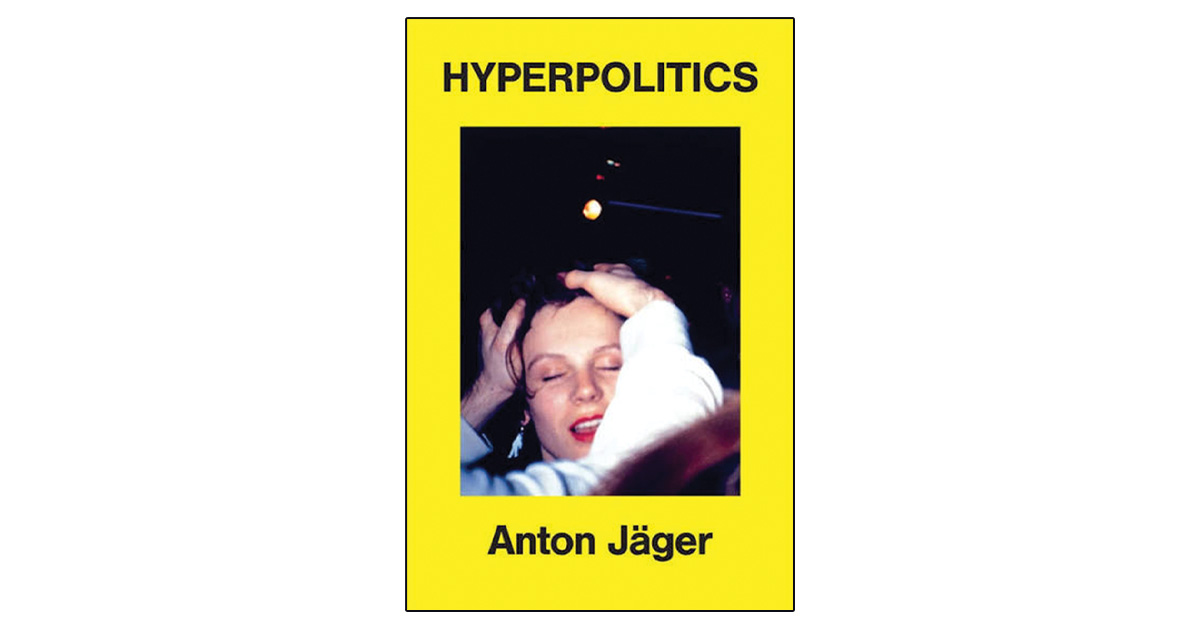
The publication of Anton Jäger’s Hyperpolitics: Extreme Politicization without Political Consequences might be seen as something to welcome by those of us who mutter about “the party”. It, along with books like Vincent Bevin’s If We Burn, puts forward the argument that the political consequences of recent struggles have dissipated in the absence of institutional forms that can sustain themselves across waves of activity. What energy does exist on the left is repeatedly lost; we are no longer building institutions, and the failure to do so allows the growth of the far-right. Whereas Bevins relied on his journalistic visits to various global protests of the 2010s, Jäger’s shorter text attempts to put forward an impressionistic account of the “hyperpolitical era”.
Admittedly, Jäger is clear in both the book itself and on most public speaking occasions about the impressionistic nature of this book. However, whilst somewhat effective at grasping the emotional and organisational stakes of the moment, Hyperpolitics likely muddies far more than it reveals, latching onto a conceptual framework that is far more about its memeability than its penetrative capacities.
Several recent reviews have touched on the limitations of Hyperpolitics. Alex Colston, writing for Protean, launched a sustained critique which particularly highlighted how a subtle economic determinism underscores much of Jäger’s account of politicisation.1 In Cosmonaut, Julian Assele further highlighted how Jäger provides an underdeveloped account of civil society institutions, and their incorporation into the state.2 Assele rightly highlights the racist dynamics of American civil society and their near absence in Jäger’s account of historic mass institutions. This review attempts to add to these by focusing on Hyperpolitics’ limited account of “institutionalisation”.
Periodising hyperpolitics
For Jäger, hyperpolitics denotes “a tendency rather than a totalizing style. Nevertheless, this book argues that it constitutes a gravitational pole in the force field of twenty-first century politics” (5). This hyperpolitical era is one wherein “politicisation”, that is, political feelings, energies and actions, far exceed their “institutionalisation”, the forms of civic association in society. Political anger and identification are contrasted with historical breakdowns in political party and trade union membership, as well as other forms of association.
This relationship allows Jäger to draw the following diagram, claiming to represent the relationship between the two aspects:

From this development, Jäger goes on to provide an impressionistic periodisation of the early 1900s to today. There is “the mass politics of the short twentieth century (1914-1989), the postpolitics of the ‘very long’ 1990s (1989-2008), and the antipolitics of the 2010s.” (5) As can be seen from the above diagram, the period of mass politics is one wherein politicisation is contained within institutional forms, the post-politics of the later years is a period of sustained collapse in politicisation and institutional decline, followed by a small window of reversal in politicisation during the anti-politics of the early 2010s, which accelerates into a moment where the politicisation rapidly exceeds institutionalization; our current hyperpolitical era.
Before approaching the problem of whether you can or should quantify “politicisation” and “institutionalisation” into lines on a graph, it is worth unpacking this periodisation.
Looking at the start of the graph, it’s notable that for Jäger, the politicisation of the late 1800s somehow exceeded the institutional form, only coming to cross over in the mid-1910s. How the “high-period” of pre-war social democracy, as well as the wave of union and workplace organisation which occurred across many European states, fits into this account is unclear.3 Certainly, it seems that the decision to introduce the period of mass politics as one wherein these previous mass institutions faced significant crises in Europe due to their support for the war is dubious.4 Far more persuasive is the introduction of this crossover later in the interwar years, after the emergence of the Russian Revolution and the interwar growth of simultaneously large social-democratic and communist organisations.5
Relatedly, we can note the claim that the institutionalisation exceeded the period of politicisation of the 1917-1923 period of revolutionary activity within Western Europe. This belies the realities certainly in Italy’s Biennio Rosso, the tragic experience of the German Revolution, as well as other European provisional republics set up in that period, whose predominant experience was a contest between council forms of democracy and existing state forms.6 This was a period where the political acts taken could be seen as in excess of institutional forms, and wherein older institutions had to reformulate their relationship to ensure their survival. Similarly, one may doubt this periodisation for the wave of struggles in Western Europe which occurred across the 1960s and 1970s and whether the institutionalisation could be said to have remained above the politicisation.7
Finally, one may question where the various national liberation struggles of the 1900s fit within this picture and how this account fits into a global class politics. Certainly, elements of Jäger’s periodisation fit regarding elements of the left in Western Europe and the United States, but we begin our analysis of class struggle in a global context. To read the immediate post-1945 period as the peak of institutionalisation hardly fits with the emergence of sustained organisations of workers across Africa, Latin America, and Asia during this period, as well as the emergence of parties committed to self-determination, either through armed struggle or other means. Certain Western European parties faced institutional crises, but globally, these years saw the emergence of institutions as broad as the Algerian Liberation Front, the Palestinian PFLP, the Việt Minh and its armed forces, and the African Party for the Independence of Guinea and Cape Verde, to name only a few. Even in the later decades, we see the emergence of the Workers’ Party of Brazil in Latin America and the struggle of workers and parties to end Apartheid in South Africa. Once you begin to look elsewhere, the counterfactuals of institutional forms come thick and fast.
All of the above points to the fact that this periodisation is based on two ideas that invoke more feeling than clarity: “institutionalisation” and “politicisation”. Certainly, there are ways to gain indicative measures for these things. How many people are members of unions? How many demonstrations are there, and how many people turned out? But to push beyond these in this manner tends to flatten the very complexity of the terrain of society and organising in it. That one could draw the graph in Hyperpolitics is itself a problem.
Reinserting the terrain of politics
Certainly, we should make the argument for mass membership organisations, particularly as Marxists, for the tasks needed to mount a struggle against the political rule of our states.8 Similarly, we can recognise that our political moment sees wider political anger captured by the organised Right in ways that are deeply concerning and put the forces of the Left on the back foot. However, particularly when it comes to the idea of “institutionalisation”, we must be clear that more needs to be demanded. To argue that we need membership and civic association is the easiest part; the issue is precisely putting forward strategies to develop and forge them.
We struggle on a political terrain which is not flat. There are the systems of global capitalism, the relations between capitals, and the many states across the globe. These states are not simply their repressive bodies – the police, border guards, prisons, and army – though they do rely on them as the ultimate basis of their existence. Against these states are the variety of subaltern classes, from workers to peasants, who engage in struggle and are ultimately to be brought together both against their states and the global system of property. They may be together in parties, in unions, or other forms of “institutionalisation” in civic society. Then there are the problems of how these institutions relate across class forces, with each other, with the state, and within global capitalism.
One of the defining features of the period covered in Hyperpolitics is the integration of civil society and political society, what Gramsci terms the integral state.9 The lines between civic associations and the traditional institutions of the state are only made ever more messy. For example, from the late 1800s through to today, workplace organisation could enter into various levels of ‘illegality’ with the state, but the period since saw the emergence of various attempts to incorporate layers of union movement into the institutions of the state, often requiring sustained movements of rank and file workers to challenge this. The same goes for a great many institutions of civic association, from mass worker parties to voluntary groupings. That this integration is constantly in flux, subject to the push and pull of class struggle, is important for understanding why different states can emerge under capitalism and different institutional forms develop to counter them.
The account of ‘institutionalisation’ put forward in Hyperpolitics, expressed most egregiously in its line graph, is unable to penetrate this messy terrain. If I succeed in getting rank and file workers to join UNISON today, that is different from if I got a similar proportion to join NALGO, its predecessor in the 1950s, or the guilds that formed that in the early 1900s. The mass workers’ parties of the late 1800s had a rapidly changing relationship with the state compared to the parties of social democracy and the Third International, never mind their changing relationships with each other and the state over the long 1900s. Accounting for the points of similarity and difference, what they reveal about our general orientation to other militants, the wider class and the development of institutions contrary to the state is required to do that work seriously.
Occasionally, some of this detail is acknowledged. For example, in “Putnam from the Left”, Jäger acknowledges that the decline of union membership “involved both push and pull factors” (28).10 A schematisation of parties in the mass political age is attempted over two pages (36-37). Similarly, acknowledgement is made that parties and unions refigured “their relationship to the state” (39). However, these qualifications float past, as we return to a narrative of institutional decline repeated on beat. Instead of an attempt to engage with this detail, we are left with an impressionistic account of various cultural artefacts which are meant to reflect the argument. The book is just as likely to labour on Wolfgang Tillmans’ photography, the writing of Michel Houellebecq, and invocations of Annie Ernaux as it is to acknowledge the complexity of the political. This gives bone without flesh.
How are we to be politicised
Jäger provocatively states that politics today is “low-commitment, low-cost, and all too often low-value” (8). What this provocation attempts to get at is how individuals may be “politicised”, come to identify with some political positions, but their activity is predominantly mediated through social media identification and engagement. What this then leads to is mass proliferation of “political” organisations, wherein campaigns without any real membership or rootedness are pronounced on social media. People attend marches, donate, and share content, but these remain small leaps which do not produce further institutions.
The absolutely correct kernel of Hyperpolitics is to argue that rebuilding mass membership organisations is a necessary part of rebuilding class politics today. Its flattening of the terrain of institutionalisation converts this provocation into something else. The most likely response from militants today is to “keep on keeping on”; if I am a member of a smaller revolutionary group mainly concerned with its own reproduction, such as the PSL in the US or the SWP in Britain, I will continue. We need “institutionalisation”, but we also need to develop an analysis of which institutional forms are needed, how they relate to the state and capital, and why our existing ones are inadequate.
Whilst minimally referenced in the book, the last few years have seen the global movement against the genocide in Palestine. As a global ecosystem of institutions resisting the genocide, this contains everything from state and non-state military institutions, the Boycott Divestment and Sanctions movement, workers taking collective action to disrupt supplies, and those engaged in direct action against the arms sector. At times, we could recognise the hyperpolitical dimensions of this movement in the imperial core, those who merely share posts but are not building institutions which sustain the struggle against the genocide. However, to really understand what Palestine may do for class struggle in nations like Britain and the US, we have to demand far more.
Take, for example, the New York Times (NYT) and its “coverage” of the genocide. There has been a longstanding history of anti-Palestinian writing by the newspaper, but this intensified along with the genocide. For example, in April 2024, it was revealed that an internal memo had forbidden writers from using the terms “genocide” and “ethnic cleansing” in their coverage.11
How the NYT and US media are acting as a cover for the genocide in Palestine has been met with a variety of tactics and activities. Most notably, Writers Against the War on Gaza has attempted to mobilise against this media complicity. On one level, some of its tactics are precisely the kind of “hyperpolitical” moves which Jäger might critique. Someone politicised by the genocide online may end their subscription to the paper or merely refuse to ever share a NYT article again. However, at the same time, it has organised sustained boycotts by writers associated with the paper, as well as building wider links within the publishing space around this, attempting sustained organising with workers within the media system to exert pressure. Outside of this, it has produced a significant media apparatus, both in its regular bulletin and its agitprop New York War Crimes, as well as mobilising with membership organisations of Palestinians and socialists to take direct action and protest the media complicity. There are a variety of tactics, institutional forms, and bodies at play here, all operating as a result of a desire to build greater “institutionalisation” around the cultural boycott.
Again, one could see the critique of some of the more petitionary and symbolic acts surrounding such a boycott as “hyperpolitical” and institutionally inadequate. However, the combination of activity with workers in media and membership organisations more broadly suggests the picture is never that clear-cut. In fact, the coming together of institutions like Writers Against the War on Gaza is precisely the kind of bodies straddling both the hyperpolitical “low-commitment” tactics and wider membership institutions; they operate to move people through the former whilst building the latter.
That is to say, Anton Jäger, a Contributing Opinion writer for the NYT since September 2023, might complain of “low-commitment, low-cost, and all too often low-value” ways of political organising. There may be reasons he finds that quite attractive. The relationship between the institutions which form around such “low-cost” activity is often ripe to develop into something larger and more complex. This is the art of organising in a hyperpolitical moment. Rise to the challenge, rather than merely diagnosing it.
- Alex Colston, ‘Hyperpolitics? Yes, please’ Protean, 26th March 2026, https://proteanmag.com/2026/03/26/hyperpolitics-yes-please/ ↩︎
- Julian Assele ‘Against Civil Society: A Review of Anton Jäger’s ‘Hyperpolitics’’, Cosmonaut, 27 March 2026, https://cosmonautmag.com/2026/03/against-civil-society-a-review-of-anton-jagers-hyperpolitics/ ↩︎
- On early European Social-Democracy, particularly its most notable form in Germany, see Steenson, Gary P Steenson, ‘Not One Man!’ Not One Penny!’ German Social Democracy, 1863-1914, (1981, University of Pittsburgh Press) as well as Andrew Bonnell, Red Banners, Books and Beer Mugs: The Mental World of German Social Democrats, 1863–1914, (2021, Haymarket Books). In the Tsarist Empire it is possible to review Eric Blanc, Revolutionary Social Democracy: Working-Class Politics Across the Russian Empire (1882-1917), (2022, Haymarket Books). ↩︎
- The crisis of institutional forms as a result of the drive to war is covered in both Rosa Luxemburg, The Junius Pamphlet: The Crisis of German Social Democracy (1915) and Lenin, The Collapse of the Second International (1915). ↩︎
- See for example the difficulties posed in Germany as the interwar years regarding the relationship between large social-democratic, communist, and ultra-left organisations. Discussed most notably in Trotsky, The Struggle Against Fascism in Germany, (1971, Pathfinder Press), The German Left and the Weimar Republic: A Selection of Documents, ed. by Ben Fowkes, (2015, Haymarket Books) and Paul Levi, In the Steps of Rosa Luxemburg: Selected Writings of Paul Levi, (2012, Haymarket Books). For the wider discussions of this amongst the Communist International see Towards the United Front: Proceedings of the Fourth Congress of the Communist International, 1922, ed. by John Riddell, (2012, Haymarket Books). ↩︎
- On Italy and the factory council movement see Paulo Spriano, The Occupation of the Factories: Italy 1920, (1975, Pluto Press) and Gwyn A. Williams, Proletarian Order: Antonio Gramsci, Factory Councils and the Origins of Communism in Italy, 1911-21, (1975, Pluto Press). For the German Revolution see Pierre Broué, The German Revolution, 1917-1923, (2006, Haymarket Books) and Chris Harman, The Lost Revolution: Germany 1918 to 1923, (1997, Bookmarks). For related revolutions of this era, such as in Austria, see Otto Bauer, The Austrian Revolution, (2021, Haymarket Books). For a limited overview, see Donny Gluckstein, Western Soviets: Workers Councils: Workers’ Councils Versus Parliament, 1915-20, (1995, Bookmarks). ↩︎
- On 1968 and the subsequent years, some introductory works include Kristin Ross, May’68 and its Afterlives, (2002, University of Chicago Press), Chris Harman, The Fire Last Time: 1968 and After, (1998, Bookmarks) and Steve Wright, Storming Heaven: Class Composition and Struggle in Italian Autonomist Marxism, (2017, Pluto Press). ↩︎
- Harry Holmes,‘Revenge of the Network Left’, Prometheus, 19 September 2024, https://prometheus-mag.com/2024/09/19/revenge-of-the-network-left/ ↩︎
- See Peter Thomas, The Gramscian Moment: Philosophy, Hegemony and Marxism, (2011, Haymarket Books) and Christine Buci-Glucksmann, Gramsci and the State, (1981, Lawrence and Wishart). ↩︎
- Again, noting that this linear decline in trade union membership and worker organisation becomes less convincing when looking at capitalism globally in the decades, rather than Europe and America. ↩︎
- Jeremy Scahill and Ryan Grim, ‘Leaked NYT Gaza Memo Tells Journalists to Avoid Words “Genocide,” “Ethnic Cleansing,” and “Occupied Territory”’ The Intercept, 15 April 2024, https://theintercept.com/2024/04/15/nyt-israel-gaza-genocide-palestine-coverage/ ↩︎