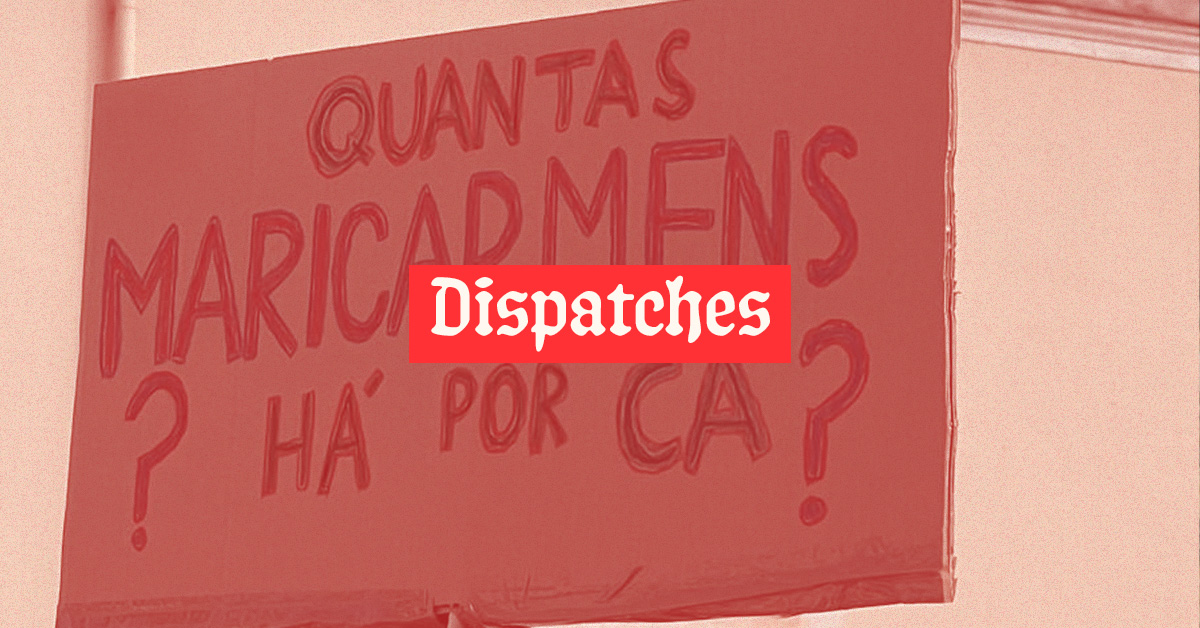
July 11th 2026, in the town of Oisy-le-Verger, in the North of France, a few thousand people assemble. A convoy of vehicles has arrived from a nearby protest camp – cars, bicycles, and tractors pass through the streets until they reach the town centre. Among the crowd, a brass band plays, black bloc activists swelter in the heat and sandwiches are distributed to the attendees. After the music stops, speeches are given from the back of a flatbed truck, from ecological groups, the agricultural workers’ union, and even from the ‘free party’ scene.
This motley group has come together to protest the proposed Seine-Nord Mega-Canal – a 106km long and 54m wide canal which aims to link the Seine to the wider Benelux region. The project has faced backlash from ecologists, farmers, and those opposed to its expanding public cost, and this demo was the culmination of such opposition.
The march, led by tractors, then proceeds along a pre-approved route with the police. At a certain point, there is a split in the crowd. Over loudhailers, marchers are told they are welcome to continue along the approved route, or to join a non-approved breakaway to visit the site where canal construction has begun. This writer decides, as with all coverage of French protests, that to really see the action, they should follow the black bloc onto the non-approved splinter.
The splinter makes its way down some side roads, then walks on the edge of a few fields, committed to not stepping on any sown crops. Coming to a fence with barbed wire and posts at the edge of a field, the black bloc began inviting everyone to cut the barbed wire and pull up the fences. As the crowd makes it around the corner of a field, they can see the construction site for the mega-canal in the distance, surrounded by French police vans. They continue marching forward, now carrying the fence posts and chunks of barbed wire they have pulled up.
As they get within a hundred metres of the construction site, riot police rush out of the vans, with visors on and launchers armed. They begin firing stun grenades and tear gas at the protesters, trying to prevent them from pushing through to the construction site. Most of those in the firing line are already prepared with helmets, masks, and goggles, and begin throwing back tear gas grenades whilst attempting to avoid the small explosive stun grenades.
The police would go on to accuse the black bloc of firing fireworks at the police, and that these ignited the field. However, it is far more likely that a poorly aimed grenade from the police landed in the dry wheat next to the construction site and set fire to it. A growing wall of fire began, as police continued an unrelenting firing of tear gas grenades down onto the march. The fire continued to grow, eventually consuming 4.4 hectares of land nearby. With fire on one side and continued tear gas and police in front of them, the crowd beat a retreat, using the fence posts to construct makeshift barriers as they went.
Returning to Oisy-le-Verger, the splinter continued to the site of the smaller existing Canal du Nord, where the rest of the march had continued to. There, a mass trespass of several hundred activists began, with everyone jumping into the canal and swimming together. The chant of ‘Siamo Tutti Antifascisti’ began, but rather than the usual clapping after the chant, those treading water smacked the water surface on beat. Droplets fly everywhere, swimmers laugh and cheer. A Frenchman in a boat is making a speech about the importance of water for life to those swimming, but at this point, this writer just lies back and floats.
Five years of struggle in France
The July action in Oisy-le-Verger is emblematic of many which have occurred in the last five years in France, as part of a series of actions coming under the umbrella of ‘Les Soulèvements de la Terre’ or Uprisings of the Earth (LST).
LST is best understood as a coalition, bringing together assorted local struggles against infrastructure projects and other forms of ecologically destructive activities in one national umbrella. These local groupings coalesce alongside various agricultural worker organisations, leftist associations, and smaller ecological groups like Extinction Rebellion.
A focus of its actions, especially given repeated heatwave and drought conditions hitting France, has been water projects, particularly the ‘mégabassines’, which are large industrial reservoirs constructed as short-term solutions to secure water supply. The argument of activists, farmers, and hydrologists is that such reservoirs secure water for the larger industrial farms, whilst destroying the existing water supply and local biodiversity. On top of this, such large bodies of water also increase vulnerability to further evaporation in hotter futures. Basically, taking water now, destroying the local habitat and smaller farms, to give to larger farms, whilst ultimately making the supply more vulnerable to climate change.
After several waves of successful actions of these proposed sites, including emerging sabotage actions, the French state struck back. During the widespread protests against Macron’s pension reform, in March 2023, in Sainte Soline, 25,000 people marched against one of these basins, meeting violent repression from 5000 police. In the ensuing conflict, an estimated 4000 grenades were fired at the protesters, hundreds were injured, and two activists were put in a coma as a result.
Macron’s government attempted to enforce the dissolution of LST, a legal measure where the state demands a group disband. However, in response, the group launched a public petition where people declared themselves members of the organisation, reaching around 110,000 publicly declared members. With such membership numbers, as well as mass demonstrations across French cities, the state was forced to back down and did not proceed with the dissolution.1
Since this demonstration, actions have continued in both a mass character, where thousands have protested the A69 motorway construction project, and in their hundreds, such as in December 2023, when a hundred masked activists sabotaged a concrete plant in Val-de-Reuil.
In 2024, to demonstrate the continued strength of the movement, a large camp and days of protest were organised at the agri-port in La Rochelle. Several tens of thousands of activists marched through the city, facing kettling and indiscriminate tear gassing in response. Despite this police were unable to prevent the march, and a contingent successfully made their way into the port.
Thus, the latest demo in 2026, now focused on a mega-canal construction project, reflects nearly five years of sustained mass protests, combined with resistance to state repression and incorporating forms of direct action. That this movement is broadly unknown in the anglophone world is a problem, especially given the poor state of our ecological movement. How has such a movement sustained itself? And what might be learned for those of us in different contexts?
Behind the ecological curtain
It is something of a truism that the worldwide climate and ecology movement is at a low ebb, compared to the wave of struggles which marked the late 2010s. In one part, this is in response to the urgency of the Palestinian liberation struggle, wherein ecological activists have moved to rightly prioritise resistance to the genocide. At the same time, there is state repression of ecological activists, such as in the growing custodial sentences in Britain and elsewhere, and burnout in the face of continued ecological breakdown and backtreading on the nominal gains of past years. Germany, long the centre-point of cross-European ecological politics, with its regular mass actions and camps around Ende Gelände, found itself in a political crisis and shunned by wider international networks, given widespread support for Israel within its ranks. It is only now emerging from the isolation, with a sharper but far-smaller anti-Zionist edge.
The movement in France has been able to sustain itself far longer for various reasons. It emerged from existing networks around the Zone à Défendre (ZAD), giant activist camps against infrastructure projects, which succeeded in mobilising some support during the 2010s. These networks contained people well used to combative resistance with the police, rooted in relationships outside of major French cities, whilst also able to organise wider support networks within.
In addition to this, the stratified nature of French agriculture means there is a farm sector which contains both the smaller farmers, often represented in the Confédération Paysanne, as well as the larger, well-off farmers British audiences would recognise. Ecological groups are then able to build alliances with local groups through these links to smaller farmers who have often sustained structures of working-class resistance in rural areas.
Rather than lead with the existential risk of climate change, the movement has focused on initiating a public contestation of the very infrastructures which both cause climate change and make us more vulnerable to it – particularly, but not exclusively, water. As stated in one of their communiques:
‘The aim of the struggle against the mega-reservoirs led by the Confédération paysanne, Bassines Non Merci, and Les Soulèvements de la Terre is to halt project construction while creating the conditions for a genuine debate over the usage and distribution of water understood as a common good. However, this takes time.’
This is not to smuggle the struggle around climate change into different topics, such as making them about water access or road building, but a longer project of democratisation of climate mitigation and adaptation. Rather than focus on the technical elements of mitigation and adaptation (though they naturally feature), what is focused on is the way the state and capital have placed us on the pathway to further ecological breakdown without our say, and in many cases, with projects in our face displaying this contempt.
If water is being made more scarce due to climate change, then movements like LST insist on the defence of water and putting it under the control of those who need it most. This does not prefigure the result, but it at least opens the reality of class rule – that the working-class are the ones suffering most in the heat, working long hours, and paying increased prices for access to water.
Some of these elements, cadres with experience of riot police and widespread small farmer unions, are not transferable. However, key elements are: commitment to building alliances between struggles against imposed and ecologically destructive projects, facilitating a diversity of tactics, not building based on self-identification with climate impact as the priority, rather the need for a pause of such destructive projects.
Thus, against British mythologies of French combativeness, the picture that emerges from France is one of rooted and sustained struggle about who is in the driving seat of the ecological transition.
However, these thoughts only came after the tear gas had subsided. For several hours in July, this author floated in the Canal du Nord and thought of nothing but the cool water in the area and the need to keep it safe.
- Note however, that since in 2025 the state did push for the dissolution of La Jeune Garde (an antifascist group) and Urgence Palestine (a Palestine solidarity collective). ↩︎