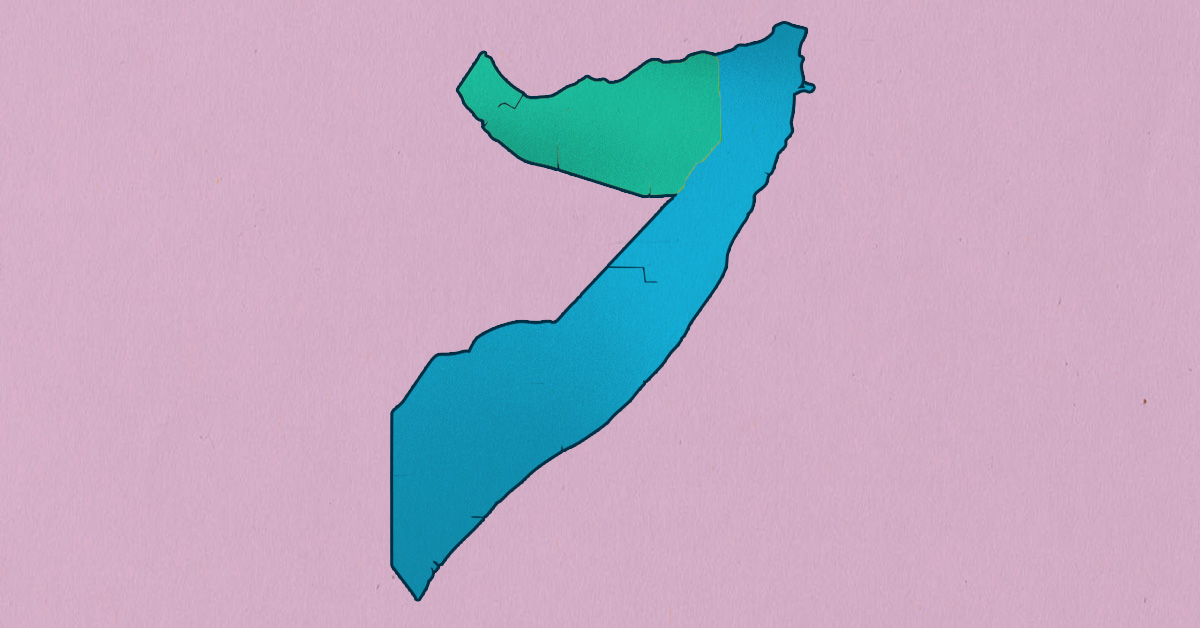
On the 26th December 2025, the world witnessed the absurd spectacle of the increasingly ostracised state of Israel’s unilateral recognition of the autonomous region of Somaliland via video-call on a chipped, red iPhone. The footage, devoid of the symbolic pomp and ceremony usually accompanied by such a significant diplomatic move, was circulated across Israeli propaganda channels and the Somaliland government’s social media accounts. In the clip, Netanyahu asserts Israel’s commitment to upholding the right of self-determination for the people of Somaliland, an audacious attempt to confer onto himself the ability to identify legitimate cases for self-determination, as opposed to what Israel claims is the illegitimacy of Palestinian national sovereignty. Such a strategy bears the echo of Zionist instrumentalisation of the genocide in Sudan to undermine the international movement against the extermination of the Palestinian people in Gaza and across the Occupied Territories1.
It is no accident that this occurred approximately three months after the UK, France, Portugal, Canada, and Australia formally recognised Palestinian statehood, a gestural manoeuvre to pressure Israel for a ‘ceasefire’ agreement, rather than a genuine expression of support for Palestinian self-determination – let alone a demonstration of a real desire to halt the genocide. Formal recognition of statehood, therefore, became a tool to: advance imperial ambitions (Israel), perform frustration with the genocide (Western governments), and further nation-building goals (Somaliland).
During the exchange, Netanyahu assured President Abdirahman Abdullahi Irro that he would convey to Trump, Somaliland’s enthusiasm to join the Abraham Accords – the alliance of co-conspirators to genocide, comprised of the UAE, Bahrain and a couple of subsequent signatories. It concluded with an invitation for a diplomatic visit to Jerusalem, which Irro gleefully accepted, grinning throughout the affair. Having just finished a year in office, Irro could now triumphantly proclaim his efficacy at advancing the cause of formal Somaliland statehood.
In celebration of the news, a minority of Somalilanders, both at home and in the diaspora, waved Israeli flags in tribute. Most, however, received the announcement with utter shock and disgust. Whether the “indigenous cadre of ‘auxiliaries’” to colonialism, to quote the great Somali psychologist and theorist Hussein Abdilahi Bulhan, have strayed far enough as to invite overthrow remains to be seen2.
Grappling with Somaliland Nationalism
The Somaliland government’s decision to align itself with Israel, especially at this present juncture, seems baffling on its surface. How could they be so craven as to obtain recognition from the state engaged in the slaughter and torturing of their Palestinian kin? Why would a region, with a long-standing commitment to anti-Zionism, not revolt at the prospect of their president entangling Somaliland nationalism with diplomatic ties to a genocidal state, even telegraphing further military, economic and political cooperation between the two parties?
The key lies in tracing the emergence and articulation of contemporary Somaliland nationalism, forged within the crucible of the civil war. Misguidedly, Somaliland nationalism has been presented as a revival of an earlier form of nationalism birthed within the British Protectorate. This narration, deployed by a significant strand of Somaliland nationalists, grants the ideology the heft of historical legitimacy and justifies its restitution. The 1960 voluntary union with Italian Somaliland is rendered a tragic interregnum, an experiment engaged in good faith that brought eventual devastation, rather than collective liberation.
Regrettably, this obscures the fact that the broader Somali nationalist project was a shared one, inflected with the specificity of the colonial contexts that fuelled its development. The Somali-inhabited lands were originally partitioned into five territories, under the rule of four imperial powers (Britain, Italy, France and Ethiopia). As historian of pan-Somali nationalism and anticolonialism, Safia Aidid, succinctly put it: “The anticolonial nationalist movements that led the former British and Italian territories to independence and unification…sought to subsume difference under the rubric of a modern Pan-Somali identity.”3
Whilst there is a great deal of linguistic concordance between Somalis, there remain divisions based on clan, race, and caste which prove formidable obstacles to the establishment of a cohesive Somali identity. Therefore, the commitment to building pan-Somali nationalism is a more ambitious endeavour than is typically credited, due to the entrenched, simplistic accounts of Somali homogeneity in scholarship and political analysis4.5
In Somaliland’s popular civil war memory, the North met brutal repression for the sin of initiating a rebellion in the early 1980s against the Siad Barre regime, a dictatorship established in a bloodless military coup, following the assassination of President Sharmaarke in October 19696. For many Somaliland nationalists the language of genocide and ethnic cleansing is used to comprehend the scale of the violence meted out to the North, due to the mobilisation of clan identity during the war and the causalities in the region being predominantly from one over-arching clan7. Korean historian, Jie-Hyun Lim’s theorisation of “victimhood nationalism” is appropriate here: by putting “the dichotomy of victimizers and victims into national terms, the victimhood becomes hereditary and thus consolidates the national collective beyond generations.”8
Consequently, the emergency precipitated by the civil war is made permanent, the threat from the Somali government always lingering, and formal recognition becomes the only way to ensure the survival of the people of Somaliland. In this respect, the civil war never really ended, it was merely in a state of dormancy, waiting to be roused.
Condemnation
The backlash to the agreement with Israel was swift and unrelenting – throwing the cause of Somaliland nationalism into existential crisis. The government of Somalia identified the declaration of recognition as an attempt to erode its sovereignty indefinitely, with Somalia’s President Hassan Sheikh Mohamud calling it a “naked invasion.” The African Union, Arab League, and nations around the world condemned the imperial machinations fragmenting Somalia, even though many of their own governments have normalised and continue to cooperate with Israel. Utilising its term as a member of the UN Security Council, Somalia called an emergency meeting, whereby 14/15 of the members (the US being the lone holdout) denounced the agreement. Staunch Somali nationalists and apologists for the Siad Barre regime (the two are not interchangeable, though there is miniscule overlap) pointed to the move as vindication of their opposition to the recognition of a secessionist state and threat to Somali territorial sovereignty in the wake of the fall of the dictatorship in 1991.
Much of the analysis by the anti-imperialist left has arrived at two conclusions:
- The recognition (rightly) should be understood in the context of Israel’s war on Yemen, as a means of countering the anti-colonial acts of solidarity with Palestine from Ansar Allah. The country has felt the hand of imperial aggression acutely: ravaged by counter-revolutionary violence after the 2011 uprising; US drone warfare; the military invasion by the Saudi-led coalition in 2015; the UK-US airstrikes in Yemen in 2024-2025; and finally, Israel’s bombing campaign last summer. For Israel and its allies, Somaliland holds a key geographical position, with its proximity to the Bab al-Mandab Strait, acting as a potential launchpad to quell Yemeni anti-imperialist and anti-capitalist actions in the Red Sea, particularly the naval blockade waged from 2023-present9. In response, Ansar Allah leader, Abdel-Malik al-Houthi threatened retaliation, declaring that if the Somaliland government permits “any Israeli presence”, it will be considered a “military target for our armed forces”.
- The correct anti-imperialist position is to affirm Somaliweyn (Greater Somali) nationalism along the lines of the pre-1991 borders. Recognition of Somaliland serves to splinter the Horn, only assisting a myriad of imperialist powers in weakening the already beleaguered region. Some have framed it in the context of national liberation struggles, reflexively defending and affirming the Somali government, in the face of the Somaliland leadership’s misdeeds against its people and its betrayal of Palestine.
Compromised Nationalisms
The Horn, and Somali political history more broadly, is a glaring blind-spot within the global anti-imperialist movement, with many scrambling to address this gap through superficial research to formulate a position. Absent the requisite attentiveness to intra-Somali divisions and strategic calculations, the reciprocal agreement between Israel and Somaliland has buoyed the fortunes of Somaliweyn nationalism, eclipsing the Somali government’s own attempts to court imperialist approval. Somalia voted to approve Trump’s plan for the colonial administration of Gaza, which was met with zero opposition by the UN Security Council and two abstentions from Russia and China respectively. The Somali government rewarded its most reliable ally, Turkey, with exclusive access to oil and gas exploration, in a deeply exploitative agreement that grants the Turkish Petroleum Corporation the right to “recover up to 90 percent of the petroleum it produces each year”- leaving Somalia with a mere 5% royalty cap. In a letter leaked last year, Somalia offered up the ports of Berbera in Somaliland and Bossaso in the autonomous region of Puntland, for exclusive use by the United States, against the wishes of Somaliland and Puntland’s regional governments. The aforementioned ports were already the site of UAE’s neocolonial endeavours, each hosting a military base, and in the case of Berbera, receiving additional “investment” of $442 million for the redevelopment of its airport and port, with the Dubai government owned, DP World, in possession of a controlling stake. The Emiratis have also been accused of utilising Bossaso for the purposes of supplying the Rapid Support Forces in Sudan, ensuring the genocide there continues unabated.
The Paradoxical Nature of Somali Recognition and Sovereignty
The Somali people have been subject to a succession of treacherous and incompetent leaders in both territories, as well as in neighbouring Djibouti. The present predominant iterations of official Somali nationalisms hardly resemble the anticolonial and post-independence dreams of the Somali people. Yet it is important to note, without offering absolution, that the Somali governments remain hamstrung by their position within the global hierarchy of nations. Additionally, the designation of Somalia as a perpetual “failed state,” has resulted in ahistorical and decontextualised renderings of its history, obscuring why this Cold War causality remains a persistent site of neocolonial predation.
And perhaps their greatest challenge: every US administration since the implosion of the dictatorship has authorised military involvement in some capacity – be it the 1993 US-led UN invasion; special operations forces; airstrikes; drone warfare; the War on Terror deputisation of neighbouring countries such as Kenya and Ethiopia, AFRICOM; and the training of Somali military personnel10.11 In fact, one can glean a great deal about the trajectory of American warfare since 1991 through the prism of its over three decades of aggression in Somalia.
Frustratingly, in attempting to make sense of this moment we are left with more questions than answers. How do we reconcile Somaliland’s hunger for recognition, regardless of the motivations and values of the state offering it? How do we square Somalia’s fears of diminished territorial and political sovereignty, with the reality that Somali sovereignty is constantly breached and rendered conditional based on the interests of imperialist powers? What use is the preoccupation with recognition and sovereignty, when, as I detailed earlier, both governments self-vassalise to varying degrees?
Route to Formal Statehood?
Somaliland’s leadership has, predictably and pragmatically, sought recognition by appealing to the Anglo-American political elite, rather than associating with Rojava, Baloch, Kashmiri and Saharawi nationalist movements that have a base of support amongst the anti-imperialist left.
Due to Somaliland’s colonial history, members of both major UK parties have displayed a keen interest and deepened their ties with its government since the 2000s, culminating in a registered All-Party Parliamentary Group for Somaliland in 2016. The group’s current chair, Tory MP Gavin Williamson has been a long-standing advocate for British recognition in a bid to advance UK interests in the region12.
Comparatively, Somaliland’s leaders’ strategy for US recognition has been to align with the American right, due to limited lobbying success with liberals, who have not deemed the cause a priority. This orientation predates Irro. His predecessor, Muse Bihi Abdi, accepted an invitation to give an address before the neocon thinktank, the Heritage Foundation in 2022. During his speech, he referred to the civil war as a genocide, as well as drawing direct parallels between the plight of Somaliland and Ukraine: “we went through the same experience.”
The next year, the foundation would share its policy programme, informally known as Project 2025, in which Somaliland and Djibouti make an unexpected appearance. Under the heading, “Counter malign Chinese activity on the continent,” its authors call for “the recognition of Somaliland statehood as a hedge against the U.S.’s deteriorating position in Djibouti.” Last June, Republican congressman, Scott Parry sponsored a Somaliland recognition bill, alongside five other GOP co-sponsors, though the bill has not moved beyond the Foreign Affairs Committee. By August, Senator Ted Cruz sought to ramp up momentum by composing a direct letter to Donald Trump, urging him to recognise Somaliland, due to its willingness to forge ties with Israel, permit “a U.S. military presence near the Red Sea along the Gulf of Aden,” as well as its receptiveness to “critical minerals agreements that would support our supply chain resilience.”
Following the recognition agreement, both Israel and Somaliland sought to solidify the alliance quickly. On 6th January 2026, Israeli Foreign Minister, Gideon Saar, arrived in Hargeisa for diplomatic talks and photo-ops. Irro, himself, has recently signalled he will visit Jerusalem in the very near future. At this year’s World Economic Forum in Davos, Irro and Israeli Prime Minister Isaac Herzog once again projected the strength of the new alliance, with the latter posting about the meeting on social media. Though Irro maintained that rumours of an agreement to “accept” displaced Palestinians in exchange for recognition were unfounded, he reiterated the government’s willingness to cultivate greater military and economic ties. In an interview with Sky News Arabia, Irro defended the recognition agreement as merely confirming the reality of an already functioning state. He blithely admitted that it was, after all, a quid pro quo exchange: “The Israeli government needed more Arab countries to recognise Israel and we need recognition, so it was two-way traffic.”
For the Israelis, the establishment of formal diplomatic ties with Somaliland marks a shift in its approach in the region. As Abdimalik Ali Warsame details in his essay charting Israeli policy in the Horn, its historic political and military support for Ethiopia was intended to act as a bulwark against Somali nationalism, which it believed was deeply entwined with Arab nationalism and anti-zionism13.
As for Irro, his sights are set upon what he sees as the possibility of forthcoming US recognition, as evidenced by a nauseating and historically revisionist Wall Street Journal op-ed. In the piece, he refashions Somaliland nationalism to meet the new reality his administration created:
“Israel and Somaliland share a deep understanding of the struggle for self-determination and international legitimacy. Somalilanders have long regarded Israel as reflecting our own journey, and the hope of advancing shared interests has never waned.”
Interestingly, Trump has equivocated on the subject, affirming Israel’s choice to recognise Somaliland whilst indicating he has no intentions of changing US policy imminently. Yet American recognition seems inevitable, but a painful price will likely be exacted in exchange. In the immediate term, Trump remains content with attacking Somalis domestically to energise his base and distract from the growing ire directed at his administration. And as members of the US Somali diaspora are painfully aware, there is no distinction between Somalia and Somaliland in this assault upon their community which reached a morbid crescendo via ICE occupation, kidnapping, detention and the execution of Minnesotans. In early February, in an attempt to hasten US recognition of Somaliland, Irro appealed to Trump in a language in which he is fluent: bribery. Once again, he offered the US access to its minerals, oil, gas, agricultural land and, to sweeten the deal for the resort devotee, its beaches.
With Somaliland nationalism plunged into jeopardy by an administration that purports to be its steward, the question before us now is this: do we pen the obituaries or is there a pathway for its survival? Ultimately, as the imperial hawks continue to pluck at the Horn, it is up to the Somali people to determine what political ideologies and collective configurations are most conducive to unity, liberation and resistance to the powers that see Somali lands as a supply route with the inconvenience of a population who call them home.
- The former US Secretary of State under Biden, Anthony Blinken serves an exemplar, naming the genocidal violence in Sudan, whilst co-waging genocide against the Palestinian people. https://2021-2025.state.gov/genocide-determination-in-sudan-and-imposing-accountability-measures/ ↩︎
- Hussein Abdilahi Bulhan, ‘Black Psyches in Captivity and Crisis,’ Race & Class XX, No. 3 (1979): 244. ↩︎
- 1. Safia Aidid, ‘A Revolution of Letters: Text, Sight and Spectacle in Socialist Somalia,’ The American Historical Review (2025): 2. ↩︎
- For a useful introduction to the aforementioned divisions refer to: Ali Jimale Ahmed, ed, The Invention of Somalia (Red Sea Press, 1995) ↩︎
- Somali nationalism was underpinned by two core tenets: the continuity of traditional Somali culture prior to European colonialism and anticolonialism. See: Hassan Mahaddallah, ‘Pithless Nationalism: The Somali Case’ in Abdi Kusow, ed, Putting the Cart Before the Horse: Contested Nationalism and the Crisis of the Nation-State in Somalia (Red Sea Press, 2004): 59-74. ↩︎
- For brief account of this history of the Siad Barre regime, placed within the context of the trajectory of Somali nationalism’s development, refer to: Ahmed I. Samatar, Socialist Somalia: Rhetoric and Reality, (Zed: London, 1988) ↩︎
- The counternarrative from most Greater Somali (Somaliweyn) nationalists, rejects this framing, which they see as negating the extent of the uprisings, destruction and loss of life in South. There is, however, a small minority that accept this reading of the civil war but maintain their fidelity to Somaliweyn. ↩︎
- Jie-Hyun Lim, ‘Victimhood Nationalism and History Reconciliation in East Asia,’ History Compass, 8, No.1: 1. ↩︎
- For more on this see: Laleh Khalili, ‘Red Sea Attacks,’ London Review of Books, Vol. 46, 4 ,February 2024, https://www.lrb.co.uk/the-paper/v46/n04/laleh-khalili/red-sea-attacks; Ashok Kumar, ‘Weaponising the Supply Chain: Yemen’s Blockade and the Contradictions of Maritime Logistics Capital,’ Antipode, Vol. 58, 1 (2026) ↩︎
- For a thorough account of Kenya’s role in the US War on Terror in Somalia see: Samar Al-Bulushi, War-making as Worldmaking: Kenya, the United States, and the War on Terror, (Stanford, 2024) ↩︎
- For an overview of the US-backed Ethiopian invasion of Somalia in 2006 which was justified via the War on Terror script of tackling “radical Islam”: Abdi Ismail Samatar, ‘Ethiopian Invasion of Somalia, US Warlordism & AU Shame,’ Review of African Political Economy, Vol. 34, No. 111, (2007) ↩︎
- See Gavin Williamson’s article calling for British recognition: https://politicsuk.com/news/time-for-britain-to-recognise-somaliland/ ↩︎
- Abdimalik Ali Warsame, ‘Israel, Ethiopia and the Somali question,’ Geeska (April 2025). https://www.geeska.com/en/israel-ethiopia-and-somali-question ↩︎