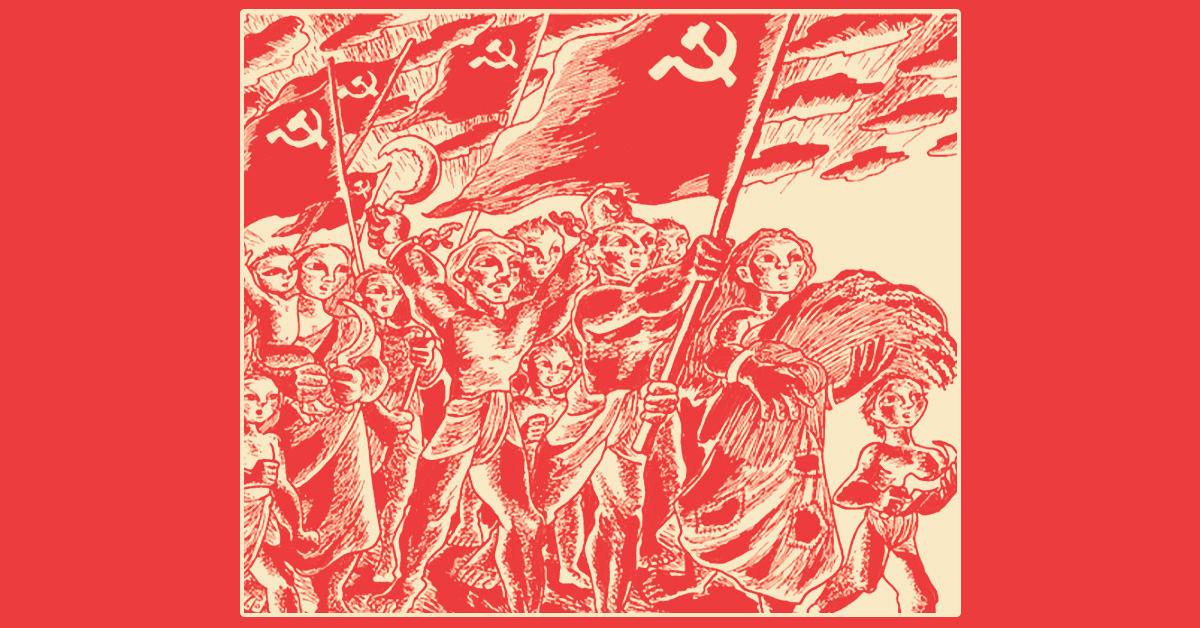
2024: a year to remember
We are without doubt living through a period of exceptional global tumult and rising popular struggle. Israel’s genocidal assault on Gaza has provoked massive protests and now a student uprising, which has spread across the world. Palestinians fighting for their survival and liberation have been joined by the solidarity of millions, who fight on despite heavy state repression. As Palestinian bodies are piled ever higher, the old smear tactic of false antisemitism – which actually distracts from the rise in genuine antisemitism, including that coming from the conspiratorial right – is growing less effective by the day. All the while, the Zionist regime is trying with all its strength to goad Iran into a full–scale regional war so as to force the US to dispatch its enemies once and for all.
In Europe, the war in Ukraine is leading to remilitarisation, with billions being spent on military aid to fund a proxy–war between Russia and NATO in which the West is determined to “fight to the last Ukrainian”. Russia is desperate to maintain and advance its regional sphere of influence and resist the incursions of the US and its project for a new American century, and both powers have declared their willingness to engulf the world in flames to reach their goals.
This conflict is a shadow of the coming war between the US and China and demonstrates the willingness of the US to exert its military power to overturn its relative decline as the imperialist hegemon. The cracks in US dominance are widening, and the elaborate superstructure which enforces it is coming under strain. In particular, the edifice of the “rules–based international order” is crumbling before our eyes. The US, in its unconditional support for Netanyahu and Israel, is now at odds with the ICC and ICJ, the very institutions it had relied upon to prop up its global rule. The legitimating institutional framework of international law and human rights, always applied unevenly in defence of the West, is increasingly discredited in the eyes of the world.
In Britain, inflation and the rising cost of living are putting everyday goods out of reach for many workers, and there is no end in sight for austerity and the stripping of public services. Cost–cutting and price gouging are keeping profits high whilst quality of life is everywhere diminishing. Capitalism’s connotation of progress and development has broken down, and this thin ideology remains only as a snarl for the existing order which is conspicuously immiserating the working class. Day by day, more people are waking up to the reality of the system, which can no longer offer enough “carrots” and relies increasingly on the “stick” of law and order, censorship, and repression.
Uneven development and weakening political legitimacy are threatening to pull apart the Union. Sinn Féin are on the rise in Ireland. Having become largest party in the occupied 6 Counties for the first time, they have taken the unprecedented step of taking the role of First Minister. With the Shinners topping the polls in the 26 Counties the question of unity is firmly on the agenda and a border poll appears inevitable. Whilst a ‘constitutional road’ to Scottish independence is off the cards for the foreseeable future, a ‘militant’ offshoot from the SNP is a real possibility, and the integrity of the UK state is far from secure.
The ruling class and its lackeys in Parliament and the media are using culture wars to manufacture political support and revive accumulation through oppression. A turn to the ‘family’ is growing, with transphobia and queerphobia being openly deployed ‘in defence of children’. Both antisemitism and anti-black racism is on the rise. Islamophobia has been successfully mainstreamed, beginning with covert and media efforts as part of the war on terror, including the British state nurturing the far right, and is now being overtly employed by ministers and politicians in defence of Israel. The far right’s rhetoric and policies against migrants and asylum seekers has also become political ‘commonsense’ and infected both the Tories and Labour, leading to increasingly extreme policies.
Returning to the global stage, capitalism is reaching its ecological limits. The climate catastrophe has already struck with the ‘Global South’ acutely suffering from its effects. Capitalism’s doctrine of ‘expansion for expansion’s sake’ is antithetical to sustainability, likewise the uneven division of the world into competing states means that it is inherently incapable of providing a global solution to what is a global problem. Unchecked, the system threatens to cross several cataclysmic “planetary boundaries” (global warming, ice cap melt, disruption of the nitrogen and phosphorus cycles, and more). With the return of the spectre of nuclear war, the risk that capitalism will annihilate us all in its compulsion to profit has never been greater.
This is not to say the end of capitalism is assured or imminent. For communists in the early twentieth century, the outbreak of WW1 and the overthrow of Russian Tsarism with a revolutionary socialist government appeared to herald the final demise of capital. However, this assessment was mistaken, and, after the horror of a second world war, capitalism entered a new ‘Golden Age’ under US hegemony that revelled in the eventual collapse of ‘Official’ Communism and triumphantly proclaimed ‘the end of history’. All our past efforts came to nothing and we are once more back at square one, without organisation or strategic direction.
In days gone by the Labour Party could be described as a bourgeois workers’ party, masquerading as a voice for the working class, while remaining thoroughly loyal to the UK state and successfully acting as a bar on revolutionary class consciousness. Under Sir Keir Starmer the Labour Party is no longer even a vehicle for false hope in a different future, instead it loudly proclaims to be nothing more than a safe ‘second eleven’ to step in for a Tory Party that has torn itself apart.
With the coming July 4th General Election a Labour victory is all but assured. Those that are voting for Sir Kier Starmer’s party are doing so out of antipathy towards the current crop of Conservatives in government rather than from a place of genuine enthusiasm for a Labour government. A crisis of expectations will surely follow as reality of the asinine logic of ‘Tories out’ plays itself out, however, whether or not the left is able to capitalise on this opportunity is a question that remains entirely within our control.
Marxists know that this decaying, moribund mode of production cannot be saved, that it goes from crisis to crisis. Only a clean sweep and the establishment of socialism on a global scale can put an end to the current ailments that blight the world. There are now more reasons than ever for a genuine mass communist party to be formed and give direction to the upsurge in activity we are seeing and take it to a higher level, a revolutionary level.
The need for a party
The capitalist mode of production and class struggle are inseparable. The majority of the population, the proletariat, are divorced from ownership of the means of production, and so must sell their labour power to those who do own the means of production, the bourgeoisie, just to subsist on the minimum amount necessary for their maintenance and reproduction. The capitalist desires to exploit their workers as much as possible e.g. lower wages, speeding up work, longer hours, whereas the worker seeks the opposite, to minimise their own exploitation as much as possible e.g. higher wages, better working conditions, work fewer hours.
This organically results in the proletariat forming organisations to fight for its own economic self–defence (e.g. trade unions) and for their own material interests under capitalism. Likewise there is an organic trend towards political representation on the level of the state in order to secure democratic and legislative gains. Any such gains, however, are not granted willingly by the capitalists or the state and must instead be won and re-won through ongoing class struggle. As a result, the organisations required by the working class are necessarily permanent organisations.
Class struggle can only cease once class society ceases to exist. The only class capable of bringing this about is the proletariat as it is the only class with an interest in ending the wage labour system and the only class that is capable – as both the overwhelming majority of the population and as the productive class – of creating an alternative society. In this way the proletariat has the potential to raise itself up from its status as a servile class to being a revolutionary universal class that represents the future of the whole of humanity.
However the proletariat is not inherently conscious of this world–historic task. Left to its own devices the natural tendency of the workers’ movement is one of seeking reforms within the capitalist system rather than devising its overthrow. It’s only once the organic workers’ movement merges with the socialist movement that the proletariat goes from being a class in itself, to becoming a class for itself and thus able to carry out its revolutionary mission. Whilst this consciousness can ‘snowball’, collective decision making and action are still necessary. Thus, if the communists are to succeed, they too require an organisation – the highest form of organisation being the class party.
The form of this party must be an embryo of the society we seek to establish, it must be radically democratic just as how we envision the proletarian state, it means the membership of the party have real control of the party, being able to freely express their political views and organise into factions. The party must be a party in the real sense of the word, being a part of society, with its millions of members enveloping as much of society as possible to form a ‘state within a state’, an organisation independent from, but fully permeating bourgeois society.
As Marx said in the Programme of the Parti Ouvrier, “the emancipation of the productive class is that of all human beings without distinction of sex or race.” The proletariat can only be emancipated once it is capable of emancipating all of humanity. The party must be the loudest advocate for the oppressed, the organisation which indicts every injustice of the capitalist system – including those injustices that are not directly tied to the class struggle. Through this solidarity the communists undermine the hegemonic power of the capitalist class and further strengthen the forces of revolution.
The crisis of the left in Britain
The formation of the Communist Party of Great Britain in 1920 was the single greatest achievement of the working class in Britain. The liquidation of that organisation in 1991 by Eurocommunist interlopers merely formalised the dissolution that had already occurred after a decades–long process of political and organisational decay.
Thirty years on from this historic defeat, the left is yet to recover anything close to the strength and influence it once had. The absence of a communist party looms large on our movement. The fragmentary remains of that tradition have become ossified whilst its one–time competitors have not only remained small and ineffective, their fissile nature has spawned countless micro–sects and ‘sects of one’ whose differences become even more obscure and abstruse with each passing day.
The far left in Britain is dominated by three major sects: the Communist Party of Britain, Socialist Workers’ Party, and Revolutionary Communist Party. All three have had their own idiosyncratic failures and crises, including transphobia, abuse cover–ups (most notoriously the SWP’s ‘Comrade Delta’ scandal, cover up, and recent non–apology) and collapsing into Labourism and opportunism. On the other hand, the membership of all three has grown recently and this injection of mostly younger comrades has led to more slick media output and some moderate impact within wider protest movements.
These recent successes only mask the inherent weaknesses of these sects, however. The pattern of splits, scandals, and periodic membership haemorrhage is an inherent feature of their form of organisation: bureaucratic centralism (command of the centre over the branches and suppression of internal democracy) and unity on the basis of theory rather than around a principled programme. Moments of breakthrough in membership growth or apparent success in broad–front electoral alliances are only ever the prelude to disappointment, when the doomsday prophesies of imminent revolution prove to be false or the militant rhetoric gives way to capitulation into craven opportunism and bourgeois reformism.
Until these organisations develop a real revolutionary strategy and put aside their petty sectarianism to build programmatic unity, there will be no mass communist party. Instead we will continue to have a confusing mess of competing organisations, in total opposition to the working class’s objective need for genuine unity
Amongst these organisations, however, there are some green shoots of hope. Firstly, the larger groups have a wellspring of dedicated activists who are learning vital skills of theory, agitation, and propaganda, and their energy could be harnessed to great effect. Secondly, trends and factions are emerging which are recognising the need for unity and beginning to work towards this. A particularly honourable mention goes to the comrades in Revolutionary Socialism in the 21st Century, who are taking advantage of their organisation’s openness about discussion and its as–yet–undetermined strategy to advance the partyist perspective. They by no means alone, and The Partyist believes wholeheartedly that the work being done by such comrades contains our greatest hope of advancement.
Strategic rethinking
Having outlined the crisis of the left in Britain as we see it, The Partyist offers the following assessment as the basis for a strategy for fostering unity and overcoming sectarianism.
We first observe that neither ‘ignoring the sects’, nor ‘party building’ through recruitment alone, are viable strategies for the creating the communist party that we so desperately need.
It is self–evident that to disregard the existing organisations of the left as sects, only to set up new, ‘pure’ organisations is to simply produce yet more – smaller and more isolated – sects. Not only is such a move highly hypocritical, it is highly detrimental in that it further atomises our movement.
Often connected with this is the notion that an organisation can become a revolutionary force despite its alienation from the existing movement through recruitment alone. However, in spite of the frequency that this idea is deployed, we note that there is not one example of this non–strategy actually producing anything more than a highly unstable sect of a few thousand that invariably produces yet more sects as well as a high turnover of potentially valuable class–fighters. In short, attempting to brute force your way into becoming a mass party is altogether delusional.
Recognising the above means that if we are to overcome the present crisis of the left in Britain, we must find a strategy that enables us to ‘work through the sects’.
Aside from the negative conclusion that sect–abstentionism is an illusory dead–end, we should also draw out some positive aspects that are to be gained from setting our strategic sights within the existing left. In particular, whilst it is undeniable that many comrades within the existing left groups personify the bureaucratic, anti–democratic, historically misinformed and altogether dogmatic ills of those organisations; it is also a fact that these ‘institutionalised’ cadres as well as the new comrades that they recruit into our movement provide a wealth of knowledge, experience and discipline.
Despite the dire situation the left finds itself in today, the above point proves that there are reasons to be hopeful. The Partyist upholds that with the correct strategy for unity, the toxic lead of the sects can be transmuted into invaluable party gold. In sterquiliniis invenitur – in filth it will be found.
We must be wary, however, of not falling into the trap of false unity that is exemplified by the many broad fronts, popular fronts, and unholy alliances that plague the left in Britain. Easy roads are always sure to lose – the popular front being yet another example. Whilst ‘broadening’ the politics of a given alliance may seem like an easy shortcut to mass support, in reality this means enforced unity of the ‘lowest common denominator’ by processes of bureaucratic centralism, veto and self–censorship – all features that run counter to the (previously outlined) needs of the revolutionary party.
Connected to this is the so–called ‘crab–scuttle to the right’ wherein the decision–making powers of a given broad–front necessarily engage in the practice of diplomatic cosying up to the right and suppression of the left as a condition of continued unity. The outcome of which should be obvious to all. The Partyist holds that genuine unity, the unity needed for the formation of a communist party, can only be achieved through democratic agreement on the basis of both principles and programme.
However, producing a ready–made programme – no matter how well devised – and waving it in the face of the sects and waiting for unity to materialise is hubris to the point of delusion. We cannot expect anything serious to be achieved without first laying the proper groundwork for unity. The Partyist believes that because all of the sects, explicitly or implicitly, recognize the need for a party, then this can be a solid foundation on which future unity efforts can be built.
Hence that question of partyism gives us the wedge to fight for strategic ‘rethinking’ within the sects and provide a solid foundation for unity of the existing left – first on the party question, then on to wider questions of principle, then on to equipping ourselves with the necessary strategy and programme.
If we are to make this happen however, we need to take that first step and normalise partyism within the discourse and collective consciousness of the left in Britain.
Our ideological war for the party
The first step in this process, without which we cannot build unity and design a political programme, is to normalise the idea of the communist party itself. In our view, it is therefore necessary to wage an ideological war within the left on three related fronts.
The first is to convince the “politically homeless” and unorganised left that it is necessary to build a party, and that this must be built through unity around a programme. This grouping includes unaffiliated students, former Corbyn supporters, Palestine activists, those fighting for LGBTQ+ liberation, climate and environmental activists who have identified capitalism as the problem, and so on. In this promising context it is vital that this perspective is nurtured and developed immediately, or this vast reserve of activists will waste time down dead–end streets or drift off altogether into apathy and reaction.
The second front is to convince those of the existing sects which ignore the party question in favour of obsessing over dogma and small differences with other groups. Examples of this include the Spartacists and other micro–tendencies, who have formed a habit around organisational activities which do nothing to advance the building of a real communist party. The habits of sectarianism die hard, but it is vital that we make this argument and challenge this self–isolating tendency.
Finally, and perhaps most importantly, there are the sects which do prioritise party–building but do so with a flawed strategy, which in most cases revolves around competing to become the “top” sect through membership growth. The numerical strength and significant skills and experience of these generally larger sects are vital resources for a future communist party, if enough of their membership can be convinced of the need for unity.
It is clear that we urgently require a journal that can advance a partyist perspective and in which these various tendencies can deliberate over the strategy for achieving principled and programmatic unity, and ultimately a genuine communist party.
How to go about that struggle
For a number of years now the Cosmonaut online magazine has provided inspiration to comrades in the USA; comrades on this side of the pond have long expressed their desire for a parallel, cosmonaut–type journal that is focused on the issues facing their own movement. It is in this climate that The Partyist boldly declares ourselves as an answer to this long–unheeded call.
For over two decades the left in britain has been wrestling with itself on how to adapt to the digital age. In recent years many of the existing groups have eventually forced themselves to take social media seriously and update the dissemination of their propaganda material accordingly; despite this positive change, the introspective ‘for–cadre’ publications of the sects still remain firmly stuck within the 15th Century.
It is entirely self–evident that the digital format brings with it unbounded versatility and potential reach. Unavoidable as the facts may be, there are still many on the organised left who see it as necessary to uphold print–media as the unquestioned basis of political life. It is certainly true that aside from their historical importance, physical paper journals continue to offer something that digital media simply cannot: the discipline and revolutionary camaraderie that is fostered through the collective self–sacrifice of their production.
This ‘paper–as–organiser’ role is a potentially powerful weapon in the arsenal of our movement; however, as with any weapon, if used incorrectly or in the wrong situation, it can become just as deadly to those who wield it. It is our assessment that the current fetishisation of the paper form is holding our movement back in terms of its (comparatively) miniscule reach, highly rigid word–counts and naturally inflexible production cycles that inevitably negatively restrict polemic and contributions relative to the digital alternatives that are now available.
As a pre–requisite for a communist party, we need a journal capable of overcoming the current state of disunity and developing the necessary strategy. It is the view of The Partyist that it is not only the political content of the existing journals that is holding back unity within our movement, but also – as we have indicated above – the form that they presently take. The ‘Cosmonaut model’ provides us with a potential solution.
We do not – and cannot – prophesise ourselves as being the driving force of, or playing the central role in, future struggles. We leave such palace–storming fantasies to the sects and revolutionary LARPers.
The Partyist is unashamedly limited in its mission. Our only interest is in the ideological battle for a communist party. We do not claim to be an ‘organisation’ – let alone a party – and hence do not distinguish ourselves from the existing left, but instead define ourselves as a vocal minority of comrades both inside and outside those groups.
We do not bar any participants from being in other existing organisations and would rather they are organised than atomised. However, whilst we claim no monopoly, we do insist that all comrades should devote their time and effort to whatever endeavours they feel best serves the fight for a communist party. We welcome and encourage all those who uphold communist principle (see ‘Our Principles’) to contribute to this journal – be it through the submission of articles or by comradely donations.
However, because a minority of members of our Editorial Board are – at least at the time of writing – members of the CPGB–PCC group, we feel obliged to specifically address our relation to their paper, the Weekly Worker. It is the unanimous position of the Editorial Board of The Partyist that:
A) The Weekly Worker claims to be “a paper of Marxist polemic and Marxist unity”, yet in both regards it is increasingly not fit for purpose. Whilst it no doubt produces some content that is useful to the wider movement, the notion that it will take us any closer to a communist party is much more dubious.
B) It is clear to all those who have had experience within that organisation that the paper has become a fossilised routine rather than a living journal.
C) The editorial apathy towards allowance of transphobia and queerphobia in the journal is not only condemnable, but thoroughly brings it into disrepute.
The Partyist as a journal
The Partyist has no interest in simply covering the news ‘from a communist perspective’, nor do we believe that dry, circular theoretical debates about the 19th or 20th centuries between dogmatic individuals takes us any closer to a mass communist party. We instead choose quality over quantity and an unwavering focus on what is necessary to achieve unity. We reject soulless hack–pieces that, no matter what the subject, are reduced to the same–old, tired, ‘capitalism = bad … and that is why we need a party’ blueprint.
The role of The Partyist will be to produce, without fail, a diverse and all–encompassing journal that seeks to educate the left on its own rich history, to promote left ‘rethinking’ and to provide a framework for the principled and programmatic agreement that is necessary for genuine unity. To this end we will publish long–form theoretical articles, relevant historical pieces and translations, reviews, reports, interviews, etc. etc.
The Editorial Board of The Partyist pledges itself to ensure the publication of a minimum of 4 pieces of media content per month. This roughly weekly release of articles will include, on the first day of every month, a set of ‘Editorial Notes’ from the Board containing a preview of upcoming content as well as updates, changes or additions to existing articles; and, in addition to this, a brief editorial assessment of the work of the left in Britain and how it brings us closer to or further from unity into a single, mass communist party.
The Partyist also endeavours to expand the range of our struggle through the production of audio–articles and a podcast; however, this will be entirely dependent on our ability to raise funds from our readership via donations. To aid in this, we shall be setting up our very own Patreon page in the very near future so that dedicated readers can become ‘Supporters’ of The Partyist; granting access to our Discord server as well as early access to articles and any future Podcasts, etc.
Special thanks
Finally, the Editorial Board of The Partyist wishes to offer special thanks to comrade Robin for volunteering time out of their life to be our dedicated proof–reader, comrade Parker McQueeney from the Marxist Unity Group in America for his invaluable help on multiple occasions, and to comrade Roxy Hall for producing – without hesitation or delay – an updated second edition of her 2021 Cosmonaut article on gender (see ‘Ten Theses on the Gender Question – revisited’) especially for the launch of this journal. Without the dedication and solidarity of these three comrades it is doubtful that we would have been able to see the creation of this journal to its full fruition.
Signed:
Fionn Hewer
Deniz Bilir
Ryan Frost
Marina J. Dewald
Samuel Thomas
Alex Higgins